Showing posts with label iSO-NE. Show all posts

Thursday, July 5, 2018

The Not-Stressed Grid in Summer

The grid is not stressed

The Northeast is using a lot of power, but the grid is not particularly stressed.  "Using a lot of power" and "stressed grid" are not the same thing.  Many local utilities are urging conservation...but this is not because the grid is stressed.  More about conservation in the next post.

How can I say the grid is not stressed? We're having a major heat wave! For days, Vermont temperatures have been in the high nineties. A number of communities opened "Cooling Stations" in public building such as fire departments. People were encouraged to go to air-conditioned malls, drink water, check in on elderly people who may need assistance, etc.

Okay, it's hot.  But I will start by comparing the grid situation on this heat wave with the grid  situation in the cold snap in December-January.

Hot weather electricity use and prices

Let's look at the ISO-NE electricity usage  chart for July 3.  The peak is near 25,000 MW. The LMP (local marginal price) prices for electricity were between about $25 and $80 per MWh, or about 3 cents to 8 cents per kWh.

Cold weather electricity use and prices

In contrast, during the cold snap at the beginning of this year, electricity use never got much higher than 22,000 MW, as shown in this graph from the ISO report on cold weather operations.

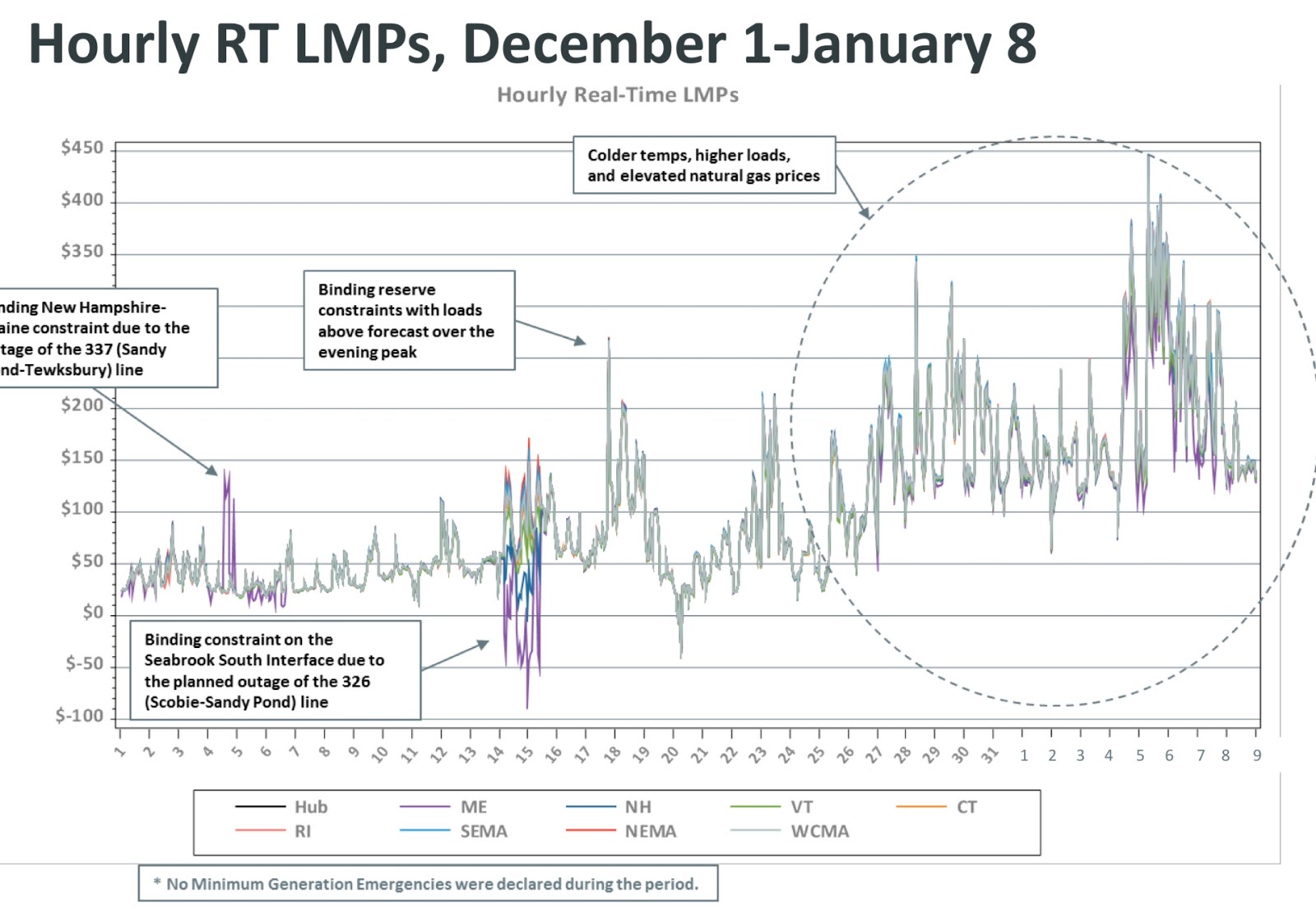
However, in  the cold snap, the LMP prices spent a lot of time between $150 and $300 per MWh (15 cents to 30 cents per kWh). The circled area on the graph below, from the same ISO report.


In short, during the cold snap we used less electricity and paid higher prices than we do now.

Conservation and fuel usage

Using more electricity in New England means making more carbon dioxide and burning more fossil fuels.  So conservation is always good. But is conservation in summer particularly wonderful? Not really.

Right now, we have a fairly clean grid. The fuel mix is mostly natural gas, nuclear,  hydro and renewables.  The grid was running 60% gas, 20% nuclear 16% hydro and renewables.  Pretty good, in terms of emissions!  Here's a recent fuel mix graph.


A fuel mix chart for the grid on July 4


In contrast, in the winter, when natural gas was not available, oil and coal were in heavy use (Oil Kept the Power Grid Running op-ed). During the cold snap, the mix was 30% oil, not "less than 1%" oil, as it is now.  Coal use was higher, also, up around 5%. 

Surplus Capacity

So far, there's no particular reason to conserve right now instead of conserving some other time.  But let's look at something else.  Perhaps, even with natural gas available, the grid is close to maximum capacity in hot weather? Perhaps, if we don't conserve, the grid will fail?

Nope. The grid is doing well.  If you look at the ISO-NE website,  it lists "surplus capacity" right on the front page.  At this moment, as I am writing this, on a very hot day, surplus capacity on the grid is 1,180 MW.  That is the capacity available above the maximum predicted peak power use for today (23, 000MW) and above the grid's operating reserve requirement for today (2,492 MW). You can always check these types of figures in the ISO-NE morning report. 

Or, you can simply remember that when ISO-NE predicted the possibility of rolling blackouts in the future, ISO was concerned with winter stress on the grid leading to blackouts. They were not concerned with high summer electricity usage. 

 In short, conserving electricity this summer doesn't save more money or more carbon dioxide then it would save at many other times. As a matter of fact, it saves less of both than it would save in a winter cold snap.  Conserving now also doesn't "save the grid" from blackouts.  The grid is operating at high capacity, but nowhere near its capacity limits.

 So why are the utilities pushing conservation right now?

Game of Peaks

The utilities are urging conservation right now because they are playing the Game of Peaks.  It's  a utility game about money. If they play the Game of Peaks well, they can shift some costs from themselves over to neighboring utilities.  Yeah, it's a zero-sum game.  ("I win" can only happen if "you lose.")

 Learn the rules for the Game of Peaks in the next post.

Thursday, May 17, 2018

Rolling Blackouts for New England? Angwin Op-Ed

Mystic Power Station

Rolling blackouts

Rolling blackouts are probably coming to New England sooner than expected.

When there’s not enough supply of electricity to meet demand, an electric grid operator cuts power to one section of the grid to keep the rest of the grid from failing.  After a while, the operator restores the power to the blacked-out area and moves the blackout on to another section. The New England grid operator (ISO-NE) recently completed a major study of various scenarios for the near-term future (2024-2025) of the grid, including the possibilities of rolling blackouts.

In New England, blackouts are expected to occur during the coldest weather, because that is when the grid is most stressed. Rolling blackouts add painful uncertainty – and danger – to everyday life.  You aren’t likely to know when a blackout will happen, because most grid operators have a policy that announcing a blackout would attract crime to the area.

Exelon announces plan to close Mystic Station

In early April, Exelon said that it would close two large natural-gas fired units at Mystic Station, Massachusetts. In its report about possibilities for the winter of 2024-25, ISO-NE had included the loss of these two plants as one of its scenarios. The ISO-NE report concluded that Mystic’s possible closure would lead to 20 to 50 hours of load shedding (rolling blackouts) and hundreds of hours of grid operation under emergency protocols.

When Exelon made its closure announcement, ISO-NE realized that the danger of rolling blackouts was suddenly more immediate than 2024.  ISO-NE now hopes to grant “out of market cost recovery” (that is, subsidies) to persuade Exelon to keep the Mystic plants operating. If ISO-NE gets FERC permission for the subsidies, some of the threat of blackouts will retreat a few years into the future.

Winter scenarios and natural gas

The foremost challenge to grid reliability is the inability of power plants to get fuel in winter.  So ISO-NE  modeled various scenarios, such as winter-long outages at key energy facilities, and difficulty or ease of delivering Liquified Natural Gas (LNG) to existing plants.

Ominously, 19 of the 23 of the ISO-NE scenarios led to rolling blackouts. The worst scenarios, with the longest blackouts, included a long outage at a nuclear plant or a long-lasting failure of a gas pipeline compressor.

A major cause of these grid problems is that the New England grid is heavily dependent on natural gas. Power plants using natural gas supply about 50% of New England’s electricity on a year-round basis. Pipelines give priority to delivering gas for home heating over delivering gas to power plants. In the winter, some power plants cannot get enough gas to operate. Other fuels have to take up the slack. But coal and nuclear generators are retiring, and with them goes needed capacity. In general, the competing-for-natural-gas problem will get steadily worse over time.

All the ISO-NE scenarios assumed that no new oil, coal, or nuclear plants are built, some existing plants will close, and no new pipelines are constructed. Their scenarios included renewable buildouts, transmission line construction, increased delivery of LNG, plant outages and compressor outages.

Natural gas and LNG

The one “no-problem” scenario (no load shedding, no emergency procedures) is one where everything goes right. It assumed no major pipeline or power plant outages. It included a large renewable buildout plus greatly increased LNG delivery, despite difficult winter weather. This no-problem scenario also assumes a minimum number of retirements of coal, oil and nuclear plants.

This positive scenario is dependent on increased LNG deliveries from abroad. Thanks to the Jones Act, New England cannot obtain domestic LNG. There are no LNG carriers flying an American flag, and the Jones Act prevents foreign carriers from delivering American goods to American ports.

We can plan to import more electricity, but ISO-NE  notes that such imports are also problematic.  Canada has extreme winter weather (and curtails electricity exports) at the same time that New England has extreme weather and a stressed grid.

New England needs a diverse grid

To avoid blackouts, we need to diversify our energy supply beyond renewables and natural gas to have a grid that can reliably deliver power in all sorts of weather.  When we close nuclear and coal plants and don’t build gas pipelines, we increase our weather-vulnerable dependency on imported LNG.

We need to keep existing nuclear, hydro, coal and oil plants available to meet peak demands, even if it takes subsidies.  Coal is a problem fuel, but running a coal plant for a comparatively short time in bad weather is a better choice than rolling blackouts.

This can’t happen overnight. It has to be planned for. If we don’t diversify our electricity supply, we will have to get used to enduring rolling blackouts.
-----
Meredith Angwin is a retired physical chemist and a member of the ISO-NE consumer advisory group. She headed the Ethan Allen Institute’s Energy Education Project and her latest book is Campaigning for Clean Air.

______

This op-ed has now appeared in several websites and news outlets. Links below to the post in other publications, some of which have comment streams.
This post at Ethan Allen Institute, The Caledonian Record, Vermont Business Magazine, VTDigger, True North Reports,  The Commons, New England Diary   Providence Journal, Rhode Island and New England May Get Hit with Rolling Blackouts in the Future, including an interview with me, appeared in GoLocalProv.com

Special note: My op-ed has now appeared in my local paper, the Valley News, on the front page of the Sunday "Perspectives" section.  It is always a thrill to see my work in my local paper!

Sunday, February 18, 2018

ISO-NE Consumer Liaison Group meeting March 1


On March 1, the Consumer Liaison Group (CLG) associated with ISO-NE will hold its quarterly meeting near Portsmouth, New Hampshire. Meetings are free and open to the public, and include a free lunch. (Rather a pleasant lunch, usually, not just some dry sandwiches.)   I am on the Coordinating Committee for the CLG.  

The topic for this meeting is "How Have the Region's Wholesale Markets Evolved Over Time? Why Should Consumers Care?"  In other words, this meeting addresses the heart of consumer concerns with the grid.  I encourage you to attend. You can also register for phone access, and the slides are usually posted.  

The graphic above is merely a screen shot, so the links don't work.  Here are the links that do work:

Most important: Register here (includes information for offsite access)


Wednesday, February 7, 2018

The Oil-filled Grid: Communications

Early January Nor'Easter
Wikimedia, NOAA
Oil on the Grid

About two weeks ago, I wrote a blog post The Northeast Grid and the Oil. This described our early-January polar weather, and how Northeastern power plants could not get enough natural gas in the below-zero weather. Homes had priority for natural gas delivery, and plants that could use oil switched from natural gas to oil.

As a matter of fact, the oil stocks were also getting depleted.

I want to update the cold-snap story with some other posts. The general public doesn't read my blog, so I did some outreach. I wrote an op-ed about the grid for my local paper, the Valley News.  The op-ed was printed on the front page of the Sunday Perspective section on January 28, and has been shared around 200 times on Facebook. Oil Kept the Power Grid Running in Recent Cold Snap.

Why were people so interested in the article?  Because a secure electric supply is an important part of personal safety during extremely cold weather.  Most home furnaces require electricity to spread the warmth into the household. People who have chosen heat pumps are also dependent on reliable electricity.

Nuclear plants and pipelines and controversy, oh my!

There were more articles on the situation, of course, not just mine.  Actually, I think there were too few articles.  Nearly running out of oil when you can't get gas---this can be a major deal during severe winter weather! I will point out some interesting articles, and I hope that people who read this will send links to a few more.

Rod Adams post described the "sobering statements" made by the grid operator about oil supply, and the weird statements made by nuclear opponents.  (Pilgrim should have shut down before the storm? Really?) He shares some graphics from ISO-NE on the weak performance of solar panels during the days of the crisis.  He also discusses Pilgrim going off-line, and whether that could have been prevented. As usual, his post has an active and informed stream of comments. Performance of the New England power grid during extreme cold Dec 25-Jan 8, at Atomic Insights blog.

Meanwhile, over at Forbes, several columnists were commenting on the situation.
Jude Clemente wrote What Happens When You Don't Build Natural Gas Pipeline
David Blackman wrote Amid Deep Freeze, New Englanders Can 'Thank' N.Y. Gov Cuomo For Their High Energy Bills
Christopher Helman wrote Natural Gas Demand Hits Record As Cold Bomb Targets Northeast

Over WBUR radio, Bruce Gellerman has a fascinating seven minute segment on how the power plants actually operated during the cold snap, including an interview with a manager of a peaker plant that runs about 800 hours a year. Do We Need More Natural Gas Pipelines?

There's a lot of controversy built into all these articles. The role of nuclear.  The need (or not-need) for more natural gas pipelines. Will new emissions regulations make handling the next cold snap much harder? Did renewables make a great contribution during the cold snap?  Or not?

The Electric Supply

A steady electric supply is hugely important to winter safety. In my opinion, it should not be such a subject of controversy.  My hope is that  reason will prevail, and we will have the nuclear plants, pipelines and energy security that we need.

Saturday, January 27, 2018

The Northeast Grid and the Oil

ISO-NE Report on Cold Weather Grid Performance

It was dramatically cold here in the Northeast from late December through January 8.  Temperatures of ten below were common. The grid used amazing (30% or more) amounts of oil, as the power plants could not get gas. (I wrote a couple of blog posts about this, which I reference at the end of this post.)

On January 16, ISO-NE issued a report on the grid behavior during this period. Cold Weather Operations, December 24, 2017 through  January 8, 2018.  This document is worth reading.   Frankly, in my blog posts, I simply did not know how bad things were becoming on the grid. Let me quote viewgraph 11 of the ISO report:
"As gas became uneconomic, the entire season’s oil supply rapidly depleted"

Pictures speak louder than words

This is a story best told in graphics.

As I noted earlier, the generation mix on the grid shifted heavily to oil. On December 24, 2017, oil supplied 2% of grid electricity. On January 6, 2018, oil provided 36% of the electricity. ISO slide 14 shows this very effectively.

Slide 14
from ISO report
Double click to expand
Other illustrations are from the same report

Update:  Ed Pheil pointed something out to me: if I don't explain that demand on the grid was rising between 12/24 and 1/1/, the decline in nuclear's share of the grid electricity (from 39% to 27% etc.) is inexplicable.  Did the nuclear plants go off-line?  No. But there are only so many nuclear plants, and they can make only so much power.

The chart below shows a steady line of "daily generation" for the nuclear plants.  It is the green line near the top of the chart. There's one exception: Pilgrim went off line when a transmission line failed.   You can see the dip.

Thank you to Ed.  This was a necessary clarification.

Slide 13


Local natural gas prices soared, while Marcellus shale prices remained fairly steady.  Electricity prices followed the natural gas prices. However, generators that could switch to oil did the switch. Oil was was less expensive. Natural gas prices rose about 30 fold (from around $3 to around $90, as shown below)

Slide 30


Due to power plants using lower-priced oil, however, prices on the grid rose from around $50 to around to $450/MWh, only a ten-fold rise.

Slide 55
Oil Depletion

The region was burning oil far faster than it was replenishing it.  On December 1, we had 68% (of the maximum oil) available to power plants.   On January 8, we had 19%.

Slide 21
For a more dramatic picture, ISO shows a single power plant's oil supply, which went from an eight-day supply to a one-day supply over the same period.
Slide 22
There are many important slides.  For example, slide 17 shows how the generators that were enrolled in the ISO-NE Winter Reliability Program really picked up the slack, and slide 18 compares the amount of oil burned in the two weeks of cold with the amount of oil burned the previous two years.  (More was burned in the two weeks of cold.)  

And then there was all the scrambling to keep things going. Slides 35 and 36 show that there were emergency conference calls about the grid---pretty much every day.  

What have we learned?

Much as I dislike burning oil for power, I dislike widespread outages even more.  I give ISO-NE tremendous credit for the Winter Reliability Program, and for keeping the lights on.

According to the last slide in the ISO program, replenishment of oil is the key issue for reliable operation during cold weather in New England.  ISO-NE is correct,  according to their charter.

slide 62


However, the ISO-NE charter is limited.  For me, the important thing is to keep Northeastern nuclear plants operating. Nuclear plants are thoroughly reliable.  (Yes, Pilgrim went offline due to a transmission line failure.) Nuclear plants keep making electricity, no matter what the weather might be, as long as there is a transmission line to send out their power. 

In cold weather, we need reliability. In cold weather, we need nuclear. 


----

Earlier blog posts:

Sunday, January 7, 2018

Vermont, "Hot Air," and Puerto Rico

Grid prices in the Northeast.  Running about 37c per kWh at 1 p.m.
You can double click to enlarge the graphics.
Graphics are screen shots from https://www.iso-ne.com/isoexpress/
Vermont

Vermont remains in the deep freeze. It was minus 5 here when I wrote this at 8 p.m. Saturday, and it was about zero at 1 p.m. Saturday when I took these screen shots.

The weather is actually colder now, Sunday morning.  It is minus 15 at 9 a.m. Fuel oil is supplying 37% of the grid now, and the price is around $300/MWh.  I'm going to use the screen shots I took yesterday, because things have not changed very much.  As usual, all charts are from the ISO-NE  ISOExpress web page.

On Saturday, fuel oil supplied over 30% of the grid electricity, and the price of power was bouncing around like crazy between $200 and $400 per MWh (five minute LMP graph at left).

Fuel mix (34% oil) at lower right,
5 minute LMP graph at left totally schizoid:
20 cents to 40 cents per kWh and back, rapidly

Meanwhile, with significant wind chill out there, wind was about half of renewables, and renewables are 11% of the grid, so wind was contributing about 5% of the power. (Same today, Sunday, but wind is about 40% instead of 50% of renewables.)

Wind is about half of the renewables now


Meanwhile, the fuel supply for New England has been getting a bit dicey. (It seems to be hanging in there, for which I am grateful.) According to an article in Reuters, Frigid weather sends heating prices soaring as energy usage spikes, spot gas prices in New England soared to a record-breaking $82.75/mmBTU before falling back to a more normal $3.80/mmBTU. More tankers are heading to the U.S. These tankers are not on a mission of mercy. Right now, the East Coast is the most high-priced market in the world for oil. The tankers can get their best prices, right here.

Coast Guard icebreakers have been used (probably still being used)  to keep open the ports of Boston, New York and Philadelphia.  A Coast Guard icebreaker was even needed on the Hudson River. Overall, the grid is working okay and I am not very worried.

But I must say:
I appreciate the Coast Guard!

Hot Air and Puerto Rico

Meanwhile, some of my earlier posts got some play in bigger media.  Jazz Shaw is a major contributor to the widely read blog Hot Air. On Thursday, Shaw wrote New England Wanted to Use All Renewable Energy...Then It Got Cold. This is a very well-referenced and well-written post.  Shaw quotes my blog extensively, and he also puts the issues in New England together with Rick Perry's aim of rewarding reliable power plants.

I should also mention that Hot Air is a very widely-read blog. As soon as the Hot Air post referencing my blog appeared, email after email arrived: "Hey Meredith, you were on Hot Air!  Great going!" It was fun.

Most of these emails came from my friends, but one note was from someone new to me.  A man who writes the Dark Island Puerto Rico blog wrote to say that Vermont and Puerto Rico seemed to be having some similarities.  He also wrote a blog post about this, also: Weather and Wind Problems.

I have been enjoying reading his blog. Puerto Rico has pretty much disappeared from the main stream news, but there are still huge areas without power. I find it very interesting to hear from a person who is really there, thoughtful and critical of about the recovery effort.  He has posts on the fate of wind farms, the useful possibility of battery back up for solar (but you still need a source of reliable power), how small modular reactors could be used, how cogeneration could be a robust future for Puerto Rico.  I recommend his blog http://darkislandpr.blogspot.com

They say there it is "an ill wind that blows nobody any good," which means that even bad situations can have some good in them.  The situation on the grid isn't great, to put it mildly.  However, my recent blog posts have introduced me to two new blogs: Hot Air and DarkIslandPR.  That is some good, and I appreciate it.

(Note to my readers: the Hot Air blog is mostly political, and DarkIslandPR is mostly about energy.  I don't want people to get the impression that I think the two blogs are very similar: they aren't. )

Wednesday, December 27, 2017

Successful encouragement of oil on the New England Grid.

Cold in New England, and Going to Stay Cold

I decided to tell this blog as a series of pictures.  

I will start with a screen shot that I took of the weather report, at about 5:30 this evening. (Note that "Hartford" refers to the town of Hartford Vermont, where I live.)  It was 7 degrees F at that time, with a drop to minus 16 expected tonight.  The next few days are expected to have single digit high temperatures and minus temperatures of two digits (minus 10, etc)
Weather at 5:30 pm and forecast

So, how is the grid doing? Fairly well, actually.  At 5:30, I took this picture, showing that the LMP (local marginal prices) were running at about 20 cents a kWh. ($200 a MWh translates to 20 cents per kWh.) The graphics below are screen shots from ISO-NE. I took my snaps at 5:30 at this ISO page, which is updated every 5 minutes. https://www.iso-ne.com/isoexpress/

Grid prices and electricity use at 5:30 p.m. and throughout the day

As you can see by the retrospective graphs to the left of the map, prices have been up and down between $100 and $250  (10 cents and 25 cents per kWh) most of the day.

Oil on the Grid

During cold snaps, gas pipelines must supply homes first, and gas-fired power plants get short-changed.  ISO-NE has a Winter Reliability Program which mainly compensates gas-fired power plants for keeping fuel on site: oil or LNG or CNG. (Liquefied or compressed natural gas.) The grid was running about 22% oil at 5:30 this evening.

The current Winter Reliability program is described in an update presentation, given December 7,  2017  by Anne George of ISO-NE. On page 5, Ms. George describes the current winter reliability program, which pays oil and gas fired generators to have fuel on site.  (Page numbers are at the lower right of each viewgraph.) On page 18, she describes how the forward capacity auctions are attracting new generation, even as older plants retire.  Specifically, ISO-NE is attracting new dual-fired natural gas resources: gas turbines that can also burn oil, and therefore can store oil on-site for cold weather.

ISO-NE's attempt to provide winter electricity by encouraging oil use in cold weather is working.  The next picture shows (among other things) the fuel mix at 5:30 on the New England Grid. 

Fuel use at 5:30 p.m. and throughout the day
You can see that 25% of the electricity was supplied by nuclear, 24% by natural gas, 22% by oil, and 11% by renewables.  Usually, the grid runs closer to 50% natural gas and just a few percent oil. If you go to viewgraph 19 of the ISO-NE presentation,  you can see that natural gas is expected to be 55% of normal generation, and oil is the merest sliver on the graph.

The Renewables

In the chart above, renewables are making 11% of the power on the grid.  This is on the high side. (Viewgraph 19 of the ISO presentation shows renewables making 5%, for example.)  The high contribution of renewables is due to the wind.

In my experience of New England, really cold weather is often deathly still.  Not this time.  The wind is blowing, the windchill factor is serious, and the wind turbines are making considerable amounts of energy.  Wind turbines are making 50%  of the renewable power on the grid, as you can see in the chart below.  Basically, the other 50% of the renewable power is being made by burning wood and refuse. That power is pretty steady: the wind contribution goes up and down.

Since wind is making half the renewable power on the grid, and renewables are making 11% of the power on the grid, therefore,  the wind turbines are making 5.5% of the power on the grid. 

 The chart below shows the percentage of renewables on the grid at 5:30 p.m. 
Renewables on the grid at 5:30 p.m. 50% of the renewable power is from wind

The End of the Grid Tour

I am pleased that it is both cold and windy. (Actually, I am not that pleased about it. I have to live here, after all.)  I also know ISO must be fuel-neutral, so dual-fuel gas-fired generators are considered good. However, I can't help but think that using more oil in the winter is a step back for New England, not  a step forward.  

If you want, you can go to the ISO site, and watch the grid.  Or if you don't live in New England, look up your own grid, and do a compare-and-contrast. I would love it if you would comment on this article.

(An article from about four years ago in similar weather: The Cold Truth on the New England Grid.)


Friday, August 25, 2017

ISO-NE Meeting Features Governor Scott: Minor Update

Vermont ISO-NE Meeting on Transmission
Note: this is a screen shot.  The links in the graphic don't work.


Links for registering for the meeting:

Update: Many people were frustrated because the links in the graphic above do not work.  I had working links available, but they were at the bottom of the post.  I am moving them to the top of the post in this update.

Here are links that work.
Woodstock Inn & Resort
CLG Webpage
Register
Mary "Weezie" Nuara

Note: if you have trouble registering,  I suggest you email Weezie Nuara.  Please register in advance because ISO-NE provides a lunch, and they need a headcount.

Now, back to writing about the meeting itself!

Governor Scott will be special guest at ISO-NE meeting in Vermont

The Consumer Liaison Group (CLG) of ISO-NE holds a public meeting every quarter. On September 7, a little less than two weeks from now, the meeting will be in Vermont. (I am on the Coordinating Committee for CLG.)

I hope you can attend. The meeting is free, and includes a lunch. The CLG is the "consumer's voice" for ISO-NE, and this will be a very special meeting.

Governor Scott will speak. He almost certainly will not speak about nuclear power, but I will never forget that he was one of four Vermont senators who voted in favor of continued operation of Vermont Yankee. You can see a short video of his statement at the time of the vote: it's on my blog post Hello Governor Scott, and Goodbye Shumlin.

FERC Order 1000: A public discussion

The main part of this meeting will be a discussion of FERC Order 1000. This order could lead to huge and expensive changes on the grid, and almost nobody knows about it. The basic idea of FERC 1000 is that grid operator (ISO-NE, for example) can order states to pay for transmission lines that are needed for "policy" not just "reliability."

In the past, if a grid operator showed that a new transmission line was needed for grid reliability, the grid operator could spread the payments for that line throughout the states in the grid region. So the line might be only located in one state, but if it was needed for reliability, all the New England states would bear the cost. The grid operator used clear engineering criteria for "the line is needed for reliability."

With FERC 1000, if a transmission line is needed for "policy," the grid operator can also force the states to share the cost of the transmission line. Say that a state has a policy of bringing in wind power from a neighboring state. That state can now commandeer all the states in the grid to pay for the new line. The line is state "policy," after all. Actually, the grid operator would do the commandeering, but the idea is the same.

In Vermont on September 7, many knowledgeable people will be discussing FERC 1000 in public.  This is a rare and important event.

I have more about FERC 1000 in this blog post from earlier this year. That post is somewhat out of date, since New England States Committee on Electricity (NESCOE)  recently lost their FERC 1000 lawsuit against FERC. A representative from NESCOE will speak at the upcoming meeting.


Wednesday, March 9, 2016

The Oddness at the Heart of RTO

RTO graphic from FERC
Regional Transmission Organizations

Tomorrow, I will be at the ISO-NE Consumer Liaison Group meeting in Connecticut. (I blogged about this meeting a few days ago.)

I would like to share my research, and my feelings, about the deep oddness at the heart of American RTO markets.  RTO (Regional Transmission Organization) markets are those in which electricity generators (power plants, etc) and electricity transmitters (transmission and distribution companies) are generally different companies. The different types of companies interact by participating in complex auction processes.  In contrast, non-RTO markets contain (mostly) vertically integrated utilities.  In non-RTO areas, usually the same companies are in charge of both generation and distribution.

I recently wrote an article for Nuclear Engineering International magazine "Pay for Performance on the U.S. Grid." This article shows how the supposedly cost-saving auctions have diverged farther and farther from anything resembling a free market. It also shows how the RTO markets basically punish reliable plants, and support unreliable plants.  

In this figure, based on Entergy research, we see that nuclear plants get around 85% of their revenue from selling kWh, (energy) while gas plants get 40% to 80% of their revenue from other sources (capacity payments, ancillary services payments.)  In this figure, based on information from James Bride of Energy Tariff Experts, we see how Capacity Payments make up the revenues for gas peaker plants. (I don't own the figures, so I have to link to them.)

If gas plants had to subsist on the prices they received for energy, if gas plants main income was the money they receive for selling kWh on the grid, it would be much harder for gas plants to undercut nuclear pricing!

I encourage you to look at the figures and read the article.  My article has a reasonable title: Pay for Performance and the U.S. Grid.  When I think about it, I refer to it as The Oddness at the Heart of RTO.

RTOs don't even save money

Well, all those complicated auctions were supposed to prevent big nasty integrated electricity companies from ripping off consumers. (The companies would rip off consumers after they had "captured" their regulators, of course.)  So, did it work?  Did the the RTO auctions and free markets lower prices for electricity?  I would argue that RTOs are not really free markets anyway (read my article), but in the meantime....did RTOs save money for the customers?

Well, no.  Or maybe yes, maybe no.

Here's another chart, this one is part of a paper prepared for NESCOE,  New England States Committee on Electricity, which "represents the collective perspective of the six New England governors in regional electricity matters."   The paper was published in December, 2015.  "Electric Restructuring in New England--A Look Back" prepared by Reishus Consulting LLC.
From a study at UC Berkeley, as reported in NESCOE review

This is a chart of retail prices over time. Note that the Restructured States (RTOs) have the highest prices for retail electricity. Yes. That's the red line at the top of the chart.

It must be added, however, that the Reishus Consulting paper also describes other studies that claim to find lowered retail electricity costs due to restructuring.  I would say that the statement that "RTOs save money for consumers" is not currently proven, to my satisfaction, and it looks as if they don't.  After all, that top cost line is the restructured (RTO) states.

The effect of RTOs

In short, RTOs may or may not save money for consumers. My opinion: probably they don't.

Undoubtedly, however, RTOs make to make it harder  for reliable plants to survive, and easier for unreliable plants.

All the nuclear plants that are in danger of closing are in RTO areas.

Thursday, January 7, 2016

The Replacement for Vermont Yankee Was…Natural Gas: Mike Twomey Guest Post

The Replacement For Vermont Yankee Was . . . Natural Gas
By Mike Twomey

Several years ago, while the legal and public relations battle raged over the future of Vermont Yankee, anti-nuclear activists -- and some elected officials -- confidently predicted that, if the plant closed, its output would be replaced by wind, solar, and other renewable energy sources.   Pro-nuclear advocates expressed doubts about that future, arguing instead that the loss of a baseload nuclear plant would inevitably lead to greater reliance on fossil fuels.  Similar debates continue with respect to Pilgrim (Plymouth, MA), Indian Point (Buchanan, NY), and other nuclear facilities.

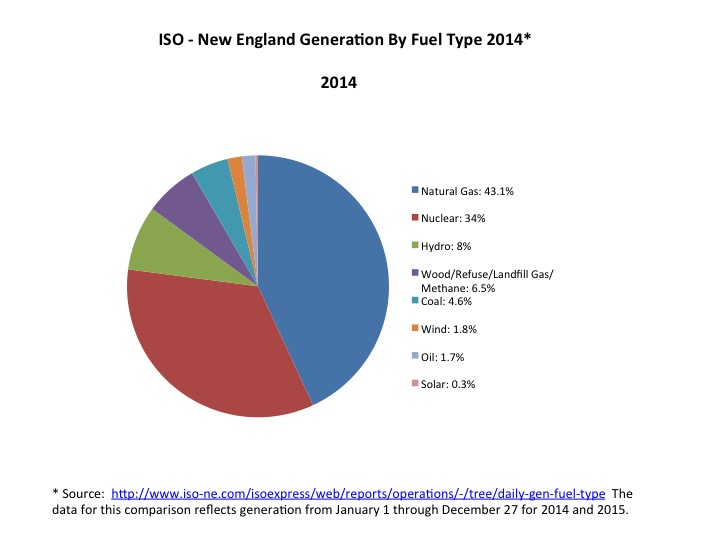
Now that 2015 has come to a close, we have an opportunity to evaluate the facts. ISO-New England (the non-profit, independent entity that ensures the reliability of the electric grid in New England) publishes data that shows daily generation by fuel type.  That data shows that in 2014 (the last year of Vermont Yankee's operation) natural gas-fired generators supplied 43.1% of the energy in New England, while nuclear provided 34%.   In 2015 (the first year since 1972 without Vermont Yankee) natural gas-fired generators supplied 48.6% of the energy in New England, while nuclear provided 29.5%.


Comparing these two charts shows the growth of natural gas on the grid
2014 and 2015
Blue is natural gas
Red is nuclear


As you can see in the chart below, the contribution of other sources of energy in New England remained essentially unchanged in 2015 compared to 2014 (the largest change was that coal-fired generators contributed one percent less in 2015 compared to 2014 (3.6% v. 4.6%).   The contribution of wind and solar remained vanishingly small in both years (wind was 2.4% in 2015 and 1.7% in 2014, while solar was 0.4% in 2015 and 0.3% in 2014).

Double-click to enlarge chart 

Generators in New England produced approximately the same amount of total MWhs in 2015 and 2014 (106.7 million MWhs in 2015 v. 107.2 million MWhs in 2014).  Taking into account the unusually mild weather in late fall of 2015, these figures deflate another prediction by anti-nuclear advocates that Vermont Yankee's baseload contribution could be replaced, in part, with energy efficiency.

The bottom line is that, without Vermont Yankee, nuclear's carbon-free contribution to the New England electric grid fell by 5.3 million MWhs in 2015 compared to 2014. Over that same time period, the contribution of natural gas-fired generators increased by nearly 5.7 million MWhs.   According to the U.S. Energy Information Agency, natural gas-fired generators produce 1.21 pounds of CO2 per kWh (https://www.eia.gov/tools/faqs/faq.cfm?id=74&t=11).  Using that formula, the additional MWhs of energy from natural gas-fired generators in New England in 2015 compared to 2014 equals approximately 3.1. million metric tons of additional CO2 in 2015 compared to 2014.  To put that in perspective, 3.1 million metric tons of CO2 is equivalent to adding more than 650,000 passenger vehicles to the roads in New England during 2015.

About this post:

This post first appeared in Linked-In on January 2, 2016 and is reprinted here with permission from Mike Twomey.  This post is a good companion piece to the recent post at this blog:  Vermont Yankee was replaced by natural gas: Doing the numbers.

The conclusions of the two posts are the same---because facts are facts.

The earlier Doing the Numbers was based on EIA data. This current post by Mike Twomey is based on ISO-NE (New England grid operator) data.   Mike Twomey's post includes data through the end of 2015, while the other post only includes data to the third quarter of 2015.

About the author:  

Mike Twomey is Vice President for External Affairs at Entergy. He is involved in many areas of negotiation and outreach concerning the nuclear plants. For example, Twomey was quoted in an October post at Vermont Digger: Entergy may move fuel into dry casks sooner than anticipated. In that article, he explains the financing of dry cask storage at Vermont Yankee.


Wednesday, December 2, 2015

Backwards to the Future: Carbon and Pollution Rise in New England

Pollution on the rise

On November 19, Heather Hunt, executive director of NESCOE, gave a presentation to the Northeastern Section meeting of the American Nuclear Society.   The presentation was titled New England Infrastructure Challenges.  Howard Shaffer and I drove down together, though it is always a bit of a struggle to drive to Boston and back again in an evening.  

In this case, the drive was well worth it.  Hunt's presentation about  proposed transmission lines, gas pipelines, and gas pipeline constraints was excellent.  As a matter of fact, you can see it for yourself. The presentation is posted online here: 

I was especially struck by one slide, showing the trends for carbon dioxide, nitrogen oxides (NOx) and sulfur dioxide (SO2). After years of lower pollution in New England, pollution trends from electricity production have reversed. Pollution from the electricity sector is on the rise. 

Slide by NESCOE, Based on EPA data
Courtesy NESCOE
Why is Pollution Rising?

The title of the talk was New England Infrastructure Challenges.  That is also the answer to the question.

For a while, pollution was falling as gas made more power and coal made less.  But then the gas constraints hit: there just isn't enough gas available for electricity production in the winter.  At that point, the grid operator pulled out all the stops to meet the demand. Coal, diesel, every fossil fuel and its brother were called into play. Some of the fossil fuel plants were called up ad hoc to meet demand, and some were part of the grid operators Winter Reliability Program, which depends on burning oil.  I describe this in a post from January 2014.

The Cold Truth on the New England Grid This Week, a High-Carbon Fuel Mix.

More pipelines for gas, and more transmission lines to Hydro Quebec, could alleviate this gas-crunch problem.  But such things take a long time to build.

However, it takes a very short time to decide to shut a nuclear plant!  Vermont Yankee and Pilgrim will no longer make clean energy for the New England grid.  Therefore, the demand for oil-fired and coal-fired and diesel-fired generation will rise during cold snaps, until all the new infrastructure can be built.

If the new infrastructure is actually built.  The number of people who will lie down in front of "fracked-gas"pipeline construction rivals the number of people who hate nuclear.  As a matter of fact, they are often the same people. I recognize some of them at meetings.

New England is going backwards to the future.

About NESCOE and about the Consumer Liaison Group of the grid operator

NESCOE  is the New England States Committee on Electricity. The important word is States.  This is a small committee, with members appointed by the Governors of the New England States. It keeps track of electricity issues as the states would perceive them.  I think NESCOE is a very good idea. Without it, the states would be individual and alone in trying to understand the implications of ISO-NE decisions. (ISO-NE is the grid operator.)  Heather Hunt is the Executive Director of NESCOE.  I appreciate her courtesy in sending me the slide above.

As it happens, I will see Hunt again tomorrow.  I am a member of the Coordinating Committee of the Consumer Liaison Group (CLG) for ISO-NE.  We are meeting in Boston tomorrow, and Hunt will be on the panel at our meeting.

Attendance is free: I encourage you to attend.  The subject is Transmission Planning in New England.    I share the announcement below, and you can find more information at the CLG web page for the meeting.


Tuesday, October 13, 2015

Pilgrim will close by 2019 UPDATE

Pilgrim
Pilgrim to close

Entergy announced today that Pilgrim will close by 2019.  Here are two links:

The Entergy announcement includes many subsidiary links

The Boston Globe has a good article on this breaking news.

Entergy is going to have a press conference today at noon Eastern Time.  There will be more information at that time.

Some Thoughts on Pilgrim and on the Grid

There is some question about exactly when Pilgrim will close.  Entergy has "contracted with ISO-NE" to supply power from Pilgrim until 2019 (Boston Globe article).  This means that Pilgrim will refuel again…unless they can cut a deal with another power plant to supply power after 2017.  Pilgrim's latest refueling outage started in April of this year, and it is roughly on a biennial cycle.  So Pilgrim is fairly sure to keep running until 2017, but may or may not refuel at that time, depending on factors such as whether it can find another power plant to take over its obligations to ISO-NE.

Well, all the stories say "supply power" but it is really about the capacity markets, not the power markets.  Plants bid in years ahead to supply "capacity"…that is, to be available to supply power when needed.  Plants are paid two ways: power payments and capacity payments.

  • A plant that supplies power most of the time (base load plants) gets most of its revenue from selling power (MWh sold). This would be the case with Pilgrim.
  • A plant that supplies power only part of the time (a peaker plant) gets a much higher proportion of its revenue from capacity payments (MW available when called upon).   This would be the case with most gas plants.

With so many plants retiring (Vermont Yankee, coal plants), available capacity has fallen and (supply and demand) capacity payments have soared. I encourage you to look at a recent chart on Capacity Payments in the Forward Capacity Market, from James Bride's keynote presentation at an ISO-NE meeting in New Hampshire last week.   The chart, on page 12 of the presentation, shows capacity payments going from $3.21 per kWmonth in 2014/2015 to $9.55 per kWmonth in 2019.

Thoughts on the ISO-NE meeting

I was at the Consumer Liaison Group meeting of ISO-NE last Friday, October 9.  I am  (currently) the only Vermont representative to the Coordinating Committee for that group. (Yeah. I need to do a geeky blog post on this.)

For right now, however, please look through the rest of the Bride presentation, especially the section on "missing money."

Intermittent renewables get much of their money from subsidies of various types, not from the grid. Therefore, they can bid into the grid at artificially low costs for their power, even bid in at negative numbers (we will PAY you to take our power!).   This lowers the power price on the grid, and particularly hurts plants that make a lot of power, like base load plants.  As base load plants retire because they can't make enough money to keep operating, the amount of capacity available diminishes, capacity payments go up, and peaker plants get proportionately more money.  Peaker plants always get a higher percentage of their money from capacity payments, but when base load plants retire, they get even more money from capacity payments.

There were several presentations on the role of intermittents on the grid.  Robert Ethier of ISO-NE was on the panel, and the Ethier presentation struck me as surprisingly cheery about predicting more base load plants will retire.  He claimed that: power prices will go down, capacity prices will go up, but the market will take care of everything.  That is my interpretation of his talk. I didn't ask him a question, but I did ask a question of Anne George of ISO-NE after her presentation. ISO-NE supposedly has some concerns with a one-fuel-source grid (natural gas) but they don't seem to be worried overmuch.

The Closing of Pilgrim Nuclear Plant is a Clear Victory for Fossil Fuels. 


Update: Graphic from Bill Mohl (Entergy) press conference this morning, showing where different types of plants get their revenue. Thank you to Entergy for sharing this graphic.


  • Nuclear gets a small percentage from capacity payments,  and most of their revenue from selling power (energy payments.) 
  • Gas turbines get a large percentage from capacity payments.
  •  Renewables get a big percentage from PTC (production tax credits) and RECs (selling Renewable Energy Certificates) which allows renewables to bid into the grid at a very low price, because those two sources of income remain intact, even with little revenue from power production.
  • I believe A.S. payments are payments as part of the ISO-NE winter reliability program, but I am not sure.  These payments are highest for dual fuel systems in this graph, which is correct for winter reliability payments.  The winter reliability program basically makes payments for keeping fuel on site.  In general, a gas turbine that can  also be fired with oil will keep oil on site, or keep CNG on site, and get the reliability payment.  

  • Tuesday, September 22, 2015

    Intergrating Renewable Resources: ISO-NE Consumer Group Meeting October 9, New Hampshire

    The Consumer Liaison Group 

    The purpose of the Consumer Liaison Group (CLG) is to be the voice of the electricity consumer in advising the grid operator, ISO-NE. As you can see by this page in their website, ISO-NE has many advisory and working groups, including groups on marketing, transmission, and planning  As you can read in this CLG annual report: The Consumer Liaison Group (CLG) is a forum for sharing information between ISO New England (ISO) and those who ultimately use and pay for electricity in New England.

    I am the Vermont representative to the Coordinating Committee of the CLG.  I used to be one of two representatives (states can have several representatives) but the representative from the Department of Public Service recently resigned.  I expect another representative will be nominated soon.

    The Upcoming Meeting in New Hampshire

    The next CLG meeting will take place on October 9 in New Hampshire (announcement above). The subject of this meeting is the important issue of integrating renewables to the grid.

    CLG meetings rotate between the six New England states, along with frequent meetings in Boston.  Here's my description of the meeting in Vermont in March, when I was the panel chair.  Here is the official (and excellent) summary of the Vermont meeting.

    Gus Fromuth, New Hampshire representative, will chair the panel for the upcoming meeting.  Here's a link to the meeting agenda, including call-in information if you can't attend in person.

    Somewhat surprisingly, a representative from Green Mountain Power will be on the panel, though Green Mountain Power only operates in Vermont, not New Hampshire.  However, the meeting panels address regional issues, as well as state issues.

    The meetings are free and open to the public.  They usually provide a lunch, so it is best to register in advance. It is not-good, seriously not-good, to register and be a no-show (wastes the cost of a lunch).  On the other hand, you can come at the last minute and I encourage you to come.  There's always room at the meeting.  The worst that can happen if you show up at the last minute would be---you don't get lunch.  (But there's usually plenty of food. )  Note: You can call in, if you can't attend in person.

    Links:

    For technical reasons  (I can't mount a pdf on a blogspot post, so I have to play with it), the links in the announcement above do not work.   Here are the links from the announcement, in the order in which they appear on the announcement.

    Sheraton Portsmouth Harborside Hotel

    CLG and CLG webpage

    Register

    Mary Louise "Weezie" Nuara email mnuara@iso-ne.com


    I hope to see you in New Hampshire!

    Tuesday, August 18, 2015

    Pay For Performance Rewards Reliability and Nuclear

    Recent Capacity Auction and Nuclear Energy

    In a recent post at NEI Nuclear Notes, Matt Wald described recent changes in the Capacity Auction for the PJM area.  He explained why these changes will be good for nuclear energy.  I encourage you to read the post, and watch the two-minute video.  The PJM Capacity Auction and Nuclear Energy.

    Note: PJM is the grid operator for Pennsylvania, New Jersey, Maryland and a large swatch of the Midwest, just as ISO-NE is the grid operator for New England

    Capacity, PJM, and Pay-For-Performance

    What was the main change in this recent auction?  Pay for Performance has been implemented.  Here is PJM's page of explanation, Capacity Performance at a Glance.

    In my opinion, this is the crucial sentence from that page: Generators that exceed performance commitments will be entitled to funds collected from generators that under- perform. 

    The sentence is crucial, but it takes some explanation.

    How the Capacity Auction Works.

    We have to start with the two auctions: Forward Capacity Auctions, and Real-Time Auctions. Real-Time Auctions are constantly on-going. They auction electricity as MWh.  These are the auctions that yielded the high MWh prices on the grid during the polar vortex, as in the figure below.

    High MWh prices
    during 2014 polar vortex
    But once a year, the grid operators run a "Forward Capacity Auction."  Power plants bid into this auction, just as they do for the Real-Time Auctions.

     But this time, the plants aren't bidding in kilowatt-hours that they plan to produce, today or tomorrow.  In the Capacity Auction, they are bidding in their AVAILABILITY to product kilowatts, in the future. The units of the Capacity Auction are Megawatt-Day (for PJM) and Kilowatt-Month (for ISO-NE).

    Megawatt-Day and Kilowatt-Month are not just weird variations on the term kWh. They are deeply different.  A megawatt day is the availability of a megawatt, if needed, for one day.  A kilowatt-month is the availability of a kilowatt, if needed, for one month.

    • The Real -Time auction bid is "Here's your energy, sir!" (and now…pay me for the electricity I produced.)
    • The Capacity auction bid is "Ready, willing, and able, sir!" (and now…pay me for my availability to go online when needed.)

    Take the Money and Don't Run?

    Capacity auctions take place once year. A plant may bid that it is available at 700 MW each month.  But then, when the grid operator actually calls upon the plant to produce power,  it may say: "So sorry. I can't get online.  I can't get gas, my coal pile froze, and my cat ate the homework."

    Cat from Wikipedia
    Looks like it would eat homework
    Until Pay-For-Performance, this did not matter. It didn't matter to the capacity payment whether or not the plant went on-line when needed. So why not bid the plant into the capacity auction?  What's the downside for the generator, after all?  Go ahead and bid,  and then take the capacity payment money. Yeah,  sometimes you have to say: "oh, sorry, can't run." But take the capacity money and run. Or not-run, as the case may be ;)

    BUT, with pay-for-performance, generators won't bid into the capacity market if they realize they may get hit with a fine.  If they don't go on-line when called to go on-line, it may cost them money.  If they don't go on-line, they may have to pay a generator who does go on-line.

    (Note: Sometimes generators refuse to go on-line because the spot price of their fuel is too expensive.  This sort of thing can be very hard on grid operators.  It is the source  of my cynical comment about the cat and the homework.)

    As Matt Wald (and the PJM capacity-performance page) point out, pay-for-performance will tend to raise the capacity auction price on the grid.  As Wald also points out, the performance-pay rewards reliable power plants, and therefore, rewards nuclear.

    Nuclear is reliable, and capacity pay-for-performance tends to reward that.