Sunday, March 6, 2011

42nd Carnival of Nuclear Energy

The 42nd Carnival of Nuclear Energy is up at Next Big Future. Come and visit and have some fun!

This compendium of the best nuclear blogs shows that nuclear does not exist in a vacuum. There are other energy sources, too. (Of course, most of them aren't as good.)

In this Carnival:
  • Gail Marcus of Nuclear Power Talk discusses the (supposed) subsidies for nuclear energy and the actual $4 a month charge proposed for Maryland ratepayers. This fee will support offshore wind farms.
  • At ANS Nuclear Cafe, Ajax Eastman, a long-time environmentalist, sees her beloved Maryland ridges chopped and cut for wind turbines. She re-examines nuclear, and she decides she likes it.
  • Charles Barton of Nuclear Green discusses the lack of due diligence in fossil fuel energy analysis.
  • In a more hopeful look at fossil fuels, Brian Wang of Next Big Future describes improved particulate control for coal plants. This form of pollution control could save millions of lives each year.
  • Dan Yurman of Idaho Samizdat shows that progress is being made on new plants in Texas and Virginia. It is clear that 2011 is shaping up to be a better year for American nuclear than 2010 was.
  • At Yes Vermont Yankee, I count fish in the Connecticut River. There are more of them than you might think, if your source of information is Arnie Gundersen. (Arnie says the river has a total of 16 shad.)
  • Rod Adams of Atomic Insights has some important ideas for improving the licensing process for the new generation of nuclear plants. Wind and solar have intrinsic limitations, but nuclear has man-made obstacles.
Overall, this 42nd Carnival provides great perspective on the world's energy options. All that, and cotton candy too! Come visit!

Friday, March 4, 2011

In Vermont, Our Word is Our Bond, So We Don't Honor Contracts


The Memorandum of Understanding

I began blogging on January 1, 2010. With my first substantive post, on January 3, 2010, I began discussing and linking to the Memorandum of Understanding (MOU). The MOU is a key document in the story of Vermont Yankee. Only nine pages long, the MOU describes the terms of purchase when Entergy bought Vermont Yankee in 2002. It includes the cost of power, the decommissioning fund, decommissioning options, and other issues about the purchase. The MOU was signed by Entergy (the buyer), utility representatives (the sellers), and the State of Vermont, in the person of the Commissioner of the Department of Public Service. As far as I can tell, it is as binding as any other document the state has ever signed.

Shumlin doesn't like it. The MOU includes the option to use SAFSTOR (delayed decommissioning) for the plant. Well, fine, Shumlin doesn't have to like it. However, Shumlin goes further: he repudiates it as a binding document because "Here in Vermont, Your Word is Your Bond." He doesn't feel the SAFSTOR option was discussed enough in committee. Therefore, in his opinion, the contract does not have to be honored. In Shumlin's opinion, SAFSTOR was a matter of Entergy "sneaking" some words in among "thousands of pages" of documents.

In the video clip above, you can hear Shumlin answer Terri Hallenbeck, a veteran reporter for the Burlington Free Press. Shumlin said that SAFSTOR wasn't discussed enough in the committee. At around 2 minutes and 40 seconds into the video above, Hallenbeck asks Shumlin why the discussions in the committee rooms would matter more than the document the state signed. Shumlin's answer: "You working for Entergy today?"

There is almost nothing I can do to comment on such an outrageous statement. A reporter's question means she is working for Entergy. If you question me, you are against me!

Okay. So Shumlin is being outrageous. He is in a world of his own. If a person asks a question, and the question indicates that reality doesn't always fit Shumlin's plans---that person is in league with his enemies.

Nineteen Eighty Four

What makes this interchange so Orwellian ("War is Peace" from 1984) is Shumlin's constant use of the phrase "In Vermont, Our Word Is Our Bond" while he explains that the contract is not something he plans to honor. A contract isn't a contract, a contract is whatever Shumlin thought the contract was.

"Our Word Is Our Bond." I find this far more frightening than if Shumlin said: "Yeah, it's in the contract, but Vermont is going to do its best to break that thing down. I don't like it, and Vermont has lawyers on staff. We'll bust it." That would at least acknowledge the existence and validity of a signed contract.

War is Peace. Signed contracts are the work of sneaky people from Louisiana. Vermonters don't have to honor such things, because in Vermont, Your Word Is Your Bond. War is Peace.

Acknowledgements:

I need to thank two excellent reporters for the information in this post. First, Anne Galloway of Vermont Digger who posted the YouTube above in her article on Shumlin's press conference. Terri Hallenbeck of Burlington Free Press for her incisive follow-up blog post which includes links to the history of other power plants in New England that have had delayed decommissioning. I also want to thank Howard Shaffer, whose short comment on the Hallenbeck article gave me the crucial idea for this post. I believe that the other reporter whose voice you hear on the video is John Dillon of VPR.


The Big Brother Image from Wikimedia commons is not exactly right for this post, but I can't find a DoubleThink Image. I can't even imagine what a DoubleThink image would look like. Or perhaps the video is the illustration?

Tuesday, March 1, 2011

Hot Climate and Cold Fish: Gundersen's Debate Misstatements


Debating Gundersen

On Thursday February 24, I debated with Arnie Gundersen on the topic: Vermont Yankee: Keep It Running or Shut It Down? The debate took place at the Janus Forum held by the University of Vermont. You can link to the audio of the debate here and read my recent post about it here.

The debate was very well-organized, but like all debates, it was time-limited. Gundersen often said things that sounded completely wrong to me, but I didn't have time to answer each assertion. My policy during the debate was to speak about what I knew about. I made notes of other Gundersen statements and planned to look up the information later.

For example, during the debate, Gundersen claimed that there are only sixteen shad in the Connecticut River. I knew this had to be wrong. Arnie said that there used to be 70,000 shad in the Connecticut River, and now there are sixteen. He emphasizes the word sixteen: "Not sixteen thousand, sixteen." He claims we have to shut down Vermont Yankee to save the shad, because the waste heat from the plant has killed them off.

(If you move the audio slider of the debate to the 46 minute mark, you can listen to this section.)

I have no idea where Gundersen could have gotten the number "sixteen." The shad counts in the Connecticut River in recent years are between 150,000 and 225,000 fish per spawning season. (See my Geeky Shad Section below for references.) There are thousands of shad in the river, though fewer and fewer as you go upstream. Shad swim upstream to spawn, like salmon. They spend most of their lives in the ocean.

Sixteen Shad and Climate Change?

At the same time that Gundersen said we had only sixteen shad in the river, he also said that replacing Vermont Yankee with fossil fuel would only add one ten-thousandth of a degree to the temperature of the earth, but in return we would "get our river back."

So, there's another number. One ten-thousandth of a degree climate change. This is per year? Over twenty years? Due to how much carbon dioxide? In other words--huh??? One-ten-thousandth of a degree is another number flying in from somewhere unknown, like sixteen fish. However, this post is long enough and I cannot address Gundersen's climate-change assertions today. More later, perhaps.

(The climate statement is near the sixteen-fish statement on the audio.)

A final word. I don't know why the Gundersens are so fond of misstatements about fish. Last summer, fish in the Connecticut River were tested for radiation, and showed only background levels. This caused Maggie Gundersen to write that you shouldn't eat fish from the river, but rather "throw them back."

There's something going on here about the Gundersens and fish, but I don't know what it is.

**********************

Geeky Shad Section

There's a picture of an American Shad at the head of this post. Shad is a delicious but bony fish, much loved by Native Americans and early colonists. John McPhee wrote a book about it: The Founding Fish. Shad have a life-cycle similar to salmon, spending much of their lives in the ocean and returning to their native streams to spawn. The shad run on the East Coast starts in April and ends in June, reaching a peak when water temperatures in the rivers are about 67 degrees. A pretty native American shrub is nicknamed "shadbush" because it blooms when the shad runs.

The shad run over the years has been hurt by pollution and the building of dams. Doe shad are very heavy with roe, and can't climb fish ladders, according to Wikipedia. Therefore, shad disappeared years ago from the Merrimack River:

Even more important to the decline of the shad is the damming of the rivers and streams in which they spawn, as pregnant doe shad are quite heavy and do not jump even when hooked. As noted above, the number of shad caught in the Merrimack River declined from almost 900,000 in 1789 to 0 in 1888, due to the fishes' inability to reach their spawning ground.

Overfishing has also had an effect. The U S Fish and Wildlife Service has an interesting web page about shad and restoration efforts. Wikipedia notes that the commercial shad catch has varied from 860,000 tons in 1999 to 600,000 tons in 2005 and is generally falling. Meanwhile, U. S. Fish and Wildlife tracks the Connecticut River shad, with 228,000 fish observed at the Holyoke Dam in 2000 and only 163,000 observed in 2007. Another important point is that the shad run historically ended at Bellows Falls, which is the next dam north of Vernon Dam (Vermont Yankee is located near Vernon Dam). A fishing website, iFished, gives a good overview of recreational shad fishing and availability on the river, including that just below Vernon Dam is an excellent place to catch these fish.

The Connecticut is not a river with sixteen lonely shad in it!


Monday, February 28, 2011

41st Carnival of Nuclear Energy Blogs

The 41st Carnival of Nuclear Energy Blogs is up at Cool Hand Nuke.

Once again, Jeff Madison of Cool Hand Nuke has done an admirable job of putting together the best of the blog posts.

Many posts, like Brian Wang at Next Big Future, and Charles Barton at Nuclear Green, discuss big topics such as thorium reactors here and in China, and the role of nuclear energy in preventing global warming. Barton also notes that perhaps we should be talking a bit more about nuclear power's other advantages: for example, its economic advantages. Similarly, Cool Hand Nuke describes Spain's recent pro-nuclear turn-around. Dan Yurman at Fuel Cycle Week describes the upcoming need for MOX fuel while Gail Marcus of Nuke Power Talk discusses why China is leading the way in so many things nuclear. Steve Aplin of Canadian Energy Issues describes the development of a hydrogen economy based on nuclear heat. At the ANS Nuclear Cafe, George Stanford talks about Obama's nuclear policy, and back at Next Big Future, Brian Wang castigates the NRC for taking 7 to 20 years to approve a new reactor design. (Yes indeed Brian. And what they do with re-licensing is also a crying shame.)

Two other posts take a more personal approach. Suzanne Hobbs of PopAtomic asks why politicians are always saying "there's no silver bullet for the energy crisis" when actually, there is one. It's nuclear. She describes her efforts to get the word out about this neglected silver bullet. Rod Adams of Atomic Insights asks why we are doing this outreach? What drives most of us to support nuclear? His conclusion is that we are doing it for our grandchildren. Both posts are very inspiring!

Come to the Carnival! Learn! Be inspired! No admission fees! No high-calorie sweets! The only Carnival you can attend easily in this lousy weather!

Sunday, February 27, 2011

Janus Forum Debate

An Expected Debate and Unexpected Debater

On Thursday of last week, I debated Arnie Gundersen about the future of Vermont Yankee. The debate took place at the Janus Forum at University of Vermont. Here's a link to the Vermont Public Radio segment about the debate, and another link to the audio version of the debate itself, also courtesy of VPR.


History
Monday Afternoon

I didn't expect to debate Arnie Gundersen. I expected Howard Shaffer to debate Arnie. That was the plan.

On Monday of last week, a couple of us got together in Burlington to hear Howard Shaffer run through his initial presentation for the Janus Forum debate on Thursday. We met in Burlington because Howard and I were due to be on a TV show on WCAX that evening. Also, Burlington was more convenient for some of the people.

We critiqued Howard's viewgraphs and then we asked him hostile questions. I learned a lot as we critiqued Howard. I was also very glad that Howard was going to be in the hot seat Thursday, not me.

I was wrong.

Thursday Morning

I was scheduled to give a talk at a Rotary in Burlington Thursday morning. While I was at the Rotary, my cell phone rang. Howard's wife told me that Howard was on his way to the emergency room in an ambulance, and they weren't sure what was wrong but he was in a lot of pain. Howard had asked her to call me and say that he couldn't do the debate in the afternoon, but he was sure I could take over and do a fine job.

(This is not a place for keeping my readers in suspense. Howard had emergency surgery for a life-threatening condition, and the surgery was successful. He is recovering at home at this point.)


When I heard this, I did what any self-respecting wife would do. I called my husband. George reminded and reassured me that Howard was being taken care of by great people at Dartmouth Hitchcock Medical Center. Everything that could be done would be done for him. George also said that I couldn't help Howard, but I had my own decision to make. Was I going to take Howard's part in the debate?

Okay. A couple of deep breaths here.

I decided to take part in the debate. I had my laptop with the Rotary presentation on it, and the laptop also had an early draft of Howard's slides on it (from the Monday meeting). I could spend an hour or so merging the presentations before I had to show up at the University of Vermont (UVM). Otherwise, the debate would be cancelled, and UVM people had spent a lot of time on preparation and publicity. Heck, I had done a lot of preparation, if you count half-a-day on Monday reviewing slides with Howard. So I decided to take part in the debate.

Thank You All Around

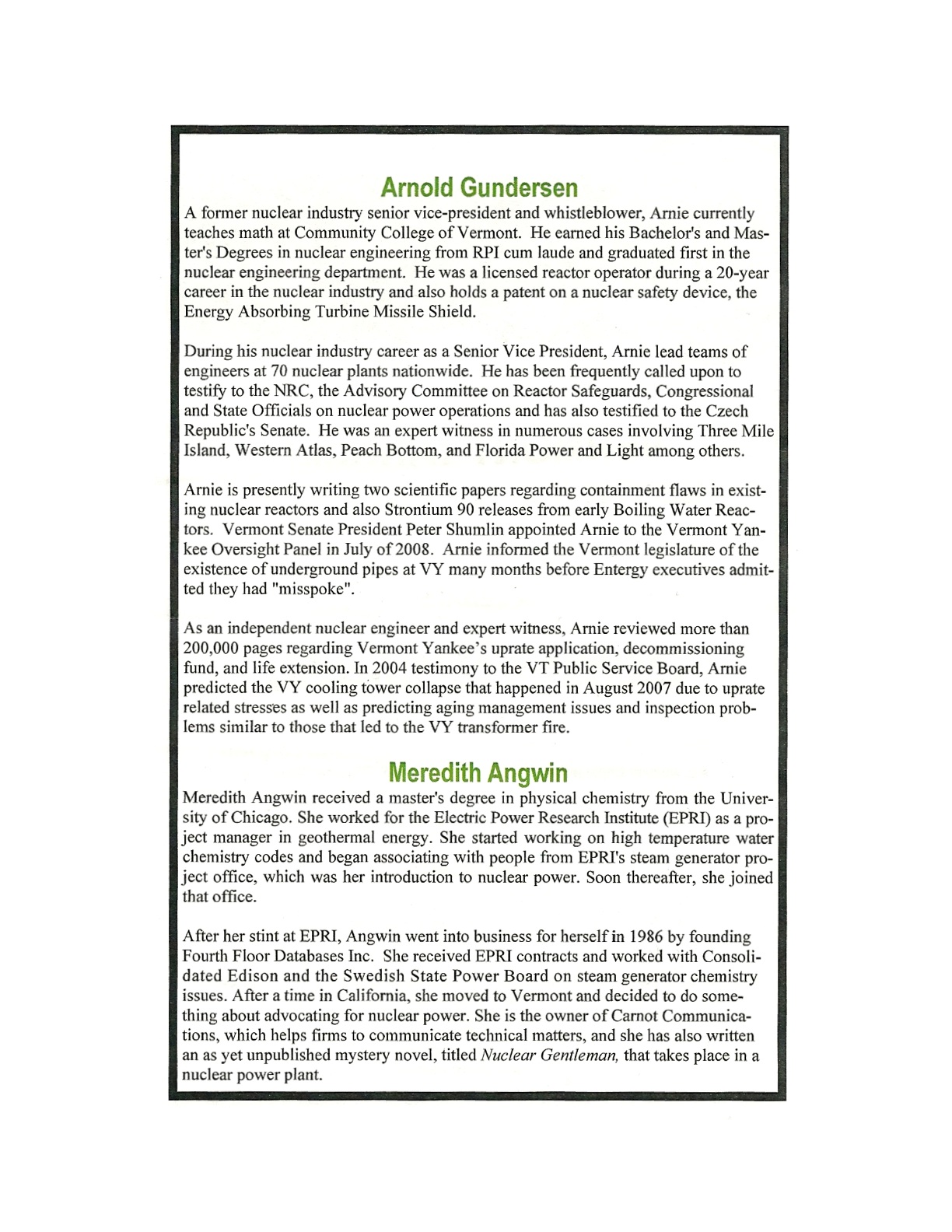
There's a lot to discuss about the debate, and I will do some of this in the days ahead. Meanwhile, I want to thank the people at the Janus Forum. They managed to hand out programs including my name and background--with only a few hours notice. I have images of those programs on this post. (As usual, double-clicking on the images will bring you to a bigger image.) I also want to thank the moderator, Emerson Lynn, for doing a fine job, and Arnie Gundersen for his well-organized presentation.

Some Links About the Debate

Once again, a link to the audio of the debate.

On Monday, Howard and I appeared on WCAX TV to talk about the debate. You can also see the video on my most recent post.

On Wednesday, Arnie Gundersen appeared on WCAX to talk about the debate.

Rod Adams of Atomic Insights blog noted that Arnie Gundersen was introduced as a person with "almost four decades of experience in the nuclear industry." (I noticed this also, and was puzzled because I knew Arnie had taught school for quite a few years. "How old is Arnie?" I wondered.) Rod did some investigation into Gundersen's resume, and discovered resume-inflation. Rod describes Gundersen's background in his blog post: Arnie Gundersen has inflated his resume, yet frequently claims that Entergy cannot be trusted.

More about the debate itself, in future posts.

Monday, February 21, 2011

Getting Ready for the Week

This is a week of meetings and speaking engagements for me and Howard and other pro-nuclear people here in Vermont.

If you have a chance, please read my earlier post on the four important meetings this week, including the Shaffer-Gundersen debate this Thursday.


This morning, a post I wrote went up at ANS Nuclear Cafe. It's all about techniques for supporting nuclear energy in public debates.


Suzanne Hobbs at Popatomic has a related post about learning from the opponents in debate.


In other important news, Dan Yurman at Idaho Samizdat describes why Vermont (and New York) will probably lose their spent fuel case against NRC.


And finally, I want to give a shout-out to Suzanne Hobbs for her post on art in support of Vermont Yankee. With her permission, one of her posters is on this website. Say NO to more Fossil Fuels in Vermont!


Have a good day! I'm off to Burlington for the day. Various activities about the debate, followed by being on a TV show.

Update Again: I embedded the TV clip.


Sunday, February 20, 2011

40th Carnival of Nuclear Energy Blogs

The ANS Nuclear Cafe is hosting the 40th Carnival of Nuclear Energy Bloggers. Dan Yurman did a wonderful job of putting this week's Carnival together. Of course, I might be just saying that because a post from Yes Vermont Yankee is the first one in the line-up.

NRC. The first group of posts shows NRC being treated like a soccer ball (deservedly). Yes Vermont Yankee criticizes their relicensing process, Next Big Future points out how badly behind they are in processing new applications, and CoolHandNuke asks why they "redacted" (i.e., hid) the scientific analysis of Yucca Mountain in their recently released report. Idaho Samizdat blogs about the three states that are suing NRC. These states object to having nuclear fuel stored on-site at their power plants. (Vermont is one of the states, of course. No surprise there.) The Samizdat post quotes a precedent: a similar suit in California. Outcome: Dry casks okay, lawsuit failed.

Tactics, Ads and Thugs. PopAtomic encourages us to learn tactics from nuclear opponents, and Nuke Power Talk notes an editorial in the Washington Post that writes about clean energy without bashing nuclear. NEI Nuclear Notes describes its recent advertising section in USA Today. Nuclear Fissionary gives a blow-by-blow (literally) account of Greenpeace activists in Spain beating up guards at a nuclear plant. Wait. I meant to say: Greenpeace thugs in Spain beating up guards. They knew the guards wouldn't fire on them. The guards had to show restraint, the thugs didn't.

The Fuel Cycle and Business Models. Nuclear Town Hall, Nuclear Green, Canadian Energy Issues, and Brave New Climate take on various aspects of the nuclear fuel cycle, including thorium reactors, fuel rod issues, plutonium and more. In contrast to these rival techniques and public controversies, Atomic Insights describes a successful business model...low on innovation, high on profits. Oops. That's the oil and gas model. Guess we won't be able to clone that one in nuclear!

In other news, the Renaissance keeps expanding, as ANS Nuclear Cafe announces the formation of a new section in India, and Areva North America reports the results of a study showing increased support for nuclear energy.

From heartening news on surveys and reprocessing, to outright brawls in Spain, the Carnival has everything. You'll smile, you'll laugh, you'll cry, you may want to punch somebody, you may want to kiss somebody. Who said being pro-nuclear is un-emotional? Come to the Carnival and have some fun!