Showing posts with label Lowell Mountain. Show all posts

Monday, October 7, 2013

Wind on the Grid: Location, Location, Location.

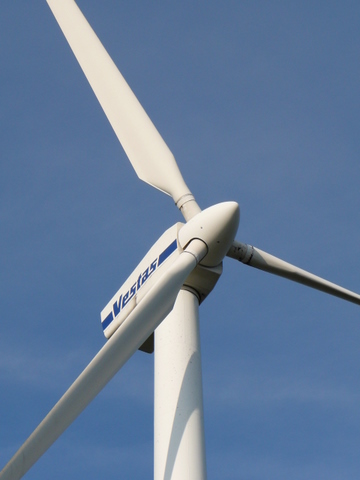
Wind Farm in Austria
The Plan and the Reality

The Vermont Comprehensive Energy Plan calls for a great expansion of renewable electricity. Can we achieve it? Some of the difficulties the state may encounter came to light this summer in the Northeast Kingdom.

The biggest renewable project to come online recently is the Kingdom Community Wind Project — commonly known as Lowell Mountain — which is owned by Green Mountain Power. During the mid-July heat wave, the regional grid operator, ISO-NE, did not allow Lowell Mountain to put all of its power on the grid. The wind was blowing, but the transmission lines were running at full capacity, and the grid operator told Lowell Mountain that the grid could not accept all of its power. The wind farm had to back off and not generate as much electricity as it could. It was “curtailed” by the grid operator.

As you can imagine, this incident led to quite an outcry. First off, it didn’t look good for the future of renewables. While Lowell Mountain has been controversial, it has also been a showcase for major new renewables being built in Vermont. If Lowell can’t send all of its power to the grid, it doesn’t bode well for the future growth of renewables.

In response, Vermont Governor Peter Shumlin wrote a letter to ISO-NE, asking why the grid operator had called upon the generating capacity of fossil-fuel plants but not that of Vermont renewables, pointing out that Vermont is very committed to renewables, etc., etc. Shumlin was clearly grandstanding. On a hot day, ISO-NE did what it is supposed to do: keep the grid functioning. To understand why that overriding concern led ISO-NE to shun power from Lowell Mountain, it’s helpful to realize that, in one regard, the grid is like the real estate market: It’s all about location, location, location.

The Reality of the Grid

ISO-NE’s first responsibility is to keep the grid meeting its physical and reliability requirements. It matches power generation with power use and avoids overloading lines. ISO-NE’s secondary responsibility is to dispatch power from generators according to various economic and contractual priority rules. These rules tend toward priority dispatch for renewables. (Though the grid operator is strictly fuel-agnostic, the rules tend to favor renewables.) However, such priority rules come second, after the grid’s physical constraints are met.

Those physical constraints are often about location, location, location.

Wind farms are usually located in rural areas, which generally do not have transmission lines capable of handling large amounts of power. In the case of Lowell Mountain, the nearest high-voltage lines also carry Hydro-Quebec and power from other sources. On a high-electricity-use day, these power sources fill the transmission capacity.

Two Kinds of Upgrades

Transmission capacity in that area would have to be upgraded significantly to accommodate all the power generated by the wind turbines on a high-use day. At the time the Lowell turbines were built, it apparently was known that the turbine power sometimes would have to be “curtailed.” However, “curtailment” has happened more often than some expected. (That’s the simple version; it’s always more complicated on the grid.) There are other factors. Depending on the type of generator, its location and the transmission lines, additional equipment may be needed to match a generator to the grid. Lowell Mountain needs something called a synchronous condenser to “tune up” its output and match it to the grid. The Lowell Mountain developers persuaded the Public Service Board to let them connect to the grid without this expensive piece of equipment, but now the grid operator says that it will have to be installed. The condenser is now being built, and it will cost $10 million. With it, Lowell will be able to put power on the grid more often.

However, without additional upgrades of local transmission lines, Lowell may still be kept off the grid when power use is high. So, two upgrades would be needed for Lowell Mountain to have reliable access to the grid. Electricity consumers ultimately will pay for the work, but which consumers?

Green Mountain Power consumers will pay for the synchronous condenser, because GMP owns the plant. Determining payment for transmission line upgrades is more complicated because transmission lines are shared across states. If a transmission upgrade makes the entire New England system more reliable, Vermont ratepayers will pay about 4 percent of its cost. If an upgrade is considered to be only of local benefit, local ratepayers pay its entire cost. ISO-NE decides whether transmission lines are needed for grid reliability as part of its reliability planning process. At this point, it is unclear which group of ratepayers would pay.

Another question: Why is the system dealing with these problems now? Why did the Public Service Board authorize turbines without also requiring an adequate connection? For whatever it is worth, many other wind farms in other parts of the world have the same problem.

Location, Location, Location

Which gets us back to location, location, location. Wind farms face some unique transmission challenges. Throughout the world, wind turbines are located in rural areas, often far from large transmission lines or large-scale users of electricity. Wind turbines also have highly variable outputs. If you build a transmission line in a rural area and build a line that is capable of taking a considerable amount of wind energy on a day when the grid is almost full, you are going to have to build an expensive line.

Building a transmission line that can always accept wind energy can be like building a freeway that is big enough to avoid congestion if a football game lets out at rush hour. We don’t do that. It would just be too expensive to build all roads big enough to avoid congestion for the infrequent occasions of abnormally high use. As a partial solution to this problem, the grid has location-dependent congestion fees.

Meanwhile, ISO-NE officials responded to Shumlin’s accusation with their own strongly worded letter. They said that Green Mountain Power knew full well that the Kingdom Community Wind Project did not meet all of ISO-NE criteria for full grid connection.

I am sure that Green Mountain Power (and others, such as the Public Service Board) must have known that the new wind farm wasn’t meeting ISO-NE connection criteria. Though such grid issues as congestion fees and synchronous condensers are arcane to most of us, there are many competent electrical system engineers who could have foreseen these problems. They almost certainly did foresee them.

Paying for the Upgrades

What should we do now to put wind on the grid? Since Kingdom Community Wind is built, I think Green Mountain Power should take the steps necessary to be sure its energy gets on the grid more reliably. It will be expensive, but that is the only option.

However, the costs and whatever environmental impact those upgrades entail should be ascribed to the wind project. More important, these costs should be considered when other projects are proposed. That does not mean that other projects should not be built. However, Vermont now has experience with a large wind farm, and it should learn from this experience.

------
Meredith Angwin is a physical chemist who worked for electric utilities for more than 25 years and now heads the Energy Education Project of the Ethan Allen Institute.
-----

I wrote this op-ed for the Valley News. It appeared in print on Sunday, September 22, 2013 as When Location Rules the Grid.

Friday, April 12, 2013

Nuclear Makes a Lot of Electricity. Controversial Renewables Make Very Little.

Where Does Electricity Come From? 

Nuclear:

Vermont Yankee went back on-line after refueling.  The outage lasted 26 days and included replacing a pump motor and transformer, as well as other maintenance.

Power produced: Vermont Yankee is 620 MW and operates over 90% of the time.   At a 90% capacity factor (actually it is higher) this would be about 560 MWyears of energy. (620 MW multiplied by 0.9 capacity factor)

Wind:

Opponents of big wind are pretty much stymied by the permitting process in Vermont.  The Public Service Board and the Siting Commission do not have to pay any attention to local planning.

However, two enterprising Vermont senators from the town of Windham are trying to get around the fact that the towns can be ignored in wind siting decisions. The town plan for Windham bans industrial wind, and these senators have sponsored a bill in the legislature which says that wind turbines cannot be built in the town of Windham.

In my opinion, there is no chance that this bill will pass. Still,  the senators will be able to tell their constituents: "I sure tried to stop big wind around here."

Power produced: The controversial Kingdom Community Wind (Lowell Mountain) project is 21 turbines, totaling 63 MW and can be expected to operate (capacity factor) less than 30% of the time.  Lowell is the largest wind installation in Vermont and can be expected to produce less than 21 MWyears of energy. (63 MW multiplied by 0.3 capacity factor)


Biomass:

There's a biomass plant being planned for Springfield, Vermont. It is running into a fair amount of opposition.  The VPR article by Susan Keese is headlined:  Sustainability of Springfield Biomass Plant in Question.  Meanwhile, Susan Smallheer reported in the Rutland Herald that the state is critical of wood-fired project's forestry plan.

A leading state forester, Steven Sinclair, recommended that the harvest plan should include that about third of the slash be left on the land for the health of the forest.  His office also removed the word "renewable" from their website when describing wood-fired projects.  For wood-fired projects, Sinclair said that “The science on both renewableness and carbon-neutrality is in question.”

Power produced: The Springfield biomass plant would be 35 MW.  Biomass plants capacity factors are variable, but on the average they have lower capacity factors than coal.  A recent National Renewable Energy Laboratory chart shows biomass with an average capacity factor of 70%. Therefore, the Springfield plant could  be expected to produce about 25 MWyears of energy. (35 MW multiplied by 0.7 capacity factor)

Solar:

Rutland Vermont is going to be a solar city.  Green Mountain power plans to "give Rutland the highest solar capacity per capita of any city in New England."  This quote is from the April 9, Green Mountain Power announcement of a Request for Proposals for a solar installation in Rutland.

Montpelier is also planning to install solar energy: Gayle Hanson of the Rutland Herald wrote about this in Capital City eyes going solar. In that article, the chairman of Montpelier's energy committee was quoted as follows: “The city gets a predictable future energy cost, and the bill for the city will be well below the cost from the utilities, so the more we have the more we save.”

Electricity from solar tends to be expensive electricity, but with net-metering (the power company buys electricity from solar arrays at a high price, but sells back-up electricity to the array owner at a lower price), a solar installation can save money for its owner.  This news release from All Earth Renewables describes these zero-cost solar programs.

Power Produced: Rutland will start with a 150 KW solar farm. Montpelier is looking at 150 to 500 KW solar arrays.   Capacity factor for sun in this area is about 18%, that is, average of 4.3 equivalent  sun hours per day.  Energy produced for the 150 KW installations would around 0.027 MWyears. (0.15MW multiplied by 0.18 capacity factor)


Thursday, March 7, 2013

Guest Post: Hallquist on Wind and the Grid

David Hallquist is the Chief Executive Officer of the Vermont Electric Cooperative (VEC).  Like most co-operatives, VEC is owned by its rate-payers.

Once upon a time, VEC was the third-largest utility in Vermont.

But then the two largest utilities, Green Mountain Power and Central Vermont Public Service, merged.  The new utility (Green Mountain Power) is a wholly-owned subsidiary of Gaz Metro of Quebec.  So now VEC is the second-largest utility in Vermont.

This afternoon, David Hallquist sent me an email including some VEC talking points.  I asked if I could use them as a guest post on my blog. He graciously agreed.

But first, a few words about VEC.  VEC takes its responsibilities quite seriously, including:

  • The requirement to use intermittent renewable power
  • The requirement to provide reliable, reasonably-priced power to its owner/ratepayers.
A recent VEC blog post Adoption of Renewable Energy Requires Realistic Timeline, shows the utility's thoughtful approach.  Late last year, the VEC Board of Directors asked the legislature to put a hold on requiring new renewable mandates in the state.

This afternoon, Hallquist sent me two documents that were very interesting.  One I already had: Matt Wald of the New York Times on the soaring prices of natural gas In New England: A Natural Gas Trap.  Hallquist also sent me the talking points below, which expand on the Wald article and look further toward the future.

These talking points are the way VEC sees the grid situation, right now.


--------------------------

Concerns about the Effect of Natural Gas prices on Electric Rates

Vermont Electric Cooperative’s power supply portfolio is designed to provide stability and predictability of short and long-term power supply costs. VEC keeps a small portion of the portfolio open so that some power can be purchased on the open market.  Recent unexpected and prolonged high price levels in the wholesale energy markets has caused concern that underlying issues may cause future market volatility that could ultimately have a negative impact on consumer electric rates.

Wholesale electricity prices skyrocketed in mid-January through the end of February:

  • Prices are normally around $36/megawatt-hour ,
  • Prices spiked at about  $1000/megawatt-hour, and 
  • Prices hovered much of the time around $200/megawatt-hour.  


This made sense in late-January as the Northeast was experiencing its worst cold snap since 2009.  What did not make sense is that the prices did not come back down when the weather moderated.  The prices finally came back down on February 24.

Natural gas prices drive wholesale electricity prices:

  • Natural gas prices in New England in mid-February were five times the prices in early January.


Natural gas prices have been high due to an increase in demand, at a time when New England’s supply is constrained:

  • New England has become more dependent on natural gas for its energy supply in the transportation, heating and electricity generation sectors.
  • Winter Storm Nemo caused a key nuclear generator, along with other smaller electricity generators, to go off- line, causing an even greater demand for natural gas.
  • Transmission infrastructure to New England spans a very long supply line starting in the Gulf of Mexico and is not adequate for current regional demand.
  • By contrast, in neighboring New York where transmission is less constrained, natural gas prices remained low in early 2013.


Natural gas and wholesale electricity prices have returned to normal levels, but future volatility is expected:

  • While the problem has gone away for the short term, this issue needs to be addressed as we continue to move to more and more natural gas as an energy source.
  • New England has traditionally seen some volatile price spikes, but this last event shows we are in a critical situation.  
  • According to ISO-NE, “the fuel supply uncertainty is escalating rapidly and is unsustainable.”


Further exacerbating the problem are the ISO operating procedures that are curtailing the production of lower cost, intermittent renewable energy generators:

  • Several times during these past few weeks, the Kingdom Community Wind project was capable of full production, yet the ISO-NE was only allowing 1/6 of the output.  
  • At one point, ISO-NE shut down Kingdom Community Wind to allow the oil peaking unit in Swanton to be run.
  • Wind curtailment is an issue across the country, and needs a national focus on ISO rules about how intermittent resources (wind and solar) are handled.  


For more information, please contact:

Dave Hallquist, CEO
dhallquist@vermontelectric.coop
1.802.730.1138

or

Randy Pratt, Manager of Programs and Policy
rpratt@vermontelectric.coop
1.802.730.1108


Saturday, November 24, 2012

Wind in Vermont: a Video

The people in this video, Margaret Harrington and Annette Smith, are eager to shut down Vermont Yankee. They are speaking on a TV series called "Nuclear Free Future."  This makes parts of the video hard to watch.  However, Annette Smith is realistic about the inability of wind projects to replace Vermont Yankee.

VPIRG and Governor Shumlin and Green Mountain Power have been very active in favor of wind.   VPIRG's booklet about shutting down Vermont Yankee proposed hundreds of wind turbines to replace it.  The Coalition for Energy Solutions (I am part of that group) wrote a report two years ago which debunked the VPRIG report.  Here's my blog post about the press conference for our report.

Annette Smith does not buy into the "wind-instead-of-Yankee" scenario favored by VPIRG. This video is a reasonable review of the current wind situation in Vermont.

I do not agree with everything in this video, but it has many valid points.  For example, the ridgeline water issue is well described.  On the other hand, wind doesn't break up large animal habitat badly, once the construction is complete.

I do not plan to go through this video word for word, however. Overall, I think this is worth watching.


Friday, February 10, 2012

The Green Mountain Power Merger: Governor Shumlin and GMP

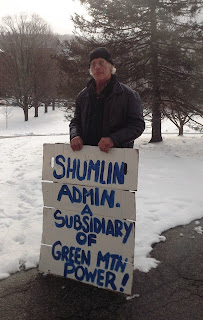
When Governor Shumlin presented his State of the State speech on January 5, protesters against wind development stood outside the Capital dome. They weren’t just protesting a wind farm, though. They were protesting Shumlin’s overly-close relationship with Green Mountain Power (GMP), the utility that is building the wind development at Lowell Mountain.

One sign showed Shumlin in bed with big wind. Another sign claimed that the Shumlin administration is a wholly-owned subsidiary of Green Mountain Power (GMP), the company building the wind farm at Lowell.

Why were the protesters carrying these signs? They noticed that there appears to be an overly close relationship between GMP and the Shumlin administration. However, the potential dangers of such a close relationship go far beyond the Lowell Mountain concerns. As reported in a previous article at True North reports, Who Owns the Infrastructure, and reprinted on this blog GMP is poised to take over the majority of Vermont’s energy infrastructure.

They will control most of the electricity merger through an upcoming merger with Central Vermont Public Service (CVPS) and subsequent control of Vermont’s transmission infrastructure. Meanwhile, the parent company of GMP is Gaz Metro of Quebec. Gaz Metro owns Vermont Gas Systems, and plans to expand the gas pipeline deeper into Vermont. A single Canadian company, Gaz Metro, is poised to own most of the gas and electrical infrastructure in Vermont.

Conflict of Interest

The relationship between Shumlin and GMP seems overly close, but can anybody prove it is a problem? Of course not. The reason most organizations (especially government organizations) avoid even the appearance of conflict of interest is that even the appearance makes decisions suspect. With conflict of interest in the background, decisions may appear biased. There is no way to prove they were fair.

While realizing that conflicts of interest are impossible to prove, we can examine the relationship between Shumlin’s administration and Green Mountain Power.

The Inaugural Ball

Green Mountain Power’s CEO Mary Powell is a strong supporter of Governor Shumlin. For example, Powell was responsible for raising the funds for Shumlin's inaugural ball.
In two posts in the 7 Days poltical blog, Shay Totten described Powell’s role in raising money for the inaugural ball. He then described how the Agency of Natural Resources (ANR) suddenly looked more favorably on ridge-line development after Shumlin took office. After the inauguration, ANR gave a go-ahead to the project despite continuing concerns about high-elevation wetlands. Before Shumlin took office, ANR scientists had said there was no way to offset the environmental effects of the wind farm development.

Wetlands and Money

For a graphic portrayal of some of the environmental issues, I recommend this video by Energize Vermont.

Why did ANR give permission for the Lowell Mountain wind farm before major environmental issues were addressed? As it happens, Green Mountain Power will lose $40 million dollars in federal tax credits if they don’t complete the project by the end of 2012. GMP’s parent company, Gaz Metro, has only $160 million a year in profits (all divisions). The United States tax credits are very significant to Gaz Metro’s bottom line.

Many environmental groups feel the Public Service Board (PSB) decision on the project was rushed and the PSB was overly influenced by the thought that GMP would lose money if they did not approve the construction.

As Energize Vermont's Lukas Snelling said in July: "The PSB and ANR must not allow GMP’s financially-driven construction schedule to undercut their obligation to protect the environment and provide all parties a say in the review process."

A Wholly-Owned Wind Farm

Green Mountain Power is building the Lowell Mountain project and will own it. In most cases, distribution utilities such as GMP buy power from other companies that own the power plants. However, in Vermont, distribution utilities are allowed to own power plants. Vermont has many small utilities and co-operatives that might disappear if they couldn’t own both the power plants and the distribution systems.

However, the post-merger Green Mountain Power will be an almost-monopolistic company in terms of distribution. For a company like this to own a power production facility could be considered a step backwards in terms of utility governance.

Natural Gas and GMP

GMP is owned by a gas company, Gaz Metro. Gas and wind are a natural pairing. Wind farms have about 35% capacity factor at best, and must be backed up with a type of power that can come on-line quickly when the wind dies down. Wind energy is usually backed up with simple cycle gas turbines: these operate like a jet engine, coming on-line very rapidly. No power plant that raises steam can come on-line quickly enough to back up wind energy. Coal, nuclear and biomass plants all raise steam and cannot back up wind energy.

It is Named Gaz Metro

As a matter of fact, the wind turbine will be “backed up” is a bit of a misstatement. Since the wind turbine will only operate about one third of the time (35% capacity factor), two-thirds of the electricity will come from the “back-up” facility. In other words, build a wind turbine, and and the back-up gas plant will provide twice as much electricity as the wind turbine provides.

Gaz Metro plans to bring its gas pipeline down to Rutland. It can perhaps put in a gas-fired power plant to back up the wind turbines that GMP (another Gaz Metro company) builds or encourages. The Comprehensive Energy Plan ecourages gas fired power plants.

As Guy Page of VTEP said, the new Comprehensive Vermont Energy Plan “talks a lot about building…medium sized natural gas plants.” The Comprehensive Energy Plan was put together very quickly, over the space of a few months, by Governor Shumlin's administration.

Wind and Gas and Robert Kennedy Jr.

The gas industry recognizes that wind can encourage natural gas use for electricity generation. For example, in a 2010 speech to a Colorado Oil and Gas Industry convention, Robert Kennedy Jr. describes his work on encouraging renewables. He ends the speech with a crowd-pleasing statement: “The plants we are building, the wind plants and the solar plants, are gas plants.”


Probable Changes in Vermont Energy, After the Merger

In short, if the administration favors GMP and encourages the merger (which they are doing), Vermont will have its infrastructure run by a foreign utility. Vermont will encourage the mixture of wind turbines and gas power plants that are very profitable for that utility. This is a long way from the situation we have now, where the large distribution utilities do not own power plants.

There are many reasons to think this situation will be worse for Vermont ratepayers than the current situation. The Vermont Public Service Board (PSB) and Department of Public Service (DPS) are supposed to protect Vermont’s interests. When Vermonters have suspicions about overly cozy relationships between politicians and power companies, these agencies are supposed to protect the consumer. Are the DPS and PSB doing their jobs?

----------------------------

The pictures of Lowell Mountain Protesters at the State of the State speech were shared by the writers of the Lowell Mountain News blog. For more information on that controversy, go to the blog
Note that the Lowell Mountain bloggers were very generous. They did not see this post before agreeing to share their pictures. Their loan of the pictures does not mean endorsement of the contents of this post.


Rod Adams blog, with a more extended video of Robert Kennedy Jr and more context on his statement: http://atomicinsights.com/2010/11/robert-f-kennedy-jr-tells-the-colorado-oil-and-gas-association-that-wind-and-solar-plants-are-gas-plants.html


This post is the second in a series. The first was Gaz Metro: Who Owns the Vermont Infrastructure.

I wrote this post for True North Reports. I am grateful for the opportunity to reprint in this blog.

Tuesday, November 8, 2011

Wind In Vermont: The Way it Is Today


Governor Peter Shumlin of Vermont is in favor of replacing Vermont Yankee with out-of state and out-of-country power, and of course with renewables.The renewables part isn't going very well.

Can't Make the Wind Blow with a Just a Smile

The video below shows Peter Shumlin attempting to shake hands with people who are protesting the Lowell Mountain wind farms. Shay Totten of 7 Days Vermont included this video in his blog post Occupiers and Environmentalists Confronting Vermont Democrats. The post is worth reading.


One interesting quote from the Totten article:"When Gov. Shumlin opposed Vermont Yankee, he was doing the right thing and we supported him. But then Green Mountain Power turns around and buys power from Seabrook [Nuclear Power] and he says nothing. Why not?" said Eric Wallace-Senft of Woodbury.

Indeed, why didn't Shumlin object to buying nuclear power from New Hampshire? Probably because Governor Shumlin is learning some things about energy supply. In March 2010, Shumlin went on national TV and said that Germany got 30% of its electricity from solar. Now, a year and a half later, Shumlin may have learned the definition of baseload.

Property Rights and Protests about Wind

Meanwhile, there are wind lawsuits. The most active one is about property rights. A retired couple, Don and Shirley Nelson, are neighbors of the Lowell Mountain Wind project. They don't like the project.

The contractor for Green Mountain Power is blasting a road near Nelson's property, and wants to be sure nobody is hurt by "flyrock" (blast debris). Wind protestors are on the Nelson's property, and they refuse to move for the blasting. After all, they are on private property by invitation. Nelson's attitude is that he never gave anybody permission to spread flyrock on his property anyway. It has ended up in court (of course).

Terri Hallenbeck of Burlington Free Press has an excellent article on the situation. Green Mountain Power first told the Nelsons they would be sued for the cost of delays. The threat was a bit of a public relations nightmare, of course! Next, Green Mountain Power offered to buy their land. So far, the Nelsons have not budged.

Two quotes from Don Nelson, from the Hallenbeck article:“After 40 years of working, if you had to sell to someone who wanted to destroy what you built, would you?” asked Don Nelson, who grew up on the property and raised his family there....(Green Mountain Power sent) a letter to the Nelsons warning them that Green Mountain Power would take them to court and hold them financially responsible for the cost of any delays caused by the campers on the ridgeline. The Nelsons characterize that as a threat to force them into selling.

“I was supposed to say, ‘Please don’t give me a million-dollar lawsuit,’” Don Nelson said. “It’s not going to happen.”

Update: The Nelsons lost the first round in court, and are appealing the verdict. Terri Hallenbeck has the story at Burlington Free Press. Summary of the appeal, from the Nelson's lawyer: “The Nelsons have the right to the exclusive use and occupancy of their own land and to deny the use of their land to others, including GMP, regardless of how important the use of the Nelsons’ land may be to GMP.”

Meanwhile, my friend Willem Post has an excellent article in Energy Collective: Was Vermont's Lowell Mountain Wind Turbine Facility a Good Idea? His answer is no, considering both cost and environmental impact.

Renewables for Vermont?

When I show up somewhere with a pro-Vermont Yankee sign, and I try to convince an opponent that nuclear is safer and better than fossil, the opponent is sure to tell me that "We don't need either fossil OR nuclear. We can meet our energy needs with renewables!"

Sometimes I wonder if the opponents actually live in Vermont.


Friday, July 15, 2011

Lowell Mountain Wind Turbine Facility in Vermont: A Guest Post by Willem Post

The Lowell Mountain Wind Turbine Facility, proposed for the Northeast Kingdom area of Vermont, has encountered much resistance, but Green Mountain Power (GMP) vows to complete the project despite objections. The politics are clear (follow the tax dollars) and many locals feel they are not being heard. Meanwhile, the wind farm energy is included in the future projections for electricity in Vermont.

Today, Willem Post has graciously shared his review of the Lowell Wind Farm with us. His most recent guest blog at this site was Subsidies for Wind and Solar. His posts are frequently featured at The Energy Collective.


Lowell Mountain Wind Turbine Facility in Vermont
by Willem Post, 14 June, 2011

The GMP-instigated 63 MW Lowell wind turbine facility with (21) 3 MW Danish wind turbines stretched along 4 miles of ridge lines has nothing to do with community-scale wind, everything with utility-scale wind. GMP is using blatant PR to soft-soap/deceive Vermonters. It is a capital intensive (63 MW x $2,500,000/MW = $157.5 million, excluding grid modifications), highly visual (410-ft tall wind turbines), noisy wind turbine facility that is proposed to be built on environmentally-sensitive ridge lines. It received a Certificate of "Public Good" from the Vermont Public Service Board, a mostly political entity.

The Lowell wind turbine facility would produce just a little of expensive, unreliable, intermittent, variable wind energy (63 MW x 1 GW/1,000 MW x 8,760 hr/yr x CF 0.30 = 165.6 GWh/yr, or about 2.76% of Vermont’s 6,000 GWh/yr consumption). This energy has near-zero dispatch value to grid operators, such as ISO-NE. For at least 10 percent of the year, the wind speeds are too low to produce any wind energy. Most of the wind energy is produced in irregular, varying, sporadic spurts at night during the winter.

Carbon Dioxide and Wind

The project has nothing to do with reducing CO2 emissions or generating wind energy. Most of the CO2 emissions that wind energy was meant to reduce is offset by the increased CO2 emissions due to the inefficient operation of the gas-fired balancing facility, as shown by my paper on Wind and Carbon Dioxide at the Energy Collective.

For the same capital cost a new 60% efficient combined cycle gas turbine facility in base-loaded mode at rated output would produce:
($157.6 million/$1,250,000/MW) x 1 GW/1000 MW x 8,760 hr/yr x CF 0.90 = 993.4 GWh/yr

or about 16.5% of Vermont’s 6,000 GWh/yr consumption. This would be more than 5 times as much electrical energy per invested dollar.

Let's look at some of the advantages of such a gas-fired facility:
  • No grid modifications would be required
  • No inefficient operation of gas-fired wind energy balancing facilities would be required,
  • Visual impact would be minimal
  • The plant takes up only a few acres
  • The electrical energy produced would be low cost, steady, reliable and dispatchable.
Job Creation and Wind

The Lowell wind turbine facility job creation is largely a mirage. The facility will temporarily employ a number of people during the construction phase for about a year. During the next 20 years, just a few people will be permanently employed to perform operations and maintenance. An enormous waste of capital to create just a few permanent jobs, as shown by this Vermont Department of Public Service study.

Following the Money

The project would not be built if there were no subsidies equivalent to at least 50% of the capital cost. Without subsidies, the wind energy produced would be at least $0.15/kWh delivered to the grid, significantly higher than New England average grid prices of about $0.055/kWh.

The project has everything to do with grabbing as much federal subsidies as possible and "coursing" them through Vermont's economy for the short-term benefit of the well-connected few . The beneficiaries include high-income, non-Vermonters looking for tax shelters and foreign companies supplying wind turbines. The long-term economic expense (higher electric rates) will be carried by the many.

Wind and Subsidies

Over the past 10 years, the subsidies for wind turbine facility owners have become so excessive that facilities are built in marginal wind areas, as on most Vermont ridge lines. Other facilities are being put in place before building infrastructure to transmit the wind energy to population centers, as in the Texas Panhandle. These wind facilities are built just to cash in on the lucrative subsidies.

Here is a partial list of subsidies:

  • Federal grant for 30% of the total project cost which also applies to Spanish, Danish, German and Chinese wind turbines thus creating jobs in those nations instead of the US. These nations would not dream of passing a law to benefit US wind turbine companies.
  • Federal accelerated depreciation allowing the entire project to be written off in five years which is particularly beneficial to wealthy, high-income people looking for additional tax shelters.
  • Federal production credit of $0.022/kWh of wind energy produced.
  • Owners of wind turbine facilities receive Renewable Energy Certificates (RECs) which they can sell on the open market. The RECs are subsequently bought by polluting companies that find it less expensive to buy the RECs than clean up their pollution.

The federal government and state legislatures are pressured to provide increasingly greater state subsidies to politically well-connected renewables vendors, developers, financial entities (such as Goldman Sachs on Wall Street) and their high-income clients who use them for tax shelters.

Wind Turbines Circumvent Environmental Protection

State legislatures and state government agencies are pressured to pave the regulatory ways to essentially circumvent state environmental and quality of life laws. Pro-forma hearings, usually required by law, are held to create a semblance of democratic process. These hearings effectively are rubber-stamp approvals of pre-ordained decisions.

Update: A popular post by Post! Turns out that Rod Adams also posted this as a guest post (longish story about how we both managed to post it the same day), and a revised version of the post is now up at The Energy Collective.