Showing posts with label Mike Twomey. Show all posts

Monday, July 25, 2016

No Country for Old Nukes? Mike Twomey Guest post

Vermont Yankee


In a scene from Cormac McCarthy's novel, No Country for Old Men, a professional assassin taunts his rival (who is cornered, defenseless, and about to meet his maker) with the following query:

"If the rule you followed brought you to this, of what use was the rule?"

It is a profound question intended to raise doubts about the decisions we make, the principles we follow, and the assumptions that guide our behaviors.  A version of this concept is applicable to a wide range of situations:  If the road you traveled brought you to a negative outcome, was it the right road? (Where could you have made different or better decisions?)  Or, in the positive:  If the road you traveled brought you to a positive outcome, it was the right road. (Do not waste your time or energy second-guessing the seemingly unhelpful detours along the way.)

I work for one of the largest nuclear operators in the U.S. and my responsibilities over the last several years have included advocacy on behalf of the continued operation of nuclear plants in New York and New England.  Working with a large team, this effort has involved complex, technical presentations to state and federal agencies with jurisdiction over the related matters that affect the licenses under which the nuclear plants operate, as well as extensive stakeholder outreach to educate the public, the media, elected officials, and others about the important benefits of nuclear power, from an electric reliability perspective, from an economic perspective, and from an environmental perspective.

Over the last six or seven years, the wholesale market for electricity has dramatically changed due to persistent low natural gas prices.  In most "organized" markets (New York, New England, Mid-Atlantic, for example), the price for power typically follows the price for natural gas.  Therefore, as the price for natural gas has plunged, wholesale power prices have also plunged to historic lows.

While wholesale power prices have plunged, the cost to run a nuclear power plant has increased, for a variety of reasons.  You do not have to be a finance professional to conclude that increasing costs and decreasing revenues will eventually lead to unprofitability.  Faced with these grim economic prospects, in 2013, Entergy announced the retirement of the Vermont Yankee Nuclear Power Station in Vernon, VT.  Vermont Yankee delivered electricity to the New England electric grid for the last time on December 29, 2014, ending a more than 42-year run of providing clean, reliable energy, employing more than 600 nuclear professionals, and paying millions annually in state and local taxes.

Due to the same economic forces that led to Vermont Yankee's closure, Entergy also announced the retirement of the Pilgrim Nuclear Power Station in Plymouth, MA in May 2019.  Pilgrim produces more than 80% of the carbon-free energy generated in Massachusetts.  In addition to inflicting the same type of economic harm in and around Plymouth that Vermont Yankee's retirement inflicted on southern Vermont, Pilgrim's retirement will make it very difficult for the Commonwealth to meet its legal obligation to reduce greenhouse gases.

During the last ten years, while we have been seeking federal (and, in some cases, state) approvals to continue to operate our existing nuclear plants, many federal and state officials have separately been pursuing efforts to reduce carbon emissions.  These efforts have included federal agency actions (most notably, the EPA's Clean Power Plan) and various state actions, including legislation, agency actions, and "encouragement" provided to utilities to take steps to reduce electric sector carbon emissions (e.g., the recent multi-state "clean energy" RFP issued by utilities in several New England states).

In general, these federal and state carbon reduction efforts have focused on providing significant subsidies and/or long term contracts to renewable energy sources, primarily wind and solar.  But, these carbon reduction efforts have not included any proposals to support the continued operation of existing nuclear facilities.  For example, the Clean Power Plan provides no incentives to states to maintain their existing nuclear plants.  And, the multi-state "clean energy" RFP issued by several New England utilities in 2015 excluded existing nuclear facilities from participating.  In short, carbon reduction advocates have tended to be single-minded in their objective: Increase the use of renewable energy.

According to data from ISO-New England, reliance on natural gas for electricity production in New England more than tripled from 2000 to 2015 (15% to 49%).  During that same period, contributions from hydro resources and renewable energy resources remained essentially flat (7% and 8-9%, respectively).  Nuclear also remained essentially flat (31% to 30%), with uprates and increased availability offset by Vermont Yankee's retirement.  The big declines have come in the use of oil-fired (22% down to 2%) and coal-fired (18% to 4%) generation.  And, from 2000 to 2014, New England saw steady reductions in CO2 emissions as natural gas-fired plants replaced oil- and coal-fired plants.

In 2015, however, Vermont Yankee's retirement increased New England's CO2 emissions by 5 percent, or more than two million metric tons.  The reason? Natural gas-fired generation replaced Vermont Yankee's output.  A similar outcome followed the retirement of the San Onofre Nuclear Generation Station in California, which resulted in meaningful increases in CO2 emissions.  Future nuclear plant retirements can be expected to produce the same results.  This means that we can expect increased CO2 emissions.

The takeaway for New England, therefore, is this:  The mix of federal and state actions (and inaction), combined with market forces, has led to (1) substantially increased reliance on natural gas-fired generation, (2) nuclear plant retirements followed by increased CO2 emissions, and (3) no meaningful increase in renewable energy's contribution to the grid. ISO-New England, the non-profit, independent entity responsible for maintaining the reliability of the region's electric grid, identified the following challenges in its most recent report:
  • Inadequate natural gas pipeline infrastructure is at times limiting the availability of gas-fired resources or causing them to switch to oil, which is creating reliability concerns and price volatility, and contributing to air emission increases in winter.
  • Substantial nongas generating capacity is retiring, limiting the options for reliable grid operation when natural gas infrastructure is constrained.
  • The weather-dependent output from wind and solar resources and the increase in [distributed generation] adds complexity to how the ISO must operate the power system to maintain reliability.
  • Expensive transmission infrastructure upgrades are needed to connect more wind and hydro resources.
  • Efforts to meet state policy goals to inject more clean energy into the system through long-term contracts may undermine confidence in the markets and inhibit future investment in competitive power resources.
We are left to ponder the consequences of a single-minded focus on supporting renewable energy and a lack of support for the existing nuclear fleet.  Even if you disagree about the relative merits of carbon reduction efforts, it is inarguable that additional nuclear plant retirements will lead to increased CO2 emissions.  Moreover, the increased dependence on natural gas-fired resources reduces fuel diversity and exposes customers to potential price volatility.  An important additional fact to recognize is that, once a nuclear plant retires, there is no opportunity to bring that plant back into service (it is not technically impossible, but it is infeasible from a regulatory standpoint and an economic perspective).

If we are, through application of a "renewable energy is the only future" rule, moving toward an electric future of increased carbon emissions, less grid reliability, insufficient fuel diversity, and increased consumer prices, then stakeholders (customers, elected officials, businesses, etc.) will be entitled to ask:  If the rule you followed brought you to this, of what use was the rule?

There is another path to follow.  In New York, the Public Service Commission is considering the adoption of a program that would compensate nuclear facilities for their non-carbon emitting attributes.   It would be the first in the U.S. to explicitly -- and financially -- acknowledge the importance of the existing nuclear facilities to carbon reduction goals.  All who desire a future electric grid that is clean, reliable, and affordable should applaud New York's efforts.  And, we should decline the pitch of renewable energy advocates who peddle the fantasy that wind and solar alone can power the grid.

----
About the author:

Mike Twomey is Vice President for External Affairs at Entergy. He is involved in many areas of negotiation and outreach concerning the nuclear plants.  His most recent guest post at this blog was The Replacement for Vermont Yankee Was...Natural Gas.

This post first appeared on LinkedIn and is republished by permission.

Wednesday, January 20, 2016

Renewables at 90% only IF grid-level storage comes first

Renewables can't be a 90% unless we have grid-level storage

Renewable installations are growing fast, but we can't have huge percentages of wind and solar on the grid unless we first have grid-level storage.  With the exception of pumped storage, grid-level storage does not exist at this time.  (No, I don't count an occasional 2 MW project as "the answer.")

We can't grow wind and solar to a higher percentage on the grid than their capacity factor implies, unless we have storage. Moving to 50% wind on the grid is not possible, without utility level storage.  

The explanation follows, based on the New England grid.

A year on the New England grid (2008)
Shows the necessity of being able to dispatch electricity
Note rise in gas usage while nuclear plants refuel
Click to enlarge
Five million down and five million up (natural gas takes the lead)

In a guest post on January 7, Michael Twomey of Entergy used grid operator (ISO-NE) data to show that between 2014 (when Vermont Yankee was running) and 2015 (when Vermont Yankee was closed), nuclear kilowatt-hours decreased by about five million MWh and gas-fired generators increased their output by almost exactly the same amount.  Natural gas went from 46,200,000 MWh to nearly 51,900,000 MWh.  Nuclear kWh nuclear went down by almost the same amount of MWh.
Click to enlarge table

Wind and solar growing fast: Jeff Schmidt's comment

Looking at the table above, you can see that wind went from 1,892,000 MWh to 2,135,00 MWh, growing by approximately 243,00 MWh, and solar grew from 327,500 to 436,200 MWh, approximately 108,700 MWh.

This rapid rate of growth (though still only adding up to 2.4% of the power on the grid), prompted Jeff Schmidt to write this comment on the Twomey article:

"This article seems to dismiss the growth of wind and solar. While I am pro-nuclear, and think that nuclear needs to play a vital role in our future energy mix, I think the author of the article is neglecting something important - growth of wind and solar.

It's true that they are still small. But, if you look at the year-over-year growth rate, as shown by the statistics provided by the ISO and called out by Mr. Twomey, we see that Solar grew 33% in a year, and Wind grew 41%. Of course, one can't predict future growth rates based on one year, but IF wind and solar can keep up strong growth like that, they could conceivably become a very large proportion of the New England energy mix inside of 10 years.

It's true that it's likely an overly optimistic and simplistic projection, but just for the sake of argument, if they can keep up that growth rate, then 9 years from now, Wind could produce about 50% of the energy, and solar about 5%. If you projected it to 10 years instead of 9, that would account for more than 100% of current grid generation.

However, at the same time, it's very likely that at some point, Wind and Solar's growth must slow. Still, it's a valid point to concede that Wind and Solar, while currently small in absolute terms, are actually growing at a pretty fast rate."

Why renewables can't keep growing--unless we have storage

I wrote the following response to Schmidt.  I oversimplified, but I am also worried that "we can't grow wind and solar" arguments are often based on cost, or on complex technical issues that are hard to explain.  So, here's my oversimplification.  Basically correct, but oversimplified.

Basically, we can't grow wind and solar to a higher percentage on the grid than their capacity factor implies, unless we have storage. Moving to 50% wind on the grid is not possible, without utility level storage.


Jeff
I wrote about Vermont's plans to be 90% renewables in today's blog post. Of course, renewable growth from 1 to 3 to 5% is possible and looks great. However, it simply does not scale. Let's oversimplify a little, though not a lot.

Most of Vermont is one weather pattern, with some exceptions. Hot, dry and sunny...all over Vermont. Windy at night...all over Vermont. Cold and windless....all over Vermont. Now, obviously, the mountains are different from the river valleys and so forth, but the statement "weather is the same all over Vermont" is far closer to true than its opposite would be.

Okay. We cannot turn wind on and off. Let's say that wind has a 30% capacity factor. For wind to grow to 30% of the electricity supply overall, that means when wind is on the grid (the wind is blowing in Vermont)...the grid has to be 100% wind. Without this high percentage when wind is available, wind is not going to be able to be 30% of the electricity, overall. So we have to build a lot of wind to get wind to 30% of the electricity supply, and we have to turn everything else off if the wind is blowing.

Well, what if we build more wind? If we do that, when the wind is blowing....what then? We have to curtail some of the wind, because the grid can't take more than 100% of wind. So, without grid level storage, wind reaches a VERY hard stop at 30%.

Well, it is windier in the mountains, and the southern part of the state gets less wind and so forth and this is an oversimplification. And the grid requires more power in the day, and less in the night (when the wind usually blows). So it is quite complicated in reality. But the basics remain.

IF you can turn things on and off, you don't reach this sort of hard stop. 100% of the electricity from natural gas...this could work. No "hard stop" involved. 100% from nuclear...well, current nuclear doesn't follow load well, but there is no "hard stop" involved, where you have more nuclear than you can use on the grid. You don't need grid level storage for nuclear, just plants that follow load a little better. And so forth.

This is why I am so cynical about the Vermont energy plan. The plan is kind of "We don't just hope for miracles, we expect them."
------

Jeff Schmidt has two guest posts at this blog:

The Nuclear Safety Paradox, which describes how experience (such as building new nuclear plants) increases safety.

Flawed Analogies, which describes the analogies nuclear opponents made in a debate against nuclear energy.

Illustration

The illustration showing the need for dispatchable power
From Sustainability presentation by David Lamont
Vermont Department of Public Service
October 18, 2010
Presentation is no longer on the web, but I had saved it to my computer.

Thursday, January 7, 2016

The Replacement for Vermont Yankee Was…Natural Gas: Mike Twomey Guest Post

The Replacement For Vermont Yankee Was . . . Natural Gas
By Mike Twomey

Several years ago, while the legal and public relations battle raged over the future of Vermont Yankee, anti-nuclear activists -- and some elected officials -- confidently predicted that, if the plant closed, its output would be replaced by wind, solar, and other renewable energy sources.   Pro-nuclear advocates expressed doubts about that future, arguing instead that the loss of a baseload nuclear plant would inevitably lead to greater reliance on fossil fuels.  Similar debates continue with respect to Pilgrim (Plymouth, MA), Indian Point (Buchanan, NY), and other nuclear facilities.

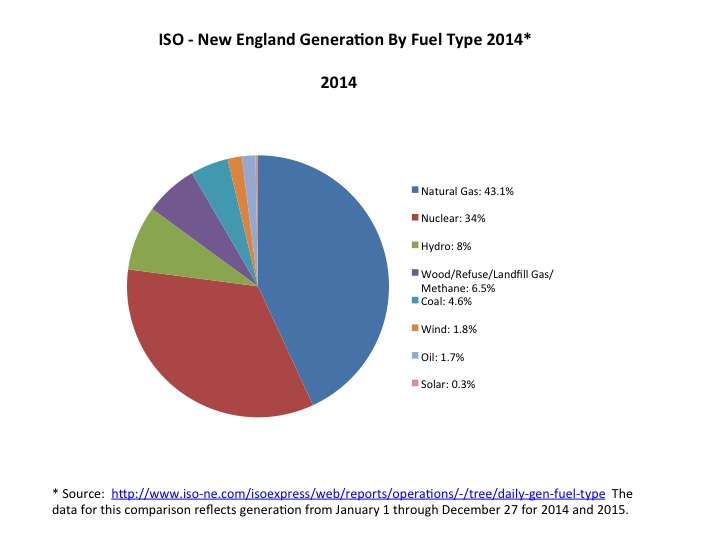
Now that 2015 has come to a close, we have an opportunity to evaluate the facts. ISO-New England (the non-profit, independent entity that ensures the reliability of the electric grid in New England) publishes data that shows daily generation by fuel type.  That data shows that in 2014 (the last year of Vermont Yankee's operation) natural gas-fired generators supplied 43.1% of the energy in New England, while nuclear provided 34%.   In 2015 (the first year since 1972 without Vermont Yankee) natural gas-fired generators supplied 48.6% of the energy in New England, while nuclear provided 29.5%.


Comparing these two charts shows the growth of natural gas on the grid
2014 and 2015
Blue is natural gas
Red is nuclear


As you can see in the chart below, the contribution of other sources of energy in New England remained essentially unchanged in 2015 compared to 2014 (the largest change was that coal-fired generators contributed one percent less in 2015 compared to 2014 (3.6% v. 4.6%).   The contribution of wind and solar remained vanishingly small in both years (wind was 2.4% in 2015 and 1.7% in 2014, while solar was 0.4% in 2015 and 0.3% in 2014).

Double-click to enlarge chart 

Generators in New England produced approximately the same amount of total MWhs in 2015 and 2014 (106.7 million MWhs in 2015 v. 107.2 million MWhs in 2014).  Taking into account the unusually mild weather in late fall of 2015, these figures deflate another prediction by anti-nuclear advocates that Vermont Yankee's baseload contribution could be replaced, in part, with energy efficiency.

The bottom line is that, without Vermont Yankee, nuclear's carbon-free contribution to the New England electric grid fell by 5.3 million MWhs in 2015 compared to 2014. Over that same time period, the contribution of natural gas-fired generators increased by nearly 5.7 million MWhs.   According to the U.S. Energy Information Agency, natural gas-fired generators produce 1.21 pounds of CO2 per kWh (https://www.eia.gov/tools/faqs/faq.cfm?id=74&t=11).  Using that formula, the additional MWhs of energy from natural gas-fired generators in New England in 2015 compared to 2014 equals approximately 3.1. million metric tons of additional CO2 in 2015 compared to 2014.  To put that in perspective, 3.1 million metric tons of CO2 is equivalent to adding more than 650,000 passenger vehicles to the roads in New England during 2015.

About this post:

This post first appeared in Linked-In on January 2, 2016 and is reprinted here with permission from Mike Twomey.  This post is a good companion piece to the recent post at this blog:  Vermont Yankee was replaced by natural gas: Doing the numbers.

The conclusions of the two posts are the same---because facts are facts.

The earlier Doing the Numbers was based on EIA data. This current post by Mike Twomey is based on ISO-NE (New England grid operator) data.   Mike Twomey's post includes data through the end of 2015, while the other post only includes data to the third quarter of 2015.

About the author:  

Mike Twomey is Vice President for External Affairs at Entergy. He is involved in many areas of negotiation and outreach concerning the nuclear plants. For example, Twomey was quoted in an October post at Vermont Digger: Entergy may move fuel into dry casks sooner than anticipated. In that article, he explains the financing of dry cask storage at Vermont Yankee.