Showing posts with label Patty O'Donnell. Show all posts

Thursday, January 4, 2018

A Hole in the Community: When a Nuclear Plant Shuts Down


A hole in the community


What happens when a nuclear plant shuts down


Vermont Yankee

At its peak, the Vermont Yankee plant generated more than 70 percent of the electricity made in Vermont. It was the largest, most reliable source of clean energy in the state and one of the largest plants in the New England grid.

But like many other nuclear plants around the U.S., Vermont Yankee was no longer economically competitive and was losing money for its owners. Its closure would cause harm across many states – and for many years.

The environmental and economic effects of closing Vermont Yankee were severe, and they were completely predictable: air pollution increased, as carbon-free nuclear energy was replaced by natural gas; energy costs increased throughout New England, with utilities warning that customer bills could rise 50 percent or more during the winter; and the region’s economy slowed as 1,000 jobs and $500 million in annual spending dried up.

Most painful, though, was the human toll on the Vernon VT, community as nuclear workers were forced to leave behind loved ones and neighbors in search of work.

In the two and a half years since Vermont Yankee closed, many good people had moved on. Someday, the community might recover. But it will never be the same.

Economic Lessons

When he made his political case that Vermont Yankee should be “retired,” then-Gov. Peter Shumlin promised a “billion-dollar bonanza” for the state. Shumlin argued that, in the short-term, decommissioning a nuclear plant would provide employment, income and spending on par with a functioning power station. While Vermont Yankee was operating, it employed more than 600 people with salaries averaging more than $100,000 a year. Those dollars cycled through the local economy, creating hundreds more indirect jobs.

But closing the plant was not a jobs bonanza – it was a jobs cliff. Hundreds of people lost their jobs, and nowhere near that many jobs were created or likely to be created. To contradict Shumlin’s assertions, I looked at the history of other nuclear plants that closed. What I saw wasn’t pretty. One of the lessons learned about decommissioning was that a closing plant must downsize its staff quickly and aggressively, in order to decommission within the budget of the decommissioning fund.

Lessons learned were everywhere, but they weren’t happy lessons. Wherever a nuclear plant closes, the pattern repeats itself: employment and average incomes fall, which means that tax revenues that fund schools, government services, roads and communities fall, too. To make up the losses, tax rates must rise. In general, the first tax rate to rise is the local property tax.

At the same time, the departure of nuclear workers increases the number of houses on the market, and lowers property values. Local businesses also suffer as temporary workers hired for periodic refueling outages no longer come to town: the outage contractors no longer rent rooms, eat at restaurants, buy groceries or fill their cars with gas. They no longer give the area economy a cheerful boost of workers making good money, with money to spend.

Emissions of carbon and other pollutants rise as clean nuclear energy is replaced by plants that burn fossil fuels. And when a nuclear plant’s around-the-clock supply of electricity is turned off, the law of supply and demand dictates that energy prices must inevitably rise. Even though natural gas prices are low now, when a nuclear plant closes, it creates more competition for the natural gas and the price of gas rises. As natural gas prices rise, so do electricity prices.

About the people

NJ Needs Nuclear: Patty from PSEG on Vimeo.

Nuclear workers are highly skilled, highly trained and highly sought-after. There are jobs to be found at other nuclear plants – for someone who is willing to uproot and leave their friends, their kids’ schools, their churches, their doctors, their favorite restaurants, their church choirs or their poker buddies.

I believe these quotes, left by anonymous commenters on my blog, Yes Vermont Yankee, help illustrate the human side of the story:
Yes, I relocated. No, it was not easy. Selling a house, buying another one, moving, finding a new house with the right schools. Moving away from grown kids. Moving away from grandkids. My wife had to leave a job that she loved …”
“There is no way I will come close to breaking even on selling my house, not with the housing market the way it is … We have elderly parents and we don't know how we are going to manage ...”
In some cases, families were split as one spouse moved to take a new job at a faraway nuclear plant, while the other stayed behind to allow children to stay in school. A plant closure could break up a family for months or years.

Change will never be easy, and it will be harder for some than for others. But plant employees will move on, and they will live well.

For younger people, living well probably means getting out of town, taking their lumps on the declining local housing market and starting anew. Older people may see the loss of a job and community as a betrayal of their lifelong work and plans, and may be less able to start over or go somewhere new.

Today, Vermont Yankee is closed, and the region is forever the worse for it: More carbon in the air, fewer jobs, higher taxes and rising electric bills for those who stay. At one low point, during town meeting, the town of Vernon decided to disband its police force and sell off the cruisers. They could no longer afford their small police force. Hard decisions had to be made.

The Bottom Line

For a plant closure, it is comparatively easy to assess the bottom line in monetary costs.

Economic input to the area down severely, taxes no longer collected, energy prices going up. The human cost – people losing their jobs, becoming discouraged and displaced as they are forced to move to new areas – cannot be calculated.

I believe the nuclear industry will survive. Nuclear workers are smart and resilient. I think the future will work out well for all of them.

I’m less certain about the communities left behind.
_____________________________________________________
The above column is sponsor-generated content from New Jersey Needs Nuclear.
----------
Note: This article is reblogged. It was first printed as sponsored-content in Politico.
http://www.politico.com/sponsor-content/2018/01/02/a-hole-in-the-community

 I wrote this article a while ago. It is partially an update to my earlier article Circles of Pain Around Vermont Yankee closing

Tuesday, November 7, 2017

Rubble at Vermont Yankee: Framing the Discussion

Vermont Yankee in the good days
The Future of Vermont Yankee

Nuclear opponents continue to attempt to put roadblocks into the Vermont Yankee decommissioning process. They claim that they want a quick, safe process for decomm, but several of them also claim that the land should "heal" for about two hundred years before anything is built there.

Basically, a quick safe process is the very last thing opponents would want, as far as I can tell. A successful  process would show that nuclear decomm is no big deal, and perhaps nuclear opponents should turn their attention to coal ash ponds.

Right now, rubblization is a major issue.  Here's my letter about it.

Framing the Discussion

Dear Editor:

I am well-known as an advocate for nuclear energy. I lost most of my interest in the Vermont Yankee plant after it closed down, and I devoted myself to writing a book about pro-nuclear advocacy. However, in the past six months, I began looking at the issues surrounding the proposed sale of Vermont Yankee to NorthStar.

Since NorthStar's announcement about the proposal to purchase Vermont Yankee, I have attended several public meetings and community briefings, and heard NorthStar CEO Scott State speak. In these meetings, Mr. State has answered the hard questions about about NorthStar's plan to decommission Vermont Yankee in a safe, well managed process over relatively short time frame. State has responded to questions with candor and transparency. For example, I hadn't really understood that the nuclear opponent slogan of "no rubblization" would lead to huge amounts of truck traffic taking rubble away from the site. (Yes, I should have realized this myself.) Mr. State noted that, without rubblization, heavily-loaded construction trucks would constantly pass the elementary school. This would be a safety hazard for parents and children.

Nuclear opponents have effectively framed the discussion to their own personal definitions of safety: their definitions ignore traffic safety and children's safety. Similarly, nuclear opponents are now speaking of letting the site "heal." In other words, they want to remove the Vermont Yankee site from possible use as a commercial site (with jobs) until such time as it meets their non-measurable criteria for "healing."

I'm hopeful the Public Utilities Commission recognizes the tangible safety, economic and environmental benefits of NorthStar's proposal.

Meredith Angwin,
Wilder, VT

This letter has appeared (sometimes with edits) in various newspapers in Vermont and New Hampshire, for example, The Brattleboro Reformer, the Burlington Free Press, the Rutland Herald,  and the Caledonian Record. It has appeared in other newspapers also, but I don't have the links.

------
Additional Reading:
 Rubblization of a road
Wikipedia illustration


Howard Shaffer's letter to the Brattleboro Reformer. Without rubblization, there would be over 4000 truckloads of rubble removed from the site. Specious Objections to the NorthStar Proposal. 

Patty O'Donnell in the Keene Sentinel. Why Wait 60 Years for Economic Benefits?

Guy Page in Seven Days on the....umm....incorrect statements....of nuclear opponents. True NorthStar

Bob Leach in the Times Argus on why Residential Standards are not the appropriate standard for cleanup.

Wikipedia on Rubblization, which is not a new concept.


Sunday, May 22, 2016

Patty O'Donnell at the Department of Energy Summit on Nuclear Power Plants

A lilac 
Department of Energy Summit on Improving the Economics of Nuclear Power Plants

On May 19, the Department of Energy held a summit on Improving the Economics of America's Nuclear Power Plants.  The four-hour meeting included many distinguished speakers, including Department of Energy Secretary Ernest Moniz, Senator Cory Booker, and more.  You can watch the entire meeting at this link.

A major purpose of the meeting was to find ways to keep America's nuclear fleet running.  Scientific American reported on the meeting. They quoted Secretary Moniz: "We are supposed to be adding zero carbon sources, not subtracting or simply replacing (them)..." The Scientific American article features a picture of Vermont Yankee. The Bloomberg article on the meeting has the following title -- Moniz: Closing Nuclear Plants Poses 'Huge Problem'.

Vernon's own Patty O'Donnell spoke at this meeting.  O'Donnell described the human impact due to Vermont Yankee closing.  If you move the video slider to the 2:39 mark (2 hours and 39 minutes into the four hour video) you can watch her ten minute talk.  It was an important and moving description of the effects of the plant closing. Her talk showed a part of the human face of "why we need nuclear energy."

Adams blog focuses on O'Donnell's talk

Rod Adams' Atomic Insights blog post about the meeting focused on O'Donnell's talk. His post is Real people are harmed when other people decide to close nuclear plants.  I encourage you to read it, and also to read the comments. Adams blog gets interesting and knowledgable comments.

Adams also made a YouTube of O'Donnell's talk.  He has it posted on his blog post, and I am sharing it here.  Big THANK YOU to Rod Adams!  A ten-minute video is so much more appealing than a four hour video. I share his video below.


********
Two little notes:

I used a picture of a lilac on this blog post because a lilac is blooming outside my window now, and because I imagine myself handing a bouquet of flowers to Patty O'Donnell.

My own major blog post on this subject is Circles of Pain around Vermont Yankee Closing.

Thursday, December 26, 2013

Be Prompt and Positive with Vermont Yankee: Guest Post by Patty O'Donnell

Patty O'Donnell speaking to Public Service Board
November 2012

Prompt, positive Vermont Yankee decision benefits everyone

By Patricia O’Donnell, Chair
Vernon Board of Selectmen


For the sake of the residents of Vernon, I strongly encourage the Vermont Public Service Board (PSB) allow Vermont Yankee and the State of Vermont to come to an equitable agreement, and issue a clean Certificate of Public Good (CPG) at the end of this year guaranteeing Vermont Yankee’s continued operation until late 2014. An unburdened CPG will provide much-needed and much-warranted economic and environmental certainty and will give all stakeholders the unobstructed opportunity to plan for the future.

As an elected representative of Vernon – a town now facing the loss of its largest employer and taxpayer, significant budget cuts, and mounting questions about its financial footing – I hope the Public Service Board will at least grant us this gift of clarity as we continue the difficult task of planning for life without Vermont Yankee.

Vernon and its residents deserve to know whether Vermont Yankee will continue to operate through next year. A prompt decision by the PSB will allow us to clearly anticipate and navigate the road through 2014 and beyond, and help to ease the financial blow to our school system, our police departments and other local services resulting from the loss of this crucial revenue source.

It is equally important for the Public Service Board to pursue a course that is both fair and equitable and looks to mitigate any further harm. Assigning a tangle of conditions or refusing outright to grant the CPG will only add insult to injury for the people of Vernon – and a contentious ruling will only hinder our efforts to recover from the loss of Vermont Yankee.

For nearly four decades, the town of Vernon, as the host community for this important economic and energy generator, has been integral to Vermont’s strength and sustainability, contributing billions of dollars in tax revenues, billions more in economic benefits, and supporting thousands of jobs statewide.

It is crucial that the PSB act expeditiously and fairly in issuing a decision, and provide some semblance of certainty as we continue through this difficult transition period. The residents of Vernon, indeed all Vermonters, deserve the security of knowing what the future holds.

Note: O'Donnell wrote this before the recent agreement between Entergy and the state.  However, it is still relevant.  The Public Service Board has not ruled yet.

Friday, November 16, 2012

Vermont People Work at Vermont Yankee: Patty O'Donnell Comments

Patty O'Donnell
Vernon Selectboard Chair
 Former State Representative
Patty O'Donnell spoke from notes, not a written statement.  She stated that Vermont Yankee is a safe plant, and one of the top-rated in the country.  Workers wouldn't live near the plant and send their children to school near the plant if the plant were not safe.

O'Donnell also spoke against the demonizing of "Entergy Louisiana" as quoted in the Brattleboro Reformer. 

Patty O'Donnell, chairwoman of the Vernon Selectboard and former legislator, said Yankee is "a high-quality nuclear power plant ... one of the best in the country."

"This isn't Entergy Louisiana," said O'Donnell. "It's Entergy Vermont Yankee. Look around this room you'll see the faces of the people who run this plant. That's Vermont Yankee."

--------

This is the eleventh in a series of posts which share statements made in favor of Vermont Yankee at the Public Service Board hearing on November 7, 2012.

Thursday, November 8, 2012

More Nuclear Supporters than Opponents at Public Service Board Hearing

The scene at the meeting
Note the green stickers and buttons of VY supporters

Public Service Board members at head table
David Coen, Commissioner John Volz, John Burke
Court Reporter at left
For continued operation, Vermont Yankee requires a Certificate of Public Good from the Vermont Public Service Board (PSB).  The only in-person public meeting for this docket was held last night at the Vernon Elementary School across the street from Vermont Yankee.

I hoped that supporters would come to this hearing.  Sometimes plant opponents practice the politics of intimidation.  I hoped this meeting would be civil.

State Representative Mike Hebert
of Vernon and Guilford
The meeting was civil. The meeting was informative. I think one reason for the civility was that plant supporters outnumbered opponents. I have noticed that the higher the percentage of supporters, the less shouting and intimidation takes place.  Also, I give much credit to the PSB members. They ran a tight, controlled meeting. They timed the talks and did not let people go over their time.

The Brattleboro Reformer article by Bob Audette started: Supporters of the continued operation of Vermont Yankee outnumbered opponents by a margin of three-to-one. Audette quoted several plant supporters in the article: I encourage you to read it.

Plant supporters spoke of local economics and the economics of electricity prices.  They spoke of environmental impacts and family life.  They spoke of reasonable and unreasonable fears.  Over the next few days, I hope to have several of their presentations as guest posts on this blog.


Former Governor Thomas P Salman
speaking in favor of Vermont Yankee
Former State Representative Patty O'Donnell
Now Chairwoman of the Vernon Selectboard
Bruce Shields, President of the Ethan Allen Institute
The Energy Education Project is part of the Institute

Thank you to Stephanie Thomson of VTEP for the pictures.

Wednesday, March 28, 2012

Vermont Yankee Supporters and Opponents

In my post about the St. Patrick's Day rally at ANS Nuclear Cafe, I wrote:

Did the opponent rally work? It undoubtedly encouraged the people at the rally. But I personally think that the whole stilt-walker, masks, funny hats business doesn’t convince anyone who is not convinced already. I don’t think that undecided people, watching on TV, would want to join the opponents’ rally.

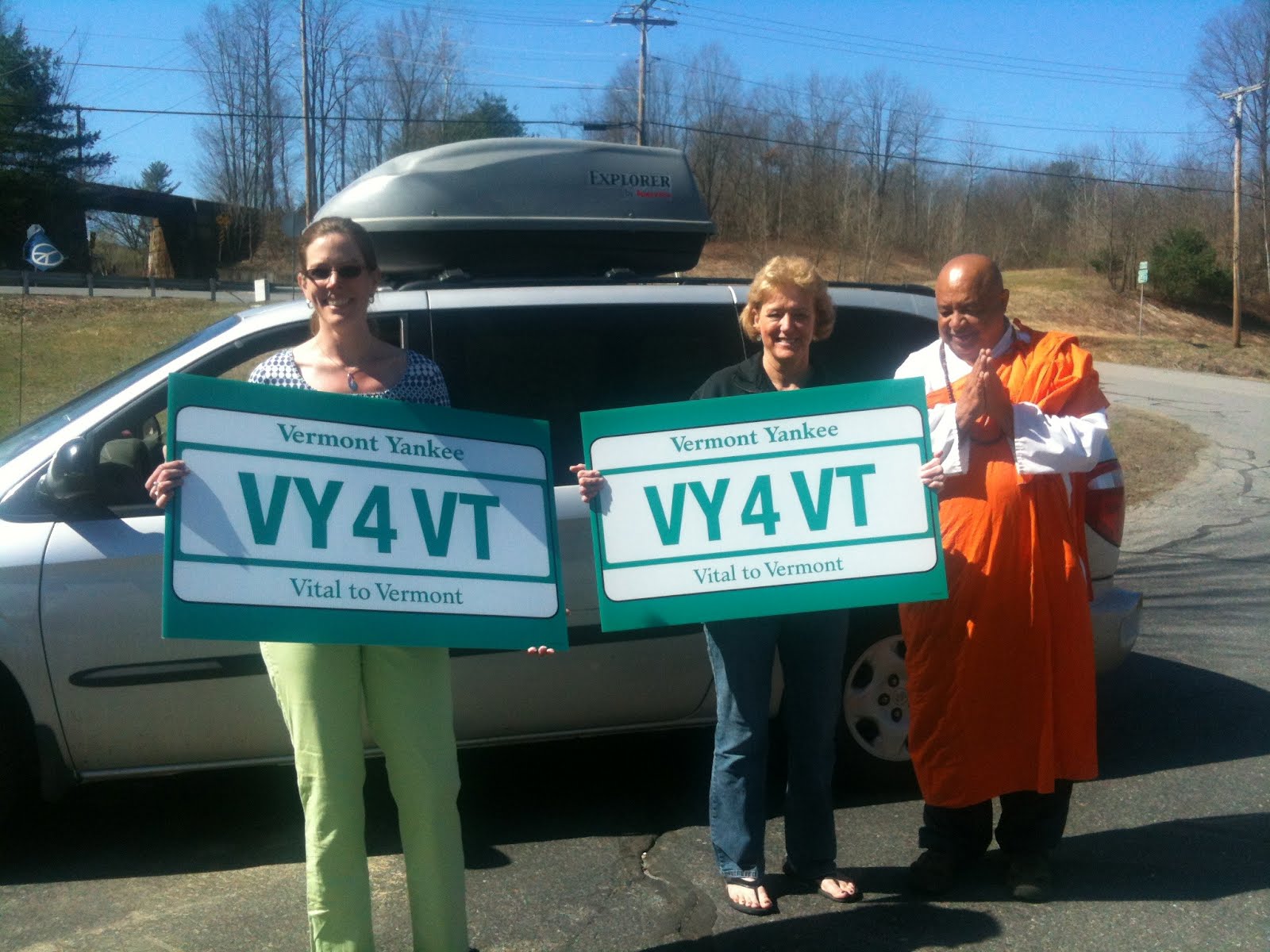
Today, I decided that pictures speak louder than words. Here's a picture of Patty O'Donnell, Ellen Merkle, and a monk from the Peace Pagoda in New York. A group of monks were on a peace-walk or maybe a peace-shuttle between power plants on the East Coast. (The monks didn't walk their whole route, though they called it a Peace Walk.) O'Donnell and Merkle live in Vernon. As the monk walked toward the plant, they saw a photo-op.


Here's a local TV report. The short video includes plant supporter Gwen Shaclumis being interviewed about Entergy. Meanwhile, the opponent rally people call Entergy a "rogue corporation." Who do you believe?

Seeing is believing...