Thankful for Nuclear Power
Everyone can be thankful for the existence of nuclear power. Nuclear provides great quantities of electricity without simultaneously providing dirty air.
In this video, the Asthma Society of Canada testifies in favor of relicensing Bruce Power nuclear plants. In the first part of the video, Mr. Oliphant of the Asthma Society describes the prevalence and health consequences of asthma. The Asthma Society used to focus on helping people manage asthma through medication. It is now taking a more pro-active role by helping society minimize asthma. The Asthma Society encourages technologies that do not lead to dirty air or global warming.
Starting at 5:50 (five minutes, fifty seconds) Oliphant describes how energy choices have health effects, and these effects must be considered. Ontario phased out coal generation: they could not have done this without nuclear power. The last half of the presentation is a strong message of gratitude for the clean air gifts of nuclear power!
Enjoy the video. Enjoy the turkey. Enjoy clean power from nuclear plants!
We all have much to be thankful for. I will also say:
We nuclear advocates especially have a lot to be thankful for. We know that we are making the world a better place.
Showing posts with label testimony. Show all posts
Showing posts with label testimony. Show all posts
Thursday, November 26, 2015


Sunday, January 26, 2014
Supporting State Science Education: PSB Comments by Carlos Pinkham
You can still comment to the Public Service Board
 |
| Science Fair from Wikipedia |
I hope these examples will inspire you to write your own comment to the board. Here's the link for comments.
http://psb.vermont.gov/docketsandprojects/public-comment?docket=7862
Comment by Dr. Carlos Pinkham
 |
| Dr. Carlos Pinkham Making his statement at PSB hearing November 2012 |
VSSMF is an all-volunteer organization. For the past seven of the 10 years the VSSMF has been affiliated with these national and international competitions, EVY has been one of our biggest supporters, providing 6% of our $25,000 annual budget and two to six judges.
Nothing can impact Vermont more significantly than inspiring its youth to get excited about STEM. I propose that for this reason alone, EVY should be granted the amended Certificate of Public Good.
Carlos F. A. Pinkham, PhD
Co-Director, VSSMF
------
Carlos Pinkham is Professor Emeritus of Biology at Norwich University. Courses taught included Environmental Biology. Former Environmental Science Officer and Senior Consultant for Army Reserve and National Guard Preventive Medicine Science Officers.
------
Carlos Pinkham is Professor Emeritus of Biology at Norwich University. Courses taught included Environmental Biology. Former Environmental Science Officer and Senior Consultant for Army Reserve and National Guard Preventive Medicine Science Officers.
Thursday, January 16, 2014
My Comment to the PSB in Support of Vermont Yankee
 |
| Opponents and supporters of Vermont Yankee Court house, Brattleboro Sept 27, 2011 |
There is still time to comment
The Vermont Public Service Board is still accepting comments in favor of granting a Certificate of Public Good for the last few months of Vermont Yankee's operation. Here's the link for your comment: http://psb.vermont.gov/docketsandprojects/public-comment?docket=7862
Meredith Angwin's Comment to the Public Service Board
I am a supporter of Vermont Yankee.
I remember standing on the streets of Brattleboro while the federal court case was underway. I held up my "Vermont Yankee" sign and the opponents held up signs saying "I support Vermont."
In those days, it was "Vermont Yankee" versus "Vermont."
In those days, it was "Vermont Yankee" versus "Vermont."
 |
| Vermont Yankee supporters on Sept 27, 2011 |
Vermont and Vermont Yankee have come to an agreement. This agreement will provide an orderly shut-down of the plant, support for Windham County and plant employees, and an end to lawsuits.
Vermont and Vermont Yankee are on the same side now.
Please support the state agencies of Vermont AND the workers of Vermont Yankee. Grant a Certificate of Public Good based on the state agreement with Vermont Yankee.
Meredith Angwin
Wilder, Vermont
----------
This is one of a series of posts: people's comments to the Public Service Board in favor of granting a Certificate of Public Good (CPG) to Vermont Yankee for its final year of operation.
I hope these posts will inspire you to write YOUR comment to the board. http://psb.vermont.gov/docketsandprojects/public-comment?docket=7862
For more information on the Public Service Board hearings and the Memorandum of Understanding, see the blog post Take Action: Comments to the Public Service Board. It has many links to background information.
Yesterday's post was John McClaughry's excellent comment about whether Entergy could trust the state of Vermont.
Wednesday, January 15, 2014
Can Entergy Trust the State? PSB Comments by John McClaughry
Comments to PSB, Docket 7862, by John McClaughry
The opponents of everything nuclear, and particularly of Vermont Yankee, are out in full throat one more time to persuade this Board that “Entergy can’t be trusted," and that the Board should not issue a CPG for the final ten months of plant operation.
As a pro-nuclear former Senator with no direct personal interest in the outcome, I would like to call your attention to the fact that it is the State of Vermont that can’t be trusted, not Entergy.
The MOU of 2002 between the state and Entergy set out the rules that the two parties would observe. One was that if Entergy wanted to prolong the plant’s operation after March 22, 2012, it would return to this Board to seek a new CPG.
But the 2005-2006 legislature completely changed the process that Entergy was required to follow to obtain a new CPG – and it did so deliberately to inject a political roadblock into what both parties in 2002 expected to be an impartial administrative proceeding before an expert board.
In my view, Act 160 of 2006 constituted a material breach of the 2002 MOU. It allowed a majority of House and Senate to vote a death sentence for Vermont Yankee for whatever reasons, or for no reasons at all, except the political urge to pander to emotional but fact-starved anti-nuclear activists.
Following that breach of trust, Entergy had little choice but to litigate to keep the plant open, which it did, successfully.
Now the anti-nuclear forces are howling about “trust.” I agree that there is an issue of “trust,” but it runs the other way – to the faithless legislature that broke the state’s deal and thereby freed Entergy from what it had agreed to.
My recommendation is for the Board to issue a final CPG for Vermont Yankee to operate through the end of 2014, based upon the latest agreement between Entergy and the State. Then we all can finally put this embarrassing decade of state perfidy and simony behind us.
John McClaughry
Kirby, Vermont
-------
John McClaughry is vice-president and co-founder of the Ethan Allen Institute. I am the director of the Energy Education Project of the Ethan Allen Institute. McClaughry sent me a copy of the comments that he sent to the PSB, and I asked if I could use these comments as a guest post.
--------
The opponents of everything nuclear, and particularly of Vermont Yankee, are out in full throat one more time to persuade this Board that “Entergy can’t be trusted," and that the Board should not issue a CPG for the final ten months of plant operation.
As a pro-nuclear former Senator with no direct personal interest in the outcome, I would like to call your attention to the fact that it is the State of Vermont that can’t be trusted, not Entergy.
The MOU of 2002 between the state and Entergy set out the rules that the two parties would observe. One was that if Entergy wanted to prolong the plant’s operation after March 22, 2012, it would return to this Board to seek a new CPG.
 |
| John McClaughry at a dinner in his honor, 2013 |
But the 2005-2006 legislature completely changed the process that Entergy was required to follow to obtain a new CPG – and it did so deliberately to inject a political roadblock into what both parties in 2002 expected to be an impartial administrative proceeding before an expert board.
In my view, Act 160 of 2006 constituted a material breach of the 2002 MOU. It allowed a majority of House and Senate to vote a death sentence for Vermont Yankee for whatever reasons, or for no reasons at all, except the political urge to pander to emotional but fact-starved anti-nuclear activists.
Following that breach of trust, Entergy had little choice but to litigate to keep the plant open, which it did, successfully.
Now the anti-nuclear forces are howling about “trust.” I agree that there is an issue of “trust,” but it runs the other way – to the faithless legislature that broke the state’s deal and thereby freed Entergy from what it had agreed to.
My recommendation is for the Board to issue a final CPG for Vermont Yankee to operate through the end of 2014, based upon the latest agreement between Entergy and the State. Then we all can finally put this embarrassing decade of state perfidy and simony behind us.
John McClaughry
Kirby, Vermont
-------
John McClaughry is vice-president and co-founder of the Ethan Allen Institute. I am the director of the Energy Education Project of the Ethan Allen Institute. McClaughry sent me a copy of the comments that he sent to the PSB, and I asked if I could use these comments as a guest post.
--------
The PSB is still accepting comments in favor of the plant.
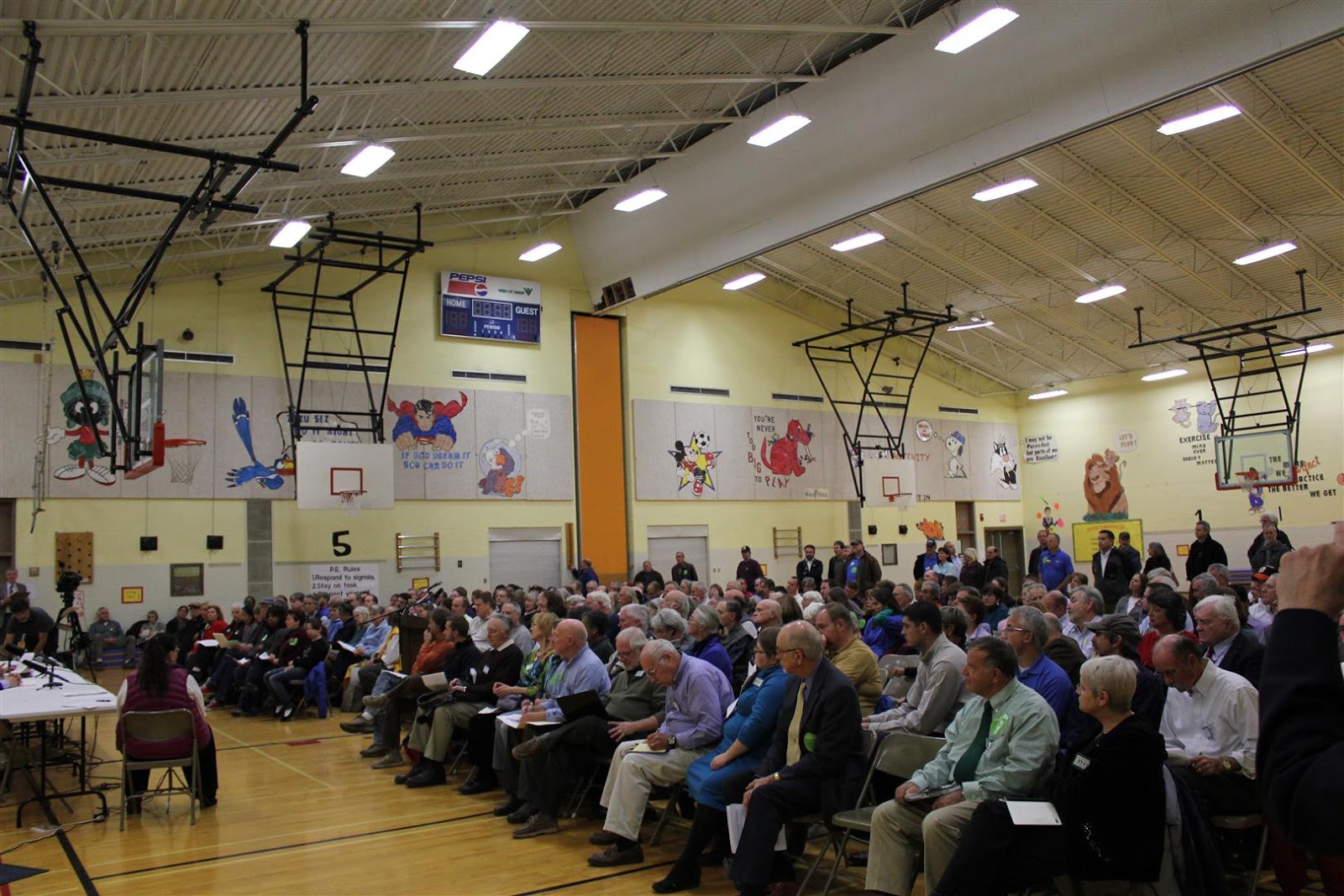 |
PSB hearing Brattleboro
November 2012
|
I encourage readers to take action by emailing comments to the Public Service Board. Here's the link for comments:
For more information on the Public Service Board hearings and the Memorandum of Understanding, see the blog post Take Action: Comments to the Public Service Board.
Tuesday, April 9, 2013
Alternative Energy Siting in Vermont: The Hearing
 The Siting Commission
When the drumbeat of opposition to the industrial wind projects grew loud enough in the fall of 2012, Governor Shumlin created the Governor's Energy Generation Siting Policy Commission by executive order on October 2, 2012. The first sentence of the executive order is that:
Whereas, as set forth in the 2011 Comprehensive Energy Plan and statute, Vermont has recognized the need to increase its energy independence and resilience through the greater use of renewable energy in all sectors;
As many Vermonters see it, this body is supposed to deflect heat from the Public Service Board, which was siting industrial wind projects and riding roughshod over Vermont town land-use planning in order to do so. This new Siting Commission is also allowed to ride roughshod over the town plans, but somehow, we are supposed to like it better. As I noted in a recent post, the Vermont Senate considered a bill requiring stronger environmental review of energy projects, but only passed a gutted bill.
At any rate, the new Commission is holding some public hearings, and I went to one last night. It was an interactive TV hearing, with people attending from all over Vermont. A large crowd was present in the Lyndonville TV studio. Lyndonville is in the Northeast Kingdom (NEK) of Vermont, where the wind projects are being built, despite much local opposition.
 |
| Spillway at Hydro Quebec |
Guy Page of VTEP (Vermont Energy Partnership) spoke. He referenced his recent report that Vermont already gets over 50% of its electricity from sources it considers renewable. Luckily, the Vermont legislature passed a law saying that power from Hydro Quebec is renewable. That sure helped our renewable percentages around here!
Note: I recommend a blog post today by Howard Shaffer about renewable energy in Vermont. Alternative energy in Vermont – Chickens coming home to roost at ANS Nuclear Cafe includes an excellent history of energy controversies in Vermont and a root cause analysis of energy opposition.
I also spoke at the Siting Commission meeting, and my statement is below.
Energy Density and Renewables: My Statement
It is relatively easy to think of people who are opposed to renewable energy projects as NIMBYs, and there may be some of that included in their opposition. However, renewable energy sources have lower energy density than traditional sources (such as fossil fuels and nuclear power). Therefore, renewable projects often require significant use of land.
The book Sustainable Energy Without the Hot Air, written by the carbon-advisor to the British Government, looks at the land use requirements for Britain if it attempted to obtain all its energy through renewables. Similarly, the recent report by the Wilderness Society looks at land-use implications if the Northeast attempts to obtain most of its energy through renewables: Cumulative Landscape Impacts of Renewable Energy Alternatives for Northern New England
If you look at these books and reports, you will see that there are extensive land-use implications to the use of renewables. Towns could be trampled by renewable projects if such projects are considered more important than their own land-use planning processes. I urge you to abide by the planning processes of the towns, and not override them.
 |
| A view in the Northeast Kingdom |
Tuesday, February 26, 2013
Voices for Vermont Yankee: Our New E-Book Supporting the Plant
Announcing the E-Book: Voices for Vermont Yankee
 A new book, Voices for Vermont Yankee, has been written in support of continued operation of the nuclear power plant. Many local people testified in favor of the plant at recent Public Service Board hearings. The book contains 21 statements in favor of the plant, as well as many pictures of the people and the hearing..
Professors, housewives, plant employees, farmers and business people all spoke to support Vermont Yankee. George and Meredith Angwin gathered this testimony and published the book.
Voices for Vermont Yankee makes an important contribution toward balancing the debate about Vermont’s energy future. Much of this debate has been dominated by well-organized groups that oppose the local power plant. In this book, the combined voices of plant supporters make a powerful statement.
The e-book is available at Amazon (Kindle) and at Barnes and Noble (Nook), both at $2.99 You can read it without owning an e-reader: free readers are available for iPad, iPhone, Blackberry, Android, PC, and Mac.
You can order the book by searching the Amazon or Nook store for Voices for Vermont Yankee, or by using these links:
http://amzn.to/VZsLhR at Amazon
http://bit.ly/YVgOVi at Nook
Meredith Angwin is the director of the Energy Education Project of the Ethan Allen Institute. Both George and Meredith Angwin are available for interviews.
----------
This is the press release I just sent out to announce this book.
I'll be talking more about the history of the book, my feelings about the book, and how I hope the book will inspire more people to speak out for nuclear. In later blogs.
For now: Here it is! Enjoy it!

Professors, housewives, plant employees, farmers and business people all spoke to support Vermont Yankee. George and Meredith Angwin gathered this testimony and published the book.
Voices for Vermont Yankee makes an important contribution toward balancing the debate about Vermont’s energy future. Much of this debate has been dominated by well-organized groups that oppose the local power plant. In this book, the combined voices of plant supporters make a powerful statement.
The e-book is available at Amazon (Kindle) and at Barnes and Noble (Nook), both at $2.99 You can read it without owning an e-reader: free readers are available for iPad, iPhone, Blackberry, Android, PC, and Mac.
You can order the book by searching the Amazon or Nook store for Voices for Vermont Yankee, or by using these links:
http://amzn.to/VZsLhR at Amazon
http://bit.ly/YVgOVi at Nook
Meredith Angwin is the director of the Energy Education Project of the Ethan Allen Institute. Both George and Meredith Angwin are available for interviews.
----------
This is the press release I just sent out to announce this book.
I'll be talking more about the history of the book, my feelings about the book, and how I hope the book will inspire more people to speak out for nuclear. In later blogs.
For now: Here it is! Enjoy it!
Monday, July 12, 2010
PSB Update: Send Your Comments

Please send in your comments to the Commissioners. The Public Service Board (PSB) Commissioners are receiving hundreds of comments on docket 7600. This docket proposes to shut down Vermont Yankee immediately. Even up the balance! The opponents have organized campaigns to send comments to the PSB, and we have to send comments also!
You can file a comment using the PSB general Comment Form. Choose "other" from the Drop Down list, and head your comments with the words "Docket 7600."
The Door to the Meeting
The picture above shows the scene near the door of Brattleboro High School on July 8, just before the PSB meeting on Docket 7600. That's me on the left (green shirt, purse). My own picture of the man in the fish costume didn't show all three eyes, but Howard Shaffer was kind enough to send me this picture.
If you double-click on the picture, you can read the sign "Revoke the Certificate of Public Evil." I suspect the fish was part of the Safe and Green Campaign's Fourth of July event, focusing on "radioactive fish." The fact that all fish have only contained background levels of radioactivity doesn't matter much to the foes of the plant. The fish are NOT radioactive, but with a fish costume and a few lies, the facts won't matter.

As I approached, the fish began talking to me. "Hi Meredith," it (he?) said. "See what your tritium has done to me? I have three fins!" (It had three eyes and two fins, actually.) After a few moments banter, the fish said he was going to eat a banana, and I warned him against doing so.
This is the first time a fish has addressed me by name. However, my favorite Mahler symphony includes a movement about St. Anthony talking to the fishes. The fishes hear the Saint's good advice, but don't change their actions.
So I was partially prepared for this conversation.

No News is Still News?
The opponents had nothing new to say. The tritium leak is fixed, the NRC gave the plant a clean bill of health. A heat-wave was raging with power prices up near $150/MWh and the plant was at 100% power, selling by contract at $45 .
What could they say? They said the same old stuff. They said that they are scared of the plant. They SUNG that they are scared of the plant. (Two people sang their testimony.) They brought banners saying No Nukes. Street Theater from top to bottom. No content.
The picture shows a man testifying (I don't know his name). The commisioners are at the front table. You can see John Dunn's back (striped shirt on left). John works at the plant. The woman with the banners is taking a picture. The man with the video camera is the controversial documentary maker, Robbie Leppzer.
The Good News
From my point of view, there were several pieces of good news about the meeting. Sure, the statements of the opponents were repetitive and snore-inducing. How long can you listen to "I'm scared. I'm really really really scared?" I guess, about three hours is the limit.
However, in the good news, more people than usual testified in favor of the plant. I was particularly happy to see a person I had never met speaking up for the plant. As the Sentinel Source reported:
David Garrecht of Guilford, Vt., spoke in support the plant’s operation and said he’s concerned that the plant will be closed early due to pressure from the media and opponents of the plant.Garrecht said he isn’t involved with any of the advocacy groups that have formed in support of or in opposition to nuclear energy generation.“The only connection I have is that I use electricity and I get bothered a little bit when some of the advocates say they’re speaking the public will, because that’s not my will,” he said. “I think that Vermont Yankee ought to continue until it can be replaced in 2032 by a more dense design of clean energy.”
To which I say: Amen.
Wednesday, February 17, 2010
Smiling Sharks at the State House
 A guest post by Howard Shaffer III. He reports on a visit to the Vermont Law School and several visits to the Vermont State House where (surprise surprise) the people who are asked to testify are devoted to closing Vermont Yankee.
SMILING SHARKS IN THE VERMONT STATEHOUSE
Late January events
On January 27th, the Joint Natural Resources and Energy Committees (House and Senate committees) met to hear testimony . The Vermont Energy Education office was the first one to present their information. The Energy Education mission is to look at all sources of energy, and to teach about advantages and disadvantages. Though there are many forms of energy used in this country (for heat, transportation, etc) the presenters only talked about electric power; how it is generated and how it can be conserved. Oddly, they never mentioned steam power generation of any kind. They spoke only of wind and solar.
The next speakers were Beyond Nuclear speakers Kevin Kamps, and Lorriane Rekmans. The announcement describes Ms. Rekmans as follows:
Lorraine Rekmans grew up in the Serpent River First Nation community from Elliot Lake, Ontario. Her community has experienced increased cancers, and devastating environmental damage from exposure as a result of uranium mining.
In Montpelier, Rekmans tried to persuade us that bad uranium mining practices in Canada fifty years ago, adversely affecting indigenous peoples, are somehow a fault of Vermont Yankee. Also, shutting down the plant will correct these mining practices. Or else it was an emotional ploy. I heard Mr. Kamps again, this time with Paul Gunter, the next night in Norwich at a Sierra Club meeting.
Still in Montpelier, though, after the Joint hearing, I briefly attended a Senate Finance Committee hearing where the Department of Public Service reviewed all the issues under consideration. VY was not mentioned. I moved on to the House Natural Resources and Energy Committee where the Gundersens were describing the trail of submissions related to VY's underground piping. The conclusion was the Legislature was misled.
The committee recessed to attend the governor's press conference, where Governor Douglas said VY had lost the trust of the people over the buried piping issue. The Committee then reconvened to hear the rest of the testimony, and do a Q&A. It wasn't pretty. The Chair, Rep. Klein said he is an anti nuke. (No surprise there, since an article containing some biography said he was raised near Indian Point and his parents were suspicious of nuclear.) H He also said that the Legislature is doing the regulator's job (emphasis added) and once a vote is taken the Legislature will be out of the loop.
Early February
On the evening of February 9, there was a meeting about Vermont Yankee at Vermont Law School. The Gundersens were on a panel with Jim Moore of VPIRG and Prof. Don Kreis of the Law School. Mr. Moore had been asked to review some of the Vermont Legislative history of VY and he reviewed it.
The Gundersens discussed the situation at VY and also made a remark that made the NRC sound special and not subject to Congressional oversight. I questioned that. In response to my question about the NRC being like the other regualatory agencies, Mrs. G. said that the Commissioners were in the pocket of the industry.
Prof. Kreis reviewed more of the legal history. During the Q&A he criticized Mrs. G. for disparaging the NRC Commissioner's integrity. He said such smearing is not helpful to the process, having been a Regulator himself.
As part of the legal history review of the VY situation, Prof Kreis said that it is an OPEN QUESTION whether or not the Vermont Legislature can do what is being attempted - block VY's consideration by the Public Service Board for an extension to its Certificate of Public Good., thus keeping the plant from continuing to operate beyond the end of the current certificate, which expires on the same day as the current NRC license. In conversation with him after the program, I raised the issue of the famous Supreme Court case under Justice Marshall in 1810. In this case, the Supreme Court ruled that a following Legislature can't pass a law negating contracts with the State which were approved by a preceding Legislature. He said the Law School has a contract with the Legislature to provide advice on these matters, and could not say more. I said I understood. The moderator of the Q&A period, Prof Mears said all the lawyers expect the VY issue to wind up in court.
On February 10, I was back in Montpelier for a session of the the House Natural Resources and Energy Committee. They had chosen to have Mr. Ray Shadis, a well-known antinuclear activist testify by phone on the nuclear fuel cycle. I learned that all mining problems are a reason to shut down VY and that thorium is fissionable!!
Next on the agenda was a Senate Natural Resources and Energy Committee hearing. I have attended many different committee hearings over the past years while tracking and learning about the Vermont Yankee and energy issues. This hearing was moved from the committee's small room to a larger hearing room. On deck were Arnie and Maggie Gundersen to enlighten all about the VY situation. WCAX-TV was set up to tape the entire testimony, which was linked to a Burlington Free Press article that day. See an earlier post on this blog to watch the testimony. Better than that, read a good review of the testimony at Is Arnie Gundersen Devious or Dumb.
Before the hearing on February 10 with the Gundersens, I spoke to one of VY's Lobbyists, from a Montpelier firm. I said it looked to me like sharks circling in the water, but he has probably seen it before. He said yes, but never this bad. The sharks were smiling too.
Saturday, February 13, 2010
Biff! Bam!! Pow!!! And Food for Thought
I have been too busy to blog recently, and I fear that may look like I am dodging the tritium issue. From my point of view, there is nothing substantially new on tritium. Various governors and so forth are calling for further oversight and investigations, Vermont Yankee continues to dig and monitor wells, NRC says it is no big deal. (I agree with NRC. See my lengthy posts on tritium and health, tritium and kale, etc etc etc.) In other words: same-old, same-old.
However, in the interest of keeping the blog fresh, I want to share two things. Both inflammatory. So my readers can have some fun. Quote without comment. I hope to comment tomorrow.
The first thing I want to share is some testimony by Arnie and Maggie Gundersen on the tritium issue. In this testimony, Arnie Gundersen concludes that Vermont Yankee is either "devious or dumb" and comes within a hairsbreadth of accusing twelve people at VY of lying. I can't find a transcript of this, but I do have this one-hour video from Burlington Free Press, and I embed it here. The part about devious or dumb is near the end.
Now, as Rod Adams notes in his blog about devious and dumb: "Dem's fighting words!" So here's Rod's blog on the subject.
Is Arnie Gundersen Devious or Dumb? (Or is He Simply a Professional Fear-Monger?)
I think my nuclear friends outside of Vermont may have seen Rod's blog but not Gundersen's testimony. My Vermont friends may have seen Gundersen's testimony but not all of them will have seen Rod's response. (By the way, the comments on Rod's post are also worth reading).
So I'm not taking the lazy way out about blogging today. I'm building bridges.
However, in the interest of keeping the blog fresh, I want to share two things. Both inflammatory. So my readers can have some fun. Quote without comment. I hope to comment tomorrow.
The first thing I want to share is some testimony by Arnie and Maggie Gundersen on the tritium issue. In this testimony, Arnie Gundersen concludes that Vermont Yankee is either "devious or dumb" and comes within a hairsbreadth of accusing twelve people at VY of lying. I can't find a transcript of this, but I do have this one-hour video from Burlington Free Press, and I embed it here. The part about devious or dumb is near the end.
Watch live streaming video from bfp_news at livestream.com
Now, as Rod Adams notes in his blog about devious and dumb: "Dem's fighting words!" So here's Rod's blog on the subject.
Is Arnie Gundersen Devious or Dumb? (Or is He Simply a Professional Fear-Monger?)
I think my nuclear friends outside of Vermont may have seen Rod's blog but not Gundersen's testimony. My Vermont friends may have seen Gundersen's testimony but not all of them will have seen Rod's response. (By the way, the comments on Rod's post are also worth reading).
So I'm not taking the lazy way out about blogging today. I'm building bridges.
Thursday, February 4, 2010
Piping and Misinformation
Did people at Entergy lie under oath and deliberately mislead regulators? (The third of the three tritium questions.)
A long post on an important subject.
In my previous post, I made a case for honest communication errors as the source of the "misinformation" that Entergy provided the regulators. I pointed out the lax use of the terms underground and buried in testimony, and described how it could have affected the questions and answers. Not everyone will agree with my conclusion. The anti-Vermont Yankee explanation would still be an unqualified "They lied!!" Anti-s would say that the plant had a motivation for lying: They claim that if Entergy admitted to underground pipes carrying radioactive material, regulators would expect clean-up to be more expensive, and they would require Entergy to put more money in the decommissioning fund.
I have stated my opinion that the plant representatives didn't lie, but rather that there were serious miscommunications about terminology. I am sure I can't convince everyone, but I have convinced myself. But there is still more.
Something is missing. Something big is missing. Nobody is covered with roses in this story, true enough. But, to be blunt about it, there's a whole lot of missing information and I think some of it is missing testimony.
As I noted in my previous post, The Times Argus put together a timeline. This timeline covered questions asked and answers received. Most of the timeline is taken from Arnie Gundersen's testimony on January 27 before the House Committee on Natural Resources and Energy. Gundersen's testimony is public record and Gundersen was kind enough to send an electronic copy to Howard Shaffer, who forwarded it to me.
Some examples of missing information.
In May, as described before, Jay Thayer answered a question about underground piping by saying he would get back to the regulators. He did not get back to the regulators. He didn't follow up. (He should have followed up.)
Neither did the regulators. They never asked him again, as far as I know. (They should have followed up.)
Another example, On July 24, 2009, Gundersen wrote an email to Public Service Board Commissioner O'Brien. In the email, Gundersen asks:
After a certain amount of to-and-fro (this question isn't for the Public Service Board, it should be answered directly by the plant, etc.) Entergy answered, according to Gundersen's testimony.
On August 13, 2009, Entergy Legislative Liaison Dave McElwee emailed Gundersen:
Okay. In May, Jay Thayer said he didn't think the plant had that sort of piping, and he would get back to the regulators. Later, in August, Gundersen asked about underground piping and Entergy answered "We haven't got any." Apparently that was the end of that exchange, also. (A month later Gundersen did ask about the storm drains at the plant.)
I find these exchanges mystifying. When you ask a question, the person answering it may understand the question, mis-understand the question, answer the question truthfully, or lie. All these are possibilities in all human exchanges. If Entergy didn't understand the questions, or if Entergy was lying, the various committees of the legislature had an obligation to find out the truth.
And what happened? They didn't bother, as far as I can tell.
A huge portion of this story is missing. In all this testimony, nobody asks for the piping drawings. People send emails or ask questions: "Do you have such piping?" They get answers: "Nope." Nobody ever asks to see a diagram.
Yet there was an ISA (Independent Safety Assessment), with engineers on the staff. If the people doing that assessment had asked Entergy for a piping diagram and been refused, such a refusal would have been reported in every newspaper in Vermont. ( Maybe every newspaper in the country.) All large industrial facilities have piping diagrams. Any facility regulated by the NRC has a piping diagram. Oversight panels must have been able to ask for and receive these diagrams.
That is the testimony that has not yet been reported. The testimony where they examine the piping diagrams.
The oversight committees seem to be playing games. The question is always: "Do you have such pipes, cross your heart and hope to die?" The question is never: "Thank you, sir. You say you don't have such piping. Can you show us the piping diagrams to confirm this statement?" The question is never: "On examining your piping diagrams, sir, I must disagree with your answer here. I see this, this, and this. The pipes I have indicated are pipes that must be examined."
To me, the exchanges that have been reported to date are like something out of Alice in Wonderland, not an engineering inquiry. Engineering inquiries don't stop at "no we don't" answers when such answers can be verified. Engineering is about verification and drawings and blueprints and pipe diagrams and piping and instrumentation diagrams and...All that stuff.
My feeling is that people in the various state oversight committees and panels, did have access to these diagrams. I simply cannot believe that they did not request and receive complete piping diagrams. The regulators have major egg on their faces for not referring to the diagrams.
Don't get me wrong. Entergy has major egg on its face for its answers. There is no question about that. I think the problem was miscommunication (in which case Entergy should have tried harder to clarify the question). Others may think the issue was outright lying under oath.
Either way, the piping diagrams showed these pipes.
It is self-serving of the regulators to cry "they didn't tell us the truth" when the truth was visible in piping diagrams that had been submitted to their offices. If the regulators and panels didn't request piping diagrams for the whole plant, then we need a more competent group of regulators and panelists, in my opinion. Indeed, if the regulators and panels didn't request the information, or if they didn't examine the information they had requested, there is plenty of egg-on-the-face to go around.
A long post on an important subject.
In my previous post, I made a case for honest communication errors as the source of the "misinformation" that Entergy provided the regulators. I pointed out the lax use of the terms underground and buried in testimony, and described how it could have affected the questions and answers. Not everyone will agree with my conclusion. The anti-Vermont Yankee explanation would still be an unqualified "They lied!!" Anti-s would say that the plant had a motivation for lying: They claim that if Entergy admitted to underground pipes carrying radioactive material, regulators would expect clean-up to be more expensive, and they would require Entergy to put more money in the decommissioning fund.
I have stated my opinion that the plant representatives didn't lie, but rather that there were serious miscommunications about terminology. I am sure I can't convince everyone, but I have convinced myself. But there is still more.
Something is missing. Something big is missing. Nobody is covered with roses in this story, true enough. But, to be blunt about it, there's a whole lot of missing information and I think some of it is missing testimony.
As I noted in my previous post, The Times Argus put together a timeline. This timeline covered questions asked and answers received. Most of the timeline is taken from Arnie Gundersen's testimony on January 27 before the House Committee on Natural Resources and Energy. Gundersen's testimony is public record and Gundersen was kind enough to send an electronic copy to Howard Shaffer, who forwarded it to me.
Some examples of missing information.
In May, as described before, Jay Thayer answered a question about underground piping by saying he would get back to the regulators. He did not get back to the regulators. He didn't follow up. (He should have followed up.)
Neither did the regulators. They never asked him again, as far as I know. (They should have followed up.)
Another example, On July 24, 2009, Gundersen wrote an email to Public Service Board Commissioner O'Brien. In the email, Gundersen asks:
“Could you please ask ENVY to confirm in writing the following SPECIFIC question: "Is there underground piping that carries radioactivity at VY?" If, for some reason, the POP misunderstood NSA and ENVY and there is, in fact, underground piping that carries radioactivity, I would like ENVY to list those underground pipes it is aware of that may contain radioactivity.”(emphasis in the original)
After a certain amount of to-and-fro (this question isn't for the Public Service Board, it should be answered directly by the plant, etc.) Entergy answered, according to Gundersen's testimony.
On August 13, 2009, Entergy Legislative Liaison Dave McElwee emailed Gundersen:
“As for your outstanding question on underground piping goes,....we have none. Since this is not an item active in the review of CRA recommendations, we consider this issue closed.”
Okay. In May, Jay Thayer said he didn't think the plant had that sort of piping, and he would get back to the regulators. Later, in August, Gundersen asked about underground piping and Entergy answered "We haven't got any." Apparently that was the end of that exchange, also. (A month later Gundersen did ask about the storm drains at the plant.)
I find these exchanges mystifying. When you ask a question, the person answering it may understand the question, mis-understand the question, answer the question truthfully, or lie. All these are possibilities in all human exchanges. If Entergy didn't understand the questions, or if Entergy was lying, the various committees of the legislature had an obligation to find out the truth.
And what happened? They didn't bother, as far as I can tell.
A huge portion of this story is missing. In all this testimony, nobody asks for the piping drawings. People send emails or ask questions: "Do you have such piping?" They get answers: "Nope." Nobody ever asks to see a diagram.
Yet there was an ISA (Independent Safety Assessment), with engineers on the staff. If the people doing that assessment had asked Entergy for a piping diagram and been refused, such a refusal would have been reported in every newspaper in Vermont. ( Maybe every newspaper in the country.) All large industrial facilities have piping diagrams. Any facility regulated by the NRC has a piping diagram. Oversight panels must have been able to ask for and receive these diagrams.
That is the testimony that has not yet been reported. The testimony where they examine the piping diagrams.
The oversight committees seem to be playing games. The question is always: "Do you have such pipes, cross your heart and hope to die?" The question is never: "Thank you, sir. You say you don't have such piping. Can you show us the piping diagrams to confirm this statement?" The question is never: "On examining your piping diagrams, sir, I must disagree with your answer here. I see this, this, and this. The pipes I have indicated are pipes that must be examined."
To me, the exchanges that have been reported to date are like something out of Alice in Wonderland, not an engineering inquiry. Engineering inquiries don't stop at "no we don't" answers when such answers can be verified. Engineering is about verification and drawings and blueprints and pipe diagrams and piping and instrumentation diagrams and...All that stuff.
My feeling is that people in the various state oversight committees and panels, did have access to these diagrams. I simply cannot believe that they did not request and receive complete piping diagrams. The regulators have major egg on their faces for not referring to the diagrams.
Don't get me wrong. Entergy has major egg on its face for its answers. There is no question about that. I think the problem was miscommunication (in which case Entergy should have tried harder to clarify the question). Others may think the issue was outright lying under oath.
Either way, the piping diagrams showed these pipes.
It is self-serving of the regulators to cry "they didn't tell us the truth" when the truth was visible in piping diagrams that had been submitted to their offices. If the regulators and panels didn't request piping diagrams for the whole plant, then we need a more competent group of regulators and panelists, in my opinion. Indeed, if the regulators and panels didn't request the information, or if they didn't examine the information they had requested, there is plenty of egg-on-the-face to go around.
Subscribe to:
Posts (Atom)