Showing posts with label NorthStar. Show all posts

Saturday, May 5, 2018

Vermont Yankee Sale: Local groups happy, CLF objects again

Almost Everyone Agrees

Entergy plans to sell Vermont Yankee to NorthStar for decommissioning.  As you can imagine, this plan has led to lots of discussions and hearings, and I have even written a few blog posts about it.

The last time I wrote about this proposed sale was right before the April 12 hearing before the Vermont PUC. (Thursday Meeting on Sale of Vermont Yankee)  In March, all parties (state agencies, Native American tribes, intervenors) signed off on the agreement between Entergy and NorthStar, as detailed by Mike Faher at Vermont Digger. (State, NorthStar strike deal for sale of Vermont Yankee).  At the April 12 hearing, supporters of the sale were clearly in the majority.  Supporters dominate meeting on sale of Vermont Yankee. (Article by Faher)

Oh, did I say "all parties" had signed off on the agreement?  Wrong. My bad. The Conservation Law Foundation refused to sign the agreement. In March, I predicted that CLF would do everything in their power to make the sale fall through.  I was right.

Sleeping Beauty

This reminds me of the Sleeping Beauty fairy tale, where fairies are giving their gifts to a newborn princess, but one fairy feels slighted.  That fairy's gift is a curse: the young princess will prick her finger on a spinning wheel and die. Another fairy partially reverses the curse. The girl will fall asleep for 100 years instead of dying.  Thus begins the story of Sleeping Beauty.

CLF is planning something similar. I don't know if they actually feel slighted, but I think they sure plan to kill the deal. If they succeed, like the girl in Sleeping Beauty, the VY power plant will be in SafStor for many many years. Sixty years. The economic development of the town will sleep for more than a generation.

The people of southern Vermont and the people of Vernon want a clean site and a new employer in Vermont. They are hoping this change will happen soon, not sixty years from now.  But when a powerful creature like CLF feels slighted, what are you going to do? A creature like that can stop time.

She pricked her finger on the spindle
Art by Anne Anderson
Lawyers and Ventures

Okay, all that was just a metaphor.  CLF is not a magical evil creature.  And it is not unstoppable.  Basically, CLF is a not-for-profit law firm (Conservation Law Foundation) and an associated "Ventures" group.

 CLF claims that the companies involved in the VY sale have not released "even a page of their contract to the public."  CLF also admits that they could have read the contract by signing a non-disclosure form, but they claim that such an agreement would be onerous and unnecessary. ( Mike Faher article in Vermont Digger Conservation Law Foundation details Vermont Yankee concerns.)

Transparency and soap

Guy Page, a frequent guest blogger at this blog, has been following the sale closely. Like me, Page cannot understand why CLF (a bunch of lawyers, after all) won't sign a non-disclosure in order to obtain more information about the sale. I will not attempt to equal Page's excellent commentary in Vermont Digger: Where most see opportunity, CLF sees only problems with VY sale.   However, I will quote him.
CLF’s knowledge of NorthStar’s plan is limited, due to its choice not to sign a non-disclosure statement protecting certain contract information. If CLF was truly concerned about transparency, it shouldn’t have soaped its side of the window.
-----
A side note about CLF Ventures

 Aside: I have never understood the relationship between the main CLF and their Ventures.  CLF is a not-for-profit 501c3, and they make their form 990 readily available. 501c3 organizations generally have educational or charitable purposes, which can include advocacy under the "educational" purpose.  

CLF Ventures seems to be a part of the main CLF, and it is described under the Our Focus section of the CLF website. Still, the work CLF does as "Ventures" seems pretty much like the work other law firms do for for-profit companies. For example, here is a quote from the CLF website: "CLF Ventures helps early stage companies gain access to the market through our unique blend of experience. We use private and public networks, our knowledge of the business, market, and regulatory arenas, and our understanding of key gatekeepers to help early stage companies access markets and generate revenues."

Helping companies "generate revenues"? Is this service also a part of the not-for-profit CLF 501c3?  I can't tell from their website: such services may be part of the main CLF, or not. The website doesn't make it easy to understand the relationship between the two (or maybe just one) entities, CLF and CLF Ventures. It is not transparent. End Aside. 


Thursday, April 5, 2018

PUC meeting on decomm April 12


sign from Wikimedia
Vermont PUC hearing on NorthStar sale set for April 12 in Brattleboro

As I described in a previous blog post, Entergy plans to sell Vermont Yankee to NorthStar for decommissioning. Most (but not all) of the intervenors are now supporting this sale. 

The sale must be approved by the Vermont Public Utilities Commission, and the Commission is holding a public hearing on April 12 in Brattleboro. 

Guy Page of Vermont Energy Partnership has a recent op-ed in the Brattleboro Reformer:  Settlement builds foundation for hope at Vermont Yankee.  In this article, he describes how the terms of the settlement will help the Windham County region, and the entire state. My favorite quote from his op-ed:
"For its part, Entergy will contribute an estimated $30 million for site restoration, and also will contribute another $40 million, if needed. 
To its credit, the state did not use the settlement as an ATM machine to fund state programs, as was the practice of some recent administrations."
Supporters, please come!
Guy wrote an email about the meeting to some plant supporters. Here is a partial quote:
The next - and final - Vermont Public Utility Commission (PUC) meeting is scheduled for Thursday, April 12 from 7-9:00 PM at Brattleboro Union High School in the multipurpose room. An informational session will be held prior to the meeting at 6:00 PM.

Please mark your calendars and plan on attending this public hearing. Even though a settlement has been reached, many longtime critics of Vermont Yankee did not participate in the negotiations, and it is likely that they will make their voices heard. The PUC needs to hear from Vernon, Windham County and the rest of Vermont why they support the settlement and why sale of Vermont Yankee to NorthStar is of economic and environmental benefit.
Please attend if you possibly can.

For more information, contact page at vtep.org  
----
Page is a frequent guest blogger at this blog.

(Note: the Vermont Public Service Board has been renamed as the Vermont Public Utility Commission.)

Monday, March 19, 2018

Thursday Meeting on Sale of VY to NorthStar

Sign from Wikipedia
The Plan for the Sale

On Thursday, March 22, the Vermont Nuclear Decommissioning Citizens Advisory Panel (NDCAP)  will meet to discuss the sale of Vermont Yankee from Entergy to NorthStar. On March 2, all the parties to the sale (and all but one of the intervenors) signed off on a Memorandum of Understanding.
This Vermont Digger article by Mike Faher covers the memorandum and  is a little easier to read than the legal document.  State, NorthStar strike deal for sale of Vermont Yankee.

Why is the proposed sale a big deal?  I will attempt to answer that question by answering three subsidiary questions and providing some links.

1) What is this deal about?

Choices After Entergy closed Vermont Yankee, the next step was decommissioning.  Entergy looked at the available funding for decomm, and it proposed that the plant be put in SAFSTOR while the funding grew and the radioactivity of the plant diminished. (SAFSTOR can last for up to 60 years.)  Nobody really liked this idea, but it was financially practical and legal.  Entergy didn't like the plan because Entergy has expertise in running plants, but not in decommissioning them.  The state didn't like it because the plant would be just sitting there, for decades.

Decomm Companies Many other nuclear plant owners have faced this issue, and most have hired a decomm company to do the actual decomm.  This is a little complicated, due to nuclear regulations.  For example, when Exelon planned to decommission the Zion units, it hired the specialist firm EnergySolutions to do the actual work.  However, "hired" is not quite the way it happens.  Exelon transferred the Zion license to EnergySolutions, and EnergySolutions will transfer the license back to Exelon when the decomm is complete. The accumulated decomm funds were transferred with the license.  In effect, EnergySolutions owns Zion temporarily, and is directly responsible to the regulatory agencies during decomm.

The proposed Entergy/ NorthStar deal took this type of deal a step further:  Entergy will sell Vermont Yankee to NorthStar, permanently.

A Sale The sale plan led to a lot of excitement among the local nuclear opponents. A first-of-a-kind transfer (direct sale, not temporary ownership), and happening in Vermont? Oh my! The list of intervenors grew and grew. I felt sorry for both of the companies (Entergy and NorthStar) that had stepped into the morass of Vermont anti-nuclear organizations. These organizations saw this transfer as their last chance to show the world how deeply anti-nuclear they are.  I think they also saw it as their last chance to wring concessions of various types from the companies involved.

Signatures The big deal is that on March 2, all but one of the intervenors signed a Memorandum of Understanding on the terms for the transfer. Basically, Entergy and NorthStar added more bonds and more insurance and more money to the pot, and everyone signed off.  It was not just a win for the intervenors though: the decomm is allowed to use rubbilization, which means using clean debris from building demolition to fill basements.  This had been a huge issue. My blog post from last year contains facts and links, Rubble at Vermont Yankee: Framing the Discussion

Well, everyone signed off on the MOU except Conservation Law Foundation, who felt there wasn't enough money or enough guarantees. CLF predicts that the decomm will run out of money and leave Vermonters on the hook, etc.  My own prediction is that CLF will do everything in their power, including lawsuits, to try to make their prediction come true.  

2) What are  the next steps?

There are quite a few. Vermont State agencies, NorthStar and intervenors have agreed on the MOU, but the state Public Utilities Commission and the Nuclear Regulatory Commission must still rule on it.  Once again, Faher at Vermont Digger has a good article on this: Vermont Yankee sale case will extend into summer.  Within that article, note that Guy Page urges plant supporters to come to the Vermont Public Utilities Commission hearing on April 12.  (Guy Page  of Vermont Energy Partnership is a frequent guest blogger at this blog.)

Guy Page's suggestion about the April meeting leads to an easy segueway into the next question:

3) Should I go to the Thursday NDCAP meeting?

Probably.  NDCAP is an advisory committee, and its meetings are often very informative.  This one will include presentations from Entergy, NorthStar and state officials. The meeting is going to be held at a bigger venue (Brattleboro High School) than usual,  because they expect quite a crowd.  In Brattleboro, "quite a crowd" can be unpleasant, as legions of nuclear opponents come in (sometimes by buses) from Massachusetts and all over Vermont and New Hampshire.  On the other hand, the NDCAP meetings are usually fairly orderly.

As I said in my book, meetings are more civilized when the groups are more even. So I do suggest that you go.

On the other hand, I am not sure I will go. I may have a family visit that interferes.  I may be there, or I may not be there.  That makes it harder for me to write: "Absolutely, go!"

If I possibly can, I will be there.

Tuesday, November 14, 2017

BATNA vs BATNA vs WATTA in Vermont

Students at International Negotiation Tournament
University of Toronto vs. University of Tromso
Wikipedia
Hostage Negotiations

In deciding on issues about Vermont Yankee decommissioning, I hope that the state of Vermont will not be overly influenced by the agendas of anti-nuclear groups. I hope so, but I worry.

For example, the Keene Sentinel wrote a recent editorial urging people to be reasonable about getting Vermont Yankee decommissioned. Among other things, the Sentinel encourages the state to not require a "residential quality" cleanup of the site.  However, the title of the editorial perturbed me:  Hostage negotiations: State regulators need to be strict but reasonable, in VY decommissioning fight. 

Decommissioning "fight"? "Hostage negotiations"? Really?

The editorial itself includes more "hostage" terminology. "At the same time, it’s been disappointing to see how quick NorthStar has been to try to hold the state hostage over the issue. The company certainly has the right to negotiate for the best deal it can get, within safety standards. But NorthStar CEO Scott State has reportedly said he’ll pull out of the deal if the firm doesn’t get its way on the “residential quality” issue —" 

Then I realized ---this is simply a matter of BATNAs.  Not hostages, but BATNAs. (More about BATNAs later.)

At some deep level, the state realizes that it doesn't have much of a BATNA, and this makes it angry.

Now I have to back up and explain what I am talking about. I'll start with the "fight," and on to the BATNAs.

The Fight

Entergy wants to sell Vermont Yankee to a consortium of businesses headed by NorthStar. These companies have expertise in decommissioning, and plan to decommission Vermont Yankee in ten years or so, which would be better for most people than the Entergy plan of letting the plant be in SAFSTOR for sixty years.

However, Entergy and NorthStar need a Certificate of Public Good  from the state in order for Entergy to sell the plant to NorthStar. And the state considers this request to be a "fight."

In general, the state usually wants two things when Entergy needs a certificate of public good.  Money and power, or rather, money and control.

Money: In return for a Certificate of Public Good (CPG), the state usually wants to get some money for projects that the state wants to do. This is standard in Vermont, and perhaps elsewhere.  I consider this sort of request to be a "tribute" payment, and I wrote about this in a post in ANS Nuclear Cafe in 2013: Millions for education. but not one cent for tribute. For example, in the past, Vermont has granted Entergy a CPG after Entergy promised to give money to a fund to help clean up Lake Champlain. You must understand that Lake Champlain is in the northwest portion of Vermont, and Vermont Yankee is in the southeast corner.  They are in different watersheds, too. Entergy funded part of the Lake Champlain cleanup, because the state "asked it" to do so, not because Entergy operations had affected Lake Champlain.

Nowadays, however, Vermont Yankee is shut down. The plant has only one source of money: the decommissioning fund.  The NRC will not allow Entergy to use that fund for random projects, such as cleaning up Lake Champlain. Therefore, the state's ability to get money is limited.

Control:  The state wants control of the Vermont Yankee decommissioning. Control issues include:

  • According to whose rules does the clean-up proceed? 
  • Clean-up the site to "residential standards" or industrial standards?  
  • How deep does NorthStar need to excavate the site?  
  • Can NorthStar rubbilize the existing buildings on site and use them for fill, or must NorthStar haul the building rubble away and buy other rubble for fill
  • Will NorthStar get the site ready for another industry that can provide jobs, or should the area be untouched and fallow, to allow the "earth to heal" for two hundred years? 

The State may take a more or less extreme position on these matters, but there wouldn't be a "fight" if the State were just trying to work out a safe, effective site restoration.

So, now we have the state in one corner, and Entergy/NorthStar in the other corner.  We understand the fight.  But what are those BATNAs?

BATNA versus BATNA

The BATNA concept was introduced in the groundbreaking book on negotiations: Getting to Yes.   Most managers are aware of the concept.

Classic decision tree
A BATNA is the "Best Alternative to Negotiated Agreement" and the negotiator with the strongest BATNA usually "wins" the negotiation.  The negotiator with the strongest BATNA gets a result closer to what he wanted, while the negotiator with the weaker BATNA obtains fewer of his goals.

So what are the BATNAs here?  What are the state's "alternatives?"  What are NorthStar's "alternatives?"

It would seem that the state and NorthStar have each other over a barrel. If the state doesn't give NorthStar a certificate of public good for the sale, NorthStar can't do the project.  If NorthStar considers the state requirements to be too onerous, it can walk away from the project, and the state will be left with a plant that will most probably be in SAFSTOR for decades.  Assuming that both parties want a successful project, which one has the better BATNA?

Well, NorthStar does. NorthStar has the better BATNA.

The NorthStar and Vermont BATNAs

This job would be good for NorthStar, but if the state requirements would cause the company to lose money on the job, it can walk away and bid on a different project instead.  There are plenty of fish in the sea, and plenty of cleanup projects on land. Tens of other possible projects are NorthStar's BATNA.

Meanwhile, the state has only this one power plant, which it wants to see decommissioned promptly.  If the state (or Entergy) had a reasonable chance of seeing several other qualified groups line up to bid on the decommissioning, the state would have a strong BATNA. NorthStar would be just one choice out of many. But the state doesn't have such a BATNA.  There are few companies qualified to do a major decommissioning, and I don't see any of them lining up to work in Vermont. They are mostly busy, and mostly working in other states that don't have the same anti-nuclear (and anti-business) bias.

The state has a weak BATNA.  As a matter of fact, I can't really define it beyond "learn to love SAFSTOR." No matter how thoughtfully and delicately NorthStar mentions its strong BATNA, the state is going to feel "held hostage." The iron laws of negotiation are holding the state hostage. I'm sure it is not comfortable.

BATNA versus WATTA

If you noticed, my discussion of the negotiations had the assumption that both the state and NorthStar would want a speedy and effective decommissioning at Vermont Yankee.  I am not going to mince words here.  There's a set of third parties in this negotiation--the anti-nuclear groups. They have their own agenda. Unfortunately, my experience is that the State of Vermont bows to any pressure exerted by an anti-nuclear group.

The anti-nuclear groups do not want a quick clean-up. As described in a recent commentary in Vermont Digger, one of the opponent groups is eager to see  a very long process. As Amelia Shea writes:
"...the question (is) of how best to protect the residents, the land and the water long into the future from the harbingers of birth defects, cancer and genetic illness. New England Coalition is advocating for intensified environmental stewardship of the site and to let the land lie fallow after the cleanup in order to achieve that goal...."
In other articles, nuclear opponents have suggested that the land lie fallow for 200 years, to "heal" from having the Vermont Yankee plant in place. This "healing" is not measurable: the opponents don't define a criteria for "healed-land".

So the nuclear opponents actually have their own agenda, and their own BATNA. Their BATNA is to encourage WATTA.  Worst Alternative To Technical Accuracy.

For the opponents, the plant spending decades in SAFSTOR is no big deal. They see SAFSTOR as just the beginning  of a several-century process of "healing." The state doesn't have a good BATNA to begin with.  If Vermont bows to the nuclear opponents and their agenda, Vermont may well end up with the plant in SAFSTOR followed by WATTA.

 Optimist

This glass is half full 
The glass is also refillable
I am a natural optimist.  I think hard-working people can make situations work out to a be a win-win, or at least, not a lose-lose.

So I hope Vermont will not end up with WATTA, but rather, Vermont  will work out an acceptable agreement with NorthStar. I hope that Vermont Yankee will be effectively and rapidly decommissioned.

I am an optimist.

Unfortunately, in Vermont, it is easy for an optimist to get disappointed.


Wednesday, June 21, 2017

Vermont Yankee Decomm: In Vermont, Do Not Make Predictions.


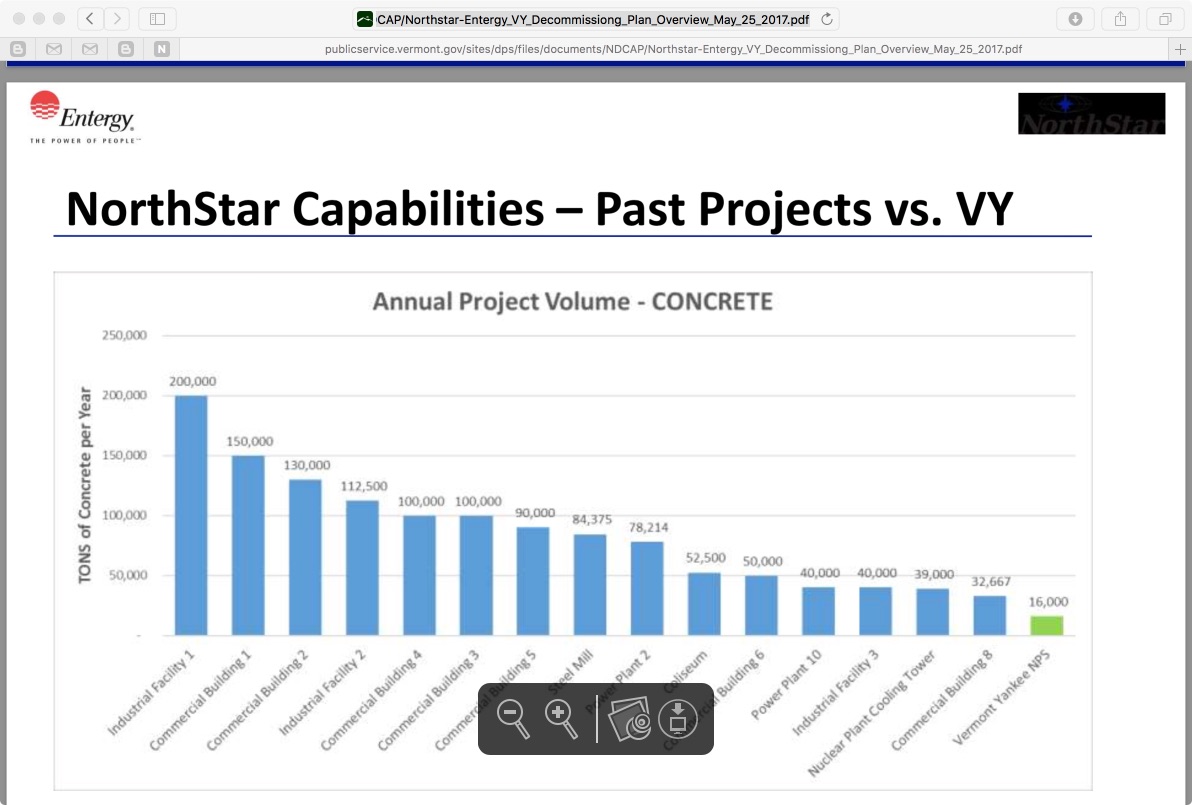
NorthStar Capabilities
From Entergy May 25 presentation
Concrete volume of VY is green bar at the right
This is Vermont.  Do not make predictions.

I'm reading Whiskey Tango Foxtrot. The book was originally called the Taliban Shuffle, but now that the movie is out, it's Whiskey Tango Foxtrot.  As I am reading, I am struck by how author Kim Barker is sometimes utterly dumbfounded by local people's reactions. Men become surprisingly violent after what she considers to be minor incidents, while major problems are greeted with shrugs about "fate." Several of her anecdotes end with her musing something like: "This is Afghanistan: what did I expect?"

Her story is sort of like the story of Vermont Yankee decommissioning.  As I observe the process, I keep getting dumbfounded by what people do.   (At least, nobody is shooting at anyone else.) I explain the situation to myself by musing "This is Vermont; what did I expect?"

The advantages of the NorthStar sale

Entergy has arranged to sell Vermont Yankee to a consortium of decommissioning companies headed by NorthStar. This is unusual, as a matter of fact, it is first-of-a-kind.  Other plants have handed their licenses to a decomm company  (Zion plants and EnergySolutions) with the expectation of getting the licenses back at the end of decomm.  At the end of decomm, the original plant owner is responsible for the site. 

With Vermont Yankee, NorthStar will buy the site, and will own the site.  When the used fuel is removed, NorthStar can sell the site.

The sale to NorthStar is attractive to the state because, if owned by Entergy,  the plant was going to be in SafStor for close to sixty years. In contrast, NorthStar expects to complete decommissioning by 2030.  Similarly, Entergy was going to begin moving fuel into dry casks around 2020.  In contrast, NorthStar expects Entergy to finish the process at that time. (Fuel moving is starting now.) An early article in VTDigger gives the basic story of the sale. 

Last month's NDCAP meeting

I was at the May 25 NDCAP meeting (Nuclear Decommissioning Citizen's Advisory Panel).  NorthStar and Entergy made presentation, and there were public comments.  Here's a link to a video of the May meeting, which was actually pretty civilized.  Though the NRC was there, the meeting was run by NDCAP, and they kept decent order.  In general, the NRC itself does not keep good order at meetings in Vermont, but the NDCAP  meeting shows it can be done.   Many of my comments below stem from the May 25 meeting. If you want to see me speaking at the meeting, I'm at the 1:45 mark, approximately.

There will be a NDCAP meeting tomorrow night at the Governor Hunt House on the Vermont Yankee campus.   I won't be there this time.

NorthStar consortium can decommission Vermont Yankee effectively

After listening to the presentations, I am convinced that NorthStar can decommission the site quickly and relatively inexpensively.  The company has experience with all sorts of sites containing both large structures and environmental disposal issues.  While nuclear opponents think that radiation is very different from any other possible contaminant, companies that actually clean up coal plants and industrial plants know how to deal with all sorts of potential problems.  NorthStar will  treat radiation with respect, but not fear or awe.  Entergy had a slide show at the May 25 meeting: I have stolen their Concrete slide to head this post, and I include the Contaminated Soils slide below.

Contaminated soils volume (VY at right, green bar)
From Entergy May 25, 2017

Of course, the opponents claim, sometimes loudly, and sometimes near tears (watch the video), that radiological contamination is so very different that all of NorthStar's capabilities don't matter. Whatever else NorthStar has done, they have only decommed rather small reactors.  Therefore, according to the opponents, they are not qualified.

This is Vermont.  What did you expect?

Transparency

NorthStar wants to keep some of its costs and overhead structures confidential. The state of Vermont is basically okay with that, but intervenors object vociferously.  

In my statement at NDCAP on May 25, I talked about the time that I tried to track down the costs of different phases of decommissioning for other power plants. I couldn't track the costs I wanted to track. Everyone (the plants, the decomm companies, the NRC) told me that I was trying to obtain proprietary information, and they could not share it.  

Judging by my experience, NorthStar is not being especially opaque. Yet the opponents continue to claim to be upset about transparency.

This is Vermont. What did you expect?

Forever?

Since the Department of Energy still has not set up a plan for picking up used nuclear fuel, the fuel is stored on-site at the power plants. Though the fuel is cooled and in dry casks, it still requires some security, until the Department of Energy picks it up, or until forever, whichever comes first.

When vertically regulated utilities are in charge of taking care of something "forever," this kind of works. Of course, the utility will not necessarily last forever, but if it merges or goes bankrupt, the utility has regulators that will (hopefully) make sure it fulfills its obligations. In the case of a merchant plant (like Vermont Yankee) or a consortium (like NorthStar), no regulator has such a clear obligation. 

Nuclear opponents worry that "the taxpayer" will pick up the bill.  I am sure NorthStar will decomm the plant successfully, so the only bill I imagine the taxpayers might have would be a bill for ongoing security around some dry casks. Not a huge bill, year by year, but a bill.

 I think the problem of paying for security would be about jurisdiction, not safety. This problem is not unique to Vermont. The question of "who is in charge decades later" could happen in any RTO area.  

Yet there is one aspect that is unique to Vermont. One entity, Entergy, is planning to sell the plant to another entity, NorthStar consortium.  As I said at the beginning, this is a First of a Kind financial arrangement for decommissioning. 

My feeling is that since neither entity is supported by being part of a regulated utility, it probably doesn't matter that much. 

But I admit it: This is Vermont, and I don't know what to expect.

Three more issues:  Rubble,  Employees, PSB appointments

This post is too long.  So I will go over these issues rather quickly.

Rubble: Northstar plans to fill the large foundation holes with rubble from the buildings.  This is a standard practice, and far less expensive than trucking the rubble out to disposal and trucking fill in to the site. However,  Entergy said that they would not use this technique, so the opponents attack NorthStar for bad faith in saying they will use the technique.  Well, when you transfer a plant to another company, the other company is not obligated to do everything the same way the former owner said it would do things. It's up to the PSB to decide what needs to be done. Howard Shaffer wrote an excellent letter on this topic, which has appeared in several local papers. 

Employees: I continue to worry about what will happen to Vermont Yankee employees who are near retirement age when NorthStar takes over. See my note at the end of an earlier post. This is an unresolved issue, as far as I know.  

PSB appointments: Governor Scott appointed a new Chairman for the three-person Public Service Board (PSB). The PSB will rule on whether or not Vermont will approve the sale. Governor Scott appointed Anthony Roisman to be chair of the Commission. Roisman is against Big Wind, but some of his cases have been against nuclear plant owners. Roisman has recused himself from the Vermont Yankee decision, which I think was a correct choice.

In Conclusion

This is Vermont.  Don't make predictions.