Thursday, February 16, 2012

Vermont and State's Rights: The Fundamental Problem

The Fundamental Problem Of State's Rights

States that espouse State's Rights in contention against the federal government are also more likely to consider themselves a law unto themselves, and trample on the rights of their own citizens.

David Hume pointed out the fundamental problem with state's rights, though he didn't use the term. Small jurisdictions are more easily captured by "factions and intrigue" which can trample the rights of the citizens. As Hume wrote:

We ... observ(e) the falsehood of the common opinion, that no large state, such as France or Great Britain, could ever be modelled into a commonwealth, but that such a form of government can only take place in a city or small territory. The contrary seems probable...(In a large state) the parts are so distant and remote, that it is very difficult, either by intrigue, prejudice, or passion, to hurry them into any measures against the public interest.

Hume's words were further refined in the Federalist papers, where Hamilton wrote:

Hence, it clearly appears, that the same advantage which a republic has over a democracy, in controlling the effects of faction, is enjoyed by a large over a small republic, -- is enjoyed by the Union over the States composing it....The influence of factious leaders may kindle a flame within their particular States, but will be unable to spread a general conflagration through the other States.

So we have defined the problem philosophically: the potential tyranny of a small state over its citizens, unless checked by a Constitution or by federal powers.

Civil rights were enacted at the Federal level. That wasn't by chance. The Bill of Rights is also at the Federal level. Again, not by chance.

When a state begins stepping on the Constitution, it will soon begin stepping on its citizens.

Hume from Wikipedia

Wednesday, February 15, 2012

Vermont and the Constitution: Three Posts

Vermont and the Constitution

I am working on a blog post about Vermont and State's Rights. Meanwhile, here are three recent articles on related issues.

Geoff Norman at Vermont Tiger. We have abundant evidence that the Vermont legislature repeatedly passes unfair laws that fail the constitutional test. However, the only people who can fight these laws are big companies like Entergy. What does that mean for the ordinary Vermont citizens who do not have resources to fight unfair laws? Read Norman at Grounds for Appeal.

Howard Shaffer at ANS Nuclear Cafe. Howard Shaffer describes the irony of the legislature promoting States Rights while holding press conferences in the Cedar Creek Room. The huge painting in this room commemorates Vermont's important role in the Battle of Cedar Creek during the Civil War. Read Reflections on the Cedar Creek Room.

Tamar Cerafici at ANS Nuclear Cafe. Lawyer Tamar Cerafici describes the ruling and its constitutional grounds. Read Cerafici Let's Find Another Word for Safety--Entergy v. Vermont in plain English.

------

Saturday, February 11, 2012

91st Carnival of Nuclear Energy Blogs: The Vogtle Edition

Yes Vermont Yankee is proud to host the Carnival of Nuclear Energy Blogs this week. This is a great week for nuclear energy: the NRC issued the first license for a new generation of nuclear power plant. Units 3 and 4 at the Vogtle site in Georgia now have a Construction and Operating License. These AP1000 reactors have an advanced design, based on the Westinghouse PWR, but with more passive safety features and less piping.

In honor of this historical occasion, I titled this Carnival The Vogtle Edition. Though the Carnival includes more than one topic, let's start with Vogtle.

The Vogtle Approval Considered Directly

By a 4-1 vote, the NRC opens the door to $14 billion in new construction of two Westinghouse AP1000 nuclear reactors. At the ANS Nuclear Cafe, Dan Yurman breaks down the NRC voting on the Vogtle licenses, the economic impacts, the opposition's next legal moves, and what might be next on the horizon for nuclear energy in the USA as a result.

The Vogtle Approval in Wider Context


Will Davis presents a condensed and simplified history of commercial nuclear energy, complete with a few rare photos, in order to help the mainstream media get the real perspective on the nuclear renaissance.


The Vogtle new build license means 25,000 new jobs in Georgia. That will accelerate the U.S. jobs recovery. Ontario could do the same by restarting the Darlington B process. Thousands of high quality long term jobs east of Toronto would look good in all of Canada.


A big congratulations goes out to all the stakeholders involved in the recently approved new build at the Vogtle site in Georgia. This is great news for the global industry as many countries, including Canada, are undergoing the new build review process. Here's to a balanced and sustainable energy future for North America!

Encouragement for Other New Types of Reactors


Len Koch, whose participation in nuclear energy research started in the 1940s, wrote an open letter to colleagues who are striving to restore interest in the progress that they made in research and development of the Integral Fast Reactor during the period from 1954 to 1994, the year that President Clinton and Hazel O’Leary, his Secretary of Energy, zeroed out all nuclear energy research funding and killed the IFR program.


The U.S. Department of Energy issued on Jan. 20 a draft Funding Opportunity Announcement that would provide $452 million in federal funds over five years to establish cost-sharing agreements with private industry to support the design and licensing of small modular reactors (SMRs).

The DOE money is expected to be eligible for first-of-a-kind engineering, design certification, and Nuclear Regulatory Commission licensing costs. Also, the reactors must be on track to be licensed by the NRC and in commercial development by 2022.

One U.S. firm, TerraPower, which isn't likely to qualify for federal funding, is in negotiations with the Chinese to build a 500 MW sodium cooled fast reactor demonstration unit. TerraPower said that contrary to media reports, Bill Gates did make substantial progress in his trip to China late last year. Gates is a private investor in the company,

China and the Rest of the World


Prime Minister Stephen Harper's recent trip to China proved positive for Canada's uranium industry. Thanks to the successful completion of negotiations between Canada and China, an agreement has been formalized that will increase exports of Canadian uranium to China. This means more jobs and new investments in Canada, and greater security of nuclear fuel supply for China, which is the world’s largest energy consumer.


South Korea, and activity on nuclear restarts in Japan and Germany. The German situation is not clear: they may have restarted coal plants and not nuclear.

Choices: Clean Fuels, Greenwashing, the Sierra Club, and Hiding Behind the Bomb

Clean Fuel by Gail Marcus of Nuke Power Talk

Gail Marcus finds another example of good intentions gone awry. In this case, attempts to use a cleaner fuel prove futile in two-stroke engines in India. The example emphasizes yet again the complexity of energy projections. Simplistic assumptions may give us a distorted impression that achieving some of our energy goals will be easy.


The recent scandal over the Sierra Club's acceptance of millions of dollars from major natural gas extraction companies in the service of its "Beyond Coal" campaign highlights not only the inherent conflicts of interest among environmental groups, but the larger problem of rent-seeking in energy markets writ large. Instead of focusing resources on the development of cheaper and more abundant energy sources, producers are instead investing - both directly and indirectly - in ways to kneecap the opposition, gaming the market through regulations, ultimately at the expense of consumers.


The Vermont Department of Health routinely analyzes fish in the river near Vermont Yankee. When they find trace radionuclides in the fish, plant opponents (including the state governor) become very noisy about the dangers of nuclear power. If plant supporters mention radiation from fallout, plant opponents accuse them of "hiding behind the bomb." Recently, the impasse was broken. The Department of Health analyzed fish from the far north of Vermont, about 150 miles from Vermont Yankee. The northern fish had the same levels of background radioactivity as the Vermont Yankee fish. Angwin includes the history of the trumped-up controversy as well as the fish facts.


In the realm of nuclear energy, the most effective test of the seriousness of objectors is asking simply, "What is your alternative?" A focus on problem-solving, rather than fault-finding, ultimately moots many of the traditional objections to nuclear.


When wind power is the supposed alternative, you should have a copy of Jason Correia's first-class wind power to nuclear power infographic. It's the a first-in-a-series feature at the ANS Nuclear Cafe. The energy density of nuclear vs. wind makes for a very dramatic comparison -- and Jason Correia provides a very enlightening description and discussion of wind and nuclear in their own right. The infographic can be saved as a beautiful poster-sized .pdf!

Charles Barton is Back On Line at Nuclear Green Revolution!

I want to start with some great good news. Charles Barton, steady advocate of advanced reactors, is back on-line! His new post is truly called Return from the Jaws of Death. Barton has been truly near to death (ten days in a coma) and we are all so glad to see him back on-line and back among the living.

With this wonderful news, I will end this Carnival!

----------

Friday, February 10, 2012

The Green Mountain Power Merger: Governor Shumlin and GMP

When Governor Shumlin presented his State of the State speech on January 5, protesters against wind development stood outside the Capital dome. They weren’t just protesting a wind farm, though. They were protesting Shumlin’s overly-close relationship with Green Mountain Power (GMP), the utility that is building the wind development at Lowell Mountain.

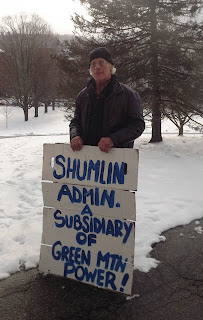
One sign showed Shumlin in bed with big wind. Another sign claimed that the Shumlin administration is a wholly-owned subsidiary of Green Mountain Power (GMP), the company building the wind farm at Lowell.

Why were the protesters carrying these signs? They noticed that there appears to be an overly close relationship between GMP and the Shumlin administration. However, the potential dangers of such a close relationship go far beyond the Lowell Mountain concerns. As reported in a previous article at True North reports, Who Owns the Infrastructure, and reprinted on this blog GMP is poised to take over the majority of Vermont’s energy infrastructure.

They will control most of the electricity merger through an upcoming merger with Central Vermont Public Service (CVPS) and subsequent control of Vermont’s transmission infrastructure. Meanwhile, the parent company of GMP is Gaz Metro of Quebec. Gaz Metro owns Vermont Gas Systems, and plans to expand the gas pipeline deeper into Vermont. A single Canadian company, Gaz Metro, is poised to own most of the gas and electrical infrastructure in Vermont.

Conflict of Interest

The relationship between Shumlin and GMP seems overly close, but can anybody prove it is a problem? Of course not. The reason most organizations (especially government organizations) avoid even the appearance of conflict of interest is that even the appearance makes decisions suspect. With conflict of interest in the background, decisions may appear biased. There is no way to prove they were fair.

While realizing that conflicts of interest are impossible to prove, we can examine the relationship between Shumlin’s administration and Green Mountain Power.

The Inaugural Ball

Green Mountain Power’s CEO Mary Powell is a strong supporter of Governor Shumlin. For example, Powell was responsible for raising the funds for Shumlin's inaugural ball.

In two posts in the 7 Days poltical blog, Shay Totten described Powell’s role in raising money for the inaugural ball. He then described how the Agency of Natural Resources (ANR) suddenly looked more favorably on ridge-line development after Shumlin took office. After the inauguration, ANR gave a go-ahead to the project despite continuing concerns about high-elevation wetlands. Before Shumlin took office, ANR scientists had said there was no way to offset the environmental effects of the wind farm development.

Wetlands and Money

For a graphic portrayal of some of the environmental issues, I recommend this video by Energize Vermont.

Why did ANR give permission for the Lowell Mountain wind farm before major environmental issues were addressed? As it happens, Green Mountain Power will lose $40 million dollars in federal tax credits if they don’t complete the project by the end of 2012. GMP’s parent company, Gaz Metro, has only $160 million a year in profits (all divisions). The United States tax credits are very significant to Gaz Metro’s bottom line.

Many environmental groups feel the Public Service Board (PSB) decision on the project was rushed and the PSB was overly influenced by the thought that GMP would lose money if they did not approve the construction.

As Energize Vermont's Lukas Snelling said in July: "The PSB and ANR must not allow GMP’s financially-driven construction schedule to undercut their obligation to protect the environment and provide all parties a say in the review process."

A Wholly-Owned Wind Farm

Green Mountain Power is building the Lowell Mountain project and will own it. In most cases, distribution utilities such as GMP buy power from other companies that own the power plants. However, in Vermont, distribution utilities are allowed to own power plants. Vermont has many small utilities and co-operatives that might disappear if they couldn’t own both the power plants and the distribution systems.

However, the post-merger Green Mountain Power will be an almost-monopolistic company in terms of distribution. For a company like this to own a power production facility could be considered a step backwards in terms of utility governance.

Natural Gas and GMP

GMP is owned by a gas company, Gaz Metro. Gas and wind are a natural pairing. Wind farms have about 35% capacity factor at best, and must be backed up with a type of power that can come on-line quickly when the wind dies down. Wind energy is usually backed up with simple cycle gas turbines: these operate like a jet engine, coming on-line very rapidly. No power plant that raises steam can come on-line quickly enough to back up wind energy. Coal, nuclear and biomass plants all raise steam and cannot back up wind energy.

It is Named Gaz Metro

As a matter of fact, the wind turbine will be “backed up” is a bit of a misstatement. Since the wind turbine will only operate about one third of the time (35% capacity factor), two-thirds of the electricity will come from the “back-up” facility. In other words, build a wind turbine, and and the back-up gas plant will provide twice as much electricity as the wind turbine provides.

Gaz Metro plans to bring its gas pipeline down to Rutland. It can perhaps put in a gas-fired power plant to back up the wind turbines that GMP (another Gaz Metro company) builds or encourages. The Comprehensive Energy Plan ecourages gas fired power plants.

As Guy Page of VTEP said, the new Comprehensive Vermont Energy Plan “talks a lot about building…medium sized natural gas plants.” The Comprehensive Energy Plan was put together very quickly, over the space of a few months, by Governor Shumlin's administration.

Wind and Gas and Robert Kennedy Jr.

The gas industry recognizes that wind can encourage natural gas use for electricity generation. For example, in a 2010 speech to a Colorado Oil and Gas Industry convention, Robert Kennedy Jr. describes his work on encouraging renewables. He ends the speech with a crowd-pleasing statement: “The plants we are building, the wind plants and the solar plants, are gas plants.”


Probable Changes in Vermont Energy, After the Merger

In short, if the administration favors GMP and encourages the merger (which they are doing), Vermont will have its infrastructure run by a foreign utility. Vermont will encourage the mixture of wind turbines and gas power plants that are very profitable for that utility. This is a long way from the situation we have now, where the large distribution utilities do not own power plants.

There are many reasons to think this situation will be worse for Vermont ratepayers than the current situation. The Vermont Public Service Board (PSB) and Department of Public Service (DPS) are supposed to protect Vermont’s interests. When Vermonters have suspicions about overly cozy relationships between politicians and power companies, these agencies are supposed to protect the consumer. Are the DPS and PSB doing their jobs?

----------------------------

The pictures of Lowell Mountain Protesters at the State of the State speech were shared by the writers of the Lowell Mountain News blog. For more information on that controversy, go to the blog
Note that the Lowell Mountain bloggers were very generous. They did not see this post before agreeing to share their pictures. Their loan of the pictures does not mean endorsement of the contents of this post.


Rod Adams blog, with a more extended video of Robert Kennedy Jr and more context on his statement: http://atomicinsights.com/2010/11/robert-f-kennedy-jr-tells-the-colorado-oil-and-gas-association-that-wind-and-solar-plants-are-gas-plants.html


This post is the second in a series. The first was Gaz Metro: Who Owns the Vermont Infrastructure.

I wrote this post for True North Reports. I am grateful for the opportunity to reprint in this blog.

Thursday, February 9, 2012

The Commerce Clause, the Role of Vermont Yankee, and the Troubles with NRC Meetings

I rarely do a post which is mostly about links to other sources, but here goes. Three important articles, none written by me.

The Commerce Clause and the Shakedown Attempts: When I read the Judge's ruling, I was astounded at the directly-illegal stuff that the Vermont legislature did. As Cavan Stone noted in his guest post on the Control-H defense: what kind of legislature goes on the record with a statement with "Okay, we have to find another word for safety"?

That's all about the pre-emption part of the ruling.

Then there's the part of the ruling about the commerce clause. John McClaughry quotes from the Judge's ruling on that section. The legislature wrote letters to Entergy that could have been written by an assistant to the Godfather. It was basically a shakedown of Entergy. Read McClaughry's post: The Other Part of the Yankee Decision. Reading his post is like watching a gangster movie.


A Victory For Vermonters: The local headlines on the ruling tended to be statements like "A Stinging Defeat." In True North Reports, Guy Page explains why the Murtha Decision was a Victory for Vermonters. Workers, ratepayers and the environment all benefit. He puts Vermont Yankee in context with Vermont power needs, Vermont revenues, ISO-NE and grid stability. A very rational report.

NRC Public Meetings Need Improvement. In July, I wrote about the difficulties of getting on the agenda to speak at the NRC meeting in Brattleboro. Yesterday, at ANS Nuclear Cafe, Suzanne Hobbs Baker wrote of attending an NRC meeting in South Carolina. Her experience had many similarities to my experience in Brattleboro. The NRC has got to make some improvements about how they sign up speakers! Read How to Survive an NRC Public Meeting, and read the comments, too.

BREAKING NEWS AND A FOURTH LINK:

VOGTLE REACTORS APPROVED BY NRC TODAY!

--------
For the record: I head the Energy Education Project of the Ethan Allen Institute in Vermont, and John McClaughry is vice-president of that Institute.

Wednesday, February 8, 2012

Sunny News about Fish and Vermont Yankee

All fish are radioactive. South Vermont fish, North Vermont fish, all fish.

The Vermont Department of Health (DOH) periodically tests radiation levels of fish in the Connecticut River. They always find background levels of radioactive strontium and cesium in the fish. Meanwhile, the opponents always say that Vermont Yankee contaminated the fish.

In the past two days, the DOH has announced test results of fish from the far north of Vermont, far from Vermont Yankee. The fish had the same level of radioactivity as the fish near the plant. Background levels.

The Northern Fish

Both the Brattleboro Reformer and the Burlington Free Press posted stories about the measurements of the northern fish.

Here's a quote from the Reformer: "The results are that cesium-137 and strontium-90 in Lake Carmi fish is in the same range as Connecticut River fish," said Irwin. "We take this as some evidence that all fish in Vermont are likely to have radioactive cesium and strontium at these levels and that, as we've hypothesized, it is from nuclear weapons fallout and the releases of Chernobyl. All of us are glad to have proof and not just conjecture."
....
"There's no danger in eating the fish," said Irwin. "Should we ever find that there are reasons to restrict diet from any sampling for any kind of radioactive or toxicological events, we would keep in mind different cultures have different diets."

(Bill Irwin is the radiological safety officer of the Vermont Department of Health)

In the Burlington Free Press, David Deen, a long-time foe of the plant acknowledged, however, that if future samples remain consistent, then Vermont Yankee officials were right that the plant was not the source of the strontium 90.

A Partial History of Fish Scares

Claiming radioactivity in the fish is due to the power plant is a well-worn tactic. In 2010, when strontium was detected in a fish from the Connecticut River, the nuclear opponents made this a centerpiece of their marches. Maggie Gundersen said that people should "throw the fish back" and not eat Connecticut River fish. Her husband, Arnie Gundersen, said they were finding radioactive fish near the plant but "blaming the bomb." In other words, he implied that Vermont Yankee was saying the fish had merely background radiation, but that was just a way to avoid acknowledging that it was Vermont Yankee's fault. My blog post It's the Nukes What Gets the Blame describes these events.

In 2011, there was another fish with strontium. Governor Shumlin said he wouldn't eat fish from the Connecticut River because of the strontium in this fish. Meanwhile the head of the Vermont Department of Health contradicted him, saying the fish was safe and the levels were low. I have a video of this press conference in the post That Strontium Fish in the Connecticut River. Later, Lochbaum and Markey weighed in on the side of the governor. I blogged about their assertions, also. They exaggerate.

Potassium and Strontium

In a wonderful guest post, Richard Schmidt compared the relative dangers of strontium, mercury, and naturally-radioactive potassium in the fish. In his post What is the Real Impact? Richard Schmidt on Strontium, Mercury and Potassium in Fish, Schmidt points out that 2 % of the radioactivity in the fish comes from strontium, and the rest comes from natural potassium.

Yesterday, the Brattleboro Reformer said pretty much the same thing. In the Reformer: In the same analyses, the fish had almost 500 times more potassium-40 in them than they do cesium-137, [Irwin] said. Potassium-40 is a naturally occurring radioactive material that is in nearly everything and was created when the planet was formed billions of years ago, said Irwin.

In other words, the natural radioactivity in the fish swamps any man-made sources of radioactivity.

It is safe to eat the fish. The fish in the north of Vermont. The fish near the plant. All the fish.

The Bomb: Not Banned Soon Enough

Where did all that strontium come from? It came from atmospheric testing of nuclear weapons. Fallout is real. Fallout measurements are not something a power plant "hides behind." Though the atmospheric test ban treaty in 1963 stopped most of bomb testing, there have been 2000 bomb tests.

On this video, you can see the accelerated rate of testing through the early 60s.


-----------
Picture at the head of the post shows me approaching Blinky the fish outside a Public Service Board meeting in July 2010. I have the light-green top and black purse: Blinky has three eyes. Picture by Howard Shaffer, published in earlier blog post.

Tuesday, February 7, 2012

Vermont Yankee and the Public Service Board: Will the PSB Release the Determination or Hold New Hearings

As I noted in an earlier post, Judge Murtha's recent ruling means that Vermont Yankee needs to apply for a Certificate of Public Good from the Public Service Board (PSB). An over-simplification of the Judge's ruling might be:
All those junk laws that the legislature passed in 2006 are not constitutional. The Memorandum of Understanding holds and the PSB must rule on the Certificate. And the PSB can't consider radiological safety or insist on below-market power prices for Vermont utilities.

The PSB must rule, but in what time-frame and on what grounds?


March 21 is not a deadline for the PSB

The first question that came up was whether Vermont Yankee needs this Certificate from the Public Service Board by March 21, when the old certificate expires. The answer is "no." The Public Service Board can take as much time as it wants: the current certificate remains in effect until it rules. As the Judge wrote: Furthermore, Vermont law provides that a license subject to an agency’s notice and hearing requirements does not expire until a final determination on an application for renewal has been made.

Will the PSB hold more hearings?

The PSB does not have a deadline, and it is not clear whether future hearings will be required. The PSB might just issue a ruling.

Back at the time of the infamous Senate vote, in early 2010, the PSB was no longer holding hearings on the Vermont Yankee certificate renewal. The rumor was that the PSB had gathered all the information they needed for their determination about a certificate. However, the Vermont legislative actions (now overturned) meant the PSB could not release their ruling at that time.

I call this a rumor because the PSB made no public announcement that "we have ceased to hold hearings on this docket." On the other hand, they weren't holding any hearings. As you can see by the PSB website for the relicensing docket, the last hearing was held in May, 2009, with all briefs due to the PSB by August 2009. By late 2009, the PSB was done. They were ready to make a determination.

Will the PSB issue the ruling they prepared in 2009 or early 2010? Or will they re-open the docket to more hearings?

Entergy Wants an Immediate Determination

Entergy filed several requests with the PSB on January 31. The first one asked for an immediate ruling on the Certificate of Public Good, based on the information the PSB had already gathered. The second one asked that the lawyers who represented Entergy in the federal court case be permitted to represent Entergy before the PSB.

The PSB did not grant these requests (so far) but they did set an end date for comments on Entergy's requests. As reported by Terri Hallenbeck of Burlington Free Press, the Public Service Board has asked that comments on Entergy's requests be submitted by March 2. As Hallenbeck writes, you can expect the state and the plant opponents to say the Board should take more testimony before issuing a ruling.

Opinions and the Rule of Law

If you go to the Vermont Digger website opinion section, you can see the usual suspects weighing in with the usual arguments. These arguments are supposedly arguments for more PSB hearings, but gee, they sound so familiar. What about those tritium releases? Entergy is staffed by liars. We must appeal the judge's ruling. It's time for civil disobedience and direct action against the plant. Etc. When I read these screeds, it's almost like the ruling never happened. The opponents are stuck on the same page they were before.

However, actually, things have changed for the better. The PSB is the next step, and the State may also appeal the federal ruling. Yet things have definitely changed for the better. As my husband wrote while I was still in the hospital: The Rule of Law has been affirmed.

------------------
Links to Original Documents: On this blog, I often link to original documents. However, I got tired of chasing links for these documents around the State of Vermont sites, Federal court sites, and so forth. So I put a bunch of relevant Vermont Yankee documents on my own site:
You can link there to the Memorandum of Understanding, the recent Federal ruling, Entergy's request for attorney reimbursement, and January 31 filings by Entergy about the PSB docket. I will add more documents as needed, or by request of my readers.
-----------
Statue of Justice from the Czech Republic. She is holding a book of the law. I have always liked this image better than the traditional "scales" image. The scales don't visually acknowledge that the weighing is not a stand-alone activity, but is done in context of the law.