Showing posts with label Decommissioning. Show all posts

Saturday, May 5, 2018

Vermont Yankee Sale: Local groups happy, CLF objects again

Almost Everyone Agrees

Entergy plans to sell Vermont Yankee to NorthStar for decommissioning.  As you can imagine, this plan has led to lots of discussions and hearings, and I have even written a few blog posts about it.

The last time I wrote about this proposed sale was right before the April 12 hearing before the Vermont PUC. (Thursday Meeting on Sale of Vermont Yankee)  In March, all parties (state agencies, Native American tribes, intervenors) signed off on the agreement between Entergy and NorthStar, as detailed by Mike Faher at Vermont Digger. (State, NorthStar strike deal for sale of Vermont Yankee).  At the April 12 hearing, supporters of the sale were clearly in the majority.  Supporters dominate meeting on sale of Vermont Yankee. (Article by Faher)

Oh, did I say "all parties" had signed off on the agreement?  Wrong. My bad. The Conservation Law Foundation refused to sign the agreement. In March, I predicted that CLF would do everything in their power to make the sale fall through.  I was right.

Sleeping Beauty

This reminds me of the Sleeping Beauty fairy tale, where fairies are giving their gifts to a newborn princess, but one fairy feels slighted.  That fairy's gift is a curse: the young princess will prick her finger on a spinning wheel and die. Another fairy partially reverses the curse. The girl will fall asleep for 100 years instead of dying.  Thus begins the story of Sleeping Beauty.

CLF is planning something similar. I don't know if they actually feel slighted, but I think they sure plan to kill the deal. If they succeed, like the girl in Sleeping Beauty, the VY power plant will be in SafStor for many many years. Sixty years. The economic development of the town will sleep for more than a generation.

The people of southern Vermont and the people of Vernon want a clean site and a new employer in Vermont. They are hoping this change will happen soon, not sixty years from now.  But when a powerful creature like CLF feels slighted, what are you going to do? A creature like that can stop time.

She pricked her finger on the spindle
Art by Anne Anderson
Lawyers and Ventures

Okay, all that was just a metaphor.  CLF is not a magical evil creature.  And it is not unstoppable.  Basically, CLF is a not-for-profit law firm (Conservation Law Foundation) and an associated "Ventures" group.

 CLF claims that the companies involved in the VY sale have not released "even a page of their contract to the public."  CLF also admits that they could have read the contract by signing a non-disclosure form, but they claim that such an agreement would be onerous and unnecessary. ( Mike Faher article in Vermont Digger Conservation Law Foundation details Vermont Yankee concerns.)

Transparency and soap

Guy Page, a frequent guest blogger at this blog, has been following the sale closely. Like me, Page cannot understand why CLF (a bunch of lawyers, after all) won't sign a non-disclosure in order to obtain more information about the sale. I will not attempt to equal Page's excellent commentary in Vermont Digger: Where most see opportunity, CLF sees only problems with VY sale.   However, I will quote him.
CLF’s knowledge of NorthStar’s plan is limited, due to its choice not to sign a non-disclosure statement protecting certain contract information. If CLF was truly concerned about transparency, it shouldn’t have soaped its side of the window.
-----
A side note about CLF Ventures

 Aside: I have never understood the relationship between the main CLF and their Ventures.  CLF is a not-for-profit 501c3, and they make their form 990 readily available. 501c3 organizations generally have educational or charitable purposes, which can include advocacy under the "educational" purpose.  

CLF Ventures seems to be a part of the main CLF, and it is described under the Our Focus section of the CLF website. Still, the work CLF does as "Ventures" seems pretty much like the work other law firms do for for-profit companies. For example, here is a quote from the CLF website: "CLF Ventures helps early stage companies gain access to the market through our unique blend of experience. We use private and public networks, our knowledge of the business, market, and regulatory arenas, and our understanding of key gatekeepers to help early stage companies access markets and generate revenues."

Helping companies "generate revenues"? Is this service also a part of the not-for-profit CLF 501c3?  I can't tell from their website: such services may be part of the main CLF, or not. The website doesn't make it easy to understand the relationship between the two (or maybe just one) entities, CLF and CLF Ventures. It is not transparent. End Aside. 


Tuesday, November 14, 2017

BATNA vs BATNA vs WATTA in Vermont

Students at International Negotiation Tournament
University of Toronto vs. University of Tromso
Wikipedia
Hostage Negotiations

In deciding on issues about Vermont Yankee decommissioning, I hope that the state of Vermont will not be overly influenced by the agendas of anti-nuclear groups. I hope so, but I worry.

For example, the Keene Sentinel wrote a recent editorial urging people to be reasonable about getting Vermont Yankee decommissioned. Among other things, the Sentinel encourages the state to not require a "residential quality" cleanup of the site.  However, the title of the editorial perturbed me:  Hostage negotiations: State regulators need to be strict but reasonable, in VY decommissioning fight. 

Decommissioning "fight"? "Hostage negotiations"? Really?

The editorial itself includes more "hostage" terminology. "At the same time, it’s been disappointing to see how quick NorthStar has been to try to hold the state hostage over the issue. The company certainly has the right to negotiate for the best deal it can get, within safety standards. But NorthStar CEO Scott State has reportedly said he’ll pull out of the deal if the firm doesn’t get its way on the “residential quality” issue —" 

Then I realized ---this is simply a matter of BATNAs.  Not hostages, but BATNAs. (More about BATNAs later.)

At some deep level, the state realizes that it doesn't have much of a BATNA, and this makes it angry.

Now I have to back up and explain what I am talking about. I'll start with the "fight," and on to the BATNAs.

The Fight

Entergy wants to sell Vermont Yankee to a consortium of businesses headed by NorthStar. These companies have expertise in decommissioning, and plan to decommission Vermont Yankee in ten years or so, which would be better for most people than the Entergy plan of letting the plant be in SAFSTOR for sixty years.

However, Entergy and NorthStar need a Certificate of Public Good  from the state in order for Entergy to sell the plant to NorthStar. And the state considers this request to be a "fight."

In general, the state usually wants two things when Entergy needs a certificate of public good.  Money and power, or rather, money and control.

Money: In return for a Certificate of Public Good (CPG), the state usually wants to get some money for projects that the state wants to do. This is standard in Vermont, and perhaps elsewhere.  I consider this sort of request to be a "tribute" payment, and I wrote about this in a post in ANS Nuclear Cafe in 2013: Millions for education. but not one cent for tribute. For example, in the past, Vermont has granted Entergy a CPG after Entergy promised to give money to a fund to help clean up Lake Champlain. You must understand that Lake Champlain is in the northwest portion of Vermont, and Vermont Yankee is in the southeast corner.  They are in different watersheds, too. Entergy funded part of the Lake Champlain cleanup, because the state "asked it" to do so, not because Entergy operations had affected Lake Champlain.

Nowadays, however, Vermont Yankee is shut down. The plant has only one source of money: the decommissioning fund.  The NRC will not allow Entergy to use that fund for random projects, such as cleaning up Lake Champlain. Therefore, the state's ability to get money is limited.

Control:  The state wants control of the Vermont Yankee decommissioning. Control issues include:

  • According to whose rules does the clean-up proceed? 
  • Clean-up the site to "residential standards" or industrial standards?  
  • How deep does NorthStar need to excavate the site?  
  • Can NorthStar rubbilize the existing buildings on site and use them for fill, or must NorthStar haul the building rubble away and buy other rubble for fill
  • Will NorthStar get the site ready for another industry that can provide jobs, or should the area be untouched and fallow, to allow the "earth to heal" for two hundred years? 

The State may take a more or less extreme position on these matters, but there wouldn't be a "fight" if the State were just trying to work out a safe, effective site restoration.

So, now we have the state in one corner, and Entergy/NorthStar in the other corner.  We understand the fight.  But what are those BATNAs?

BATNA versus BATNA

The BATNA concept was introduced in the groundbreaking book on negotiations: Getting to Yes.   Most managers are aware of the concept.

Classic decision tree
A BATNA is the "Best Alternative to Negotiated Agreement" and the negotiator with the strongest BATNA usually "wins" the negotiation.  The negotiator with the strongest BATNA gets a result closer to what he wanted, while the negotiator with the weaker BATNA obtains fewer of his goals.

So what are the BATNAs here?  What are the state's "alternatives?"  What are NorthStar's "alternatives?"

It would seem that the state and NorthStar have each other over a barrel. If the state doesn't give NorthStar a certificate of public good for the sale, NorthStar can't do the project.  If NorthStar considers the state requirements to be too onerous, it can walk away from the project, and the state will be left with a plant that will most probably be in SAFSTOR for decades.  Assuming that both parties want a successful project, which one has the better BATNA?

Well, NorthStar does. NorthStar has the better BATNA.

The NorthStar and Vermont BATNAs

This job would be good for NorthStar, but if the state requirements would cause the company to lose money on the job, it can walk away and bid on a different project instead.  There are plenty of fish in the sea, and plenty of cleanup projects on land. Tens of other possible projects are NorthStar's BATNA.

Meanwhile, the state has only this one power plant, which it wants to see decommissioned promptly.  If the state (or Entergy) had a reasonable chance of seeing several other qualified groups line up to bid on the decommissioning, the state would have a strong BATNA. NorthStar would be just one choice out of many. But the state doesn't have such a BATNA.  There are few companies qualified to do a major decommissioning, and I don't see any of them lining up to work in Vermont. They are mostly busy, and mostly working in other states that don't have the same anti-nuclear (and anti-business) bias.

The state has a weak BATNA.  As a matter of fact, I can't really define it beyond "learn to love SAFSTOR." No matter how thoughtfully and delicately NorthStar mentions its strong BATNA, the state is going to feel "held hostage." The iron laws of negotiation are holding the state hostage. I'm sure it is not comfortable.

BATNA versus WATTA

If you noticed, my discussion of the negotiations had the assumption that both the state and NorthStar would want a speedy and effective decommissioning at Vermont Yankee.  I am not going to mince words here.  There's a set of third parties in this negotiation--the anti-nuclear groups. They have their own agenda. Unfortunately, my experience is that the State of Vermont bows to any pressure exerted by an anti-nuclear group.

The anti-nuclear groups do not want a quick clean-up. As described in a recent commentary in Vermont Digger, one of the opponent groups is eager to see  a very long process. As Amelia Shea writes:
"...the question (is) of how best to protect the residents, the land and the water long into the future from the harbingers of birth defects, cancer and genetic illness. New England Coalition is advocating for intensified environmental stewardship of the site and to let the land lie fallow after the cleanup in order to achieve that goal...."
In other articles, nuclear opponents have suggested that the land lie fallow for 200 years, to "heal" from having the Vermont Yankee plant in place. This "healing" is not measurable: the opponents don't define a criteria for "healed-land".

So the nuclear opponents actually have their own agenda, and their own BATNA. Their BATNA is to encourage WATTA.  Worst Alternative To Technical Accuracy.

For the opponents, the plant spending decades in SAFSTOR is no big deal. They see SAFSTOR as just the beginning  of a several-century process of "healing." The state doesn't have a good BATNA to begin with.  If Vermont bows to the nuclear opponents and their agenda, Vermont may well end up with the plant in SAFSTOR followed by WATTA.

 Optimist

This glass is half full 
The glass is also refillable
I am a natural optimist.  I think hard-working people can make situations work out to a be a win-win, or at least, not a lose-lose.

So I hope Vermont will not end up with WATTA, but rather, Vermont  will work out an acceptable agreement with NorthStar. I hope that Vermont Yankee will be effectively and rapidly decommissioned.

I am an optimist.

Unfortunately, in Vermont, it is easy for an optimist to get disappointed.


Tuesday, November 7, 2017

Rubble at Vermont Yankee: Framing the Discussion

Vermont Yankee in the good days
The Future of Vermont Yankee

Nuclear opponents continue to attempt to put roadblocks into the Vermont Yankee decommissioning process. They claim that they want a quick, safe process for decomm, but several of them also claim that the land should "heal" for about two hundred years before anything is built there.

Basically, a quick safe process is the very last thing opponents would want, as far as I can tell. A successful  process would show that nuclear decomm is no big deal, and perhaps nuclear opponents should turn their attention to coal ash ponds.

Right now, rubblization is a major issue.  Here's my letter about it.

Framing the Discussion

Dear Editor:

I am well-known as an advocate for nuclear energy. I lost most of my interest in the Vermont Yankee plant after it closed down, and I devoted myself to writing a book about pro-nuclear advocacy. However, in the past six months, I began looking at the issues surrounding the proposed sale of Vermont Yankee to NorthStar.

Since NorthStar's announcement about the proposal to purchase Vermont Yankee, I have attended several public meetings and community briefings, and heard NorthStar CEO Scott State speak. In these meetings, Mr. State has answered the hard questions about about NorthStar's plan to decommission Vermont Yankee in a safe, well managed process over relatively short time frame. State has responded to questions with candor and transparency. For example, I hadn't really understood that the nuclear opponent slogan of "no rubblization" would lead to huge amounts of truck traffic taking rubble away from the site. (Yes, I should have realized this myself.) Mr. State noted that, without rubblization, heavily-loaded construction trucks would constantly pass the elementary school. This would be a safety hazard for parents and children.

Nuclear opponents have effectively framed the discussion to their own personal definitions of safety: their definitions ignore traffic safety and children's safety. Similarly, nuclear opponents are now speaking of letting the site "heal." In other words, they want to remove the Vermont Yankee site from possible use as a commercial site (with jobs) until such time as it meets their non-measurable criteria for "healing."

I'm hopeful the Public Utilities Commission recognizes the tangible safety, economic and environmental benefits of NorthStar's proposal.

Meredith Angwin,
Wilder, VT

This letter has appeared (sometimes with edits) in various newspapers in Vermont and New Hampshire, for example, The Brattleboro Reformer, the Burlington Free Press, the Rutland Herald,  and the Caledonian Record. It has appeared in other newspapers also, but I don't have the links.

------
Additional Reading:
 Rubblization of a road
Wikipedia illustration


Howard Shaffer's letter to the Brattleboro Reformer. Without rubblization, there would be over 4000 truckloads of rubble removed from the site. Specious Objections to the NorthStar Proposal. 

Patty O'Donnell in the Keene Sentinel. Why Wait 60 Years for Economic Benefits?

Guy Page in Seven Days on the....umm....incorrect statements....of nuclear opponents. True NorthStar

Bob Leach in the Times Argus on why Residential Standards are not the appropriate standard for cleanup.

Wikipedia on Rubblization, which is not a new concept.


Wednesday, June 21, 2017

Vermont Yankee Decomm: In Vermont, Do Not Make Predictions.


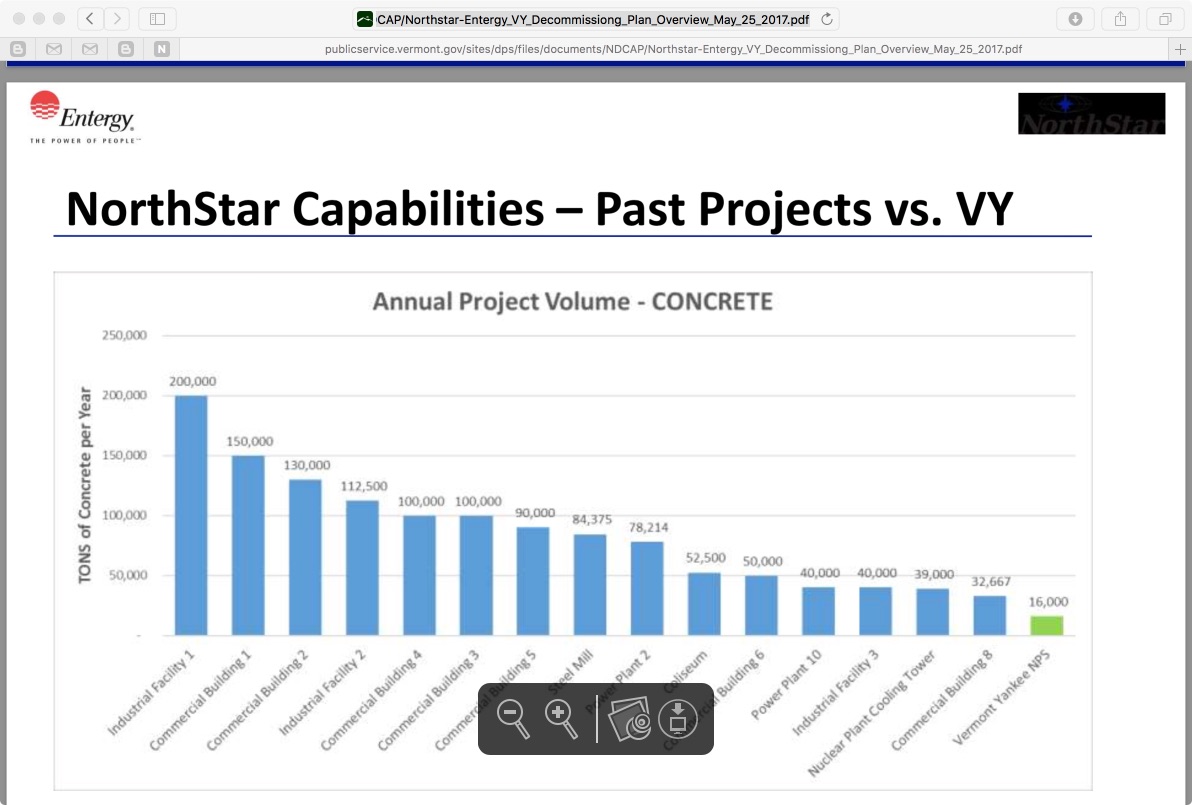
NorthStar Capabilities
From Entergy May 25 presentation
Concrete volume of VY is green bar at the right
This is Vermont.  Do not make predictions.

I'm reading Whiskey Tango Foxtrot. The book was originally called the Taliban Shuffle, but now that the movie is out, it's Whiskey Tango Foxtrot.  As I am reading, I am struck by how author Kim Barker is sometimes utterly dumbfounded by local people's reactions. Men become surprisingly violent after what she considers to be minor incidents, while major problems are greeted with shrugs about "fate." Several of her anecdotes end with her musing something like: "This is Afghanistan: what did I expect?"

Her story is sort of like the story of Vermont Yankee decommissioning.  As I observe the process, I keep getting dumbfounded by what people do.   (At least, nobody is shooting at anyone else.) I explain the situation to myself by musing "This is Vermont; what did I expect?"

The advantages of the NorthStar sale

Entergy has arranged to sell Vermont Yankee to a consortium of decommissioning companies headed by NorthStar. This is unusual, as a matter of fact, it is first-of-a-kind.  Other plants have handed their licenses to a decomm company  (Zion plants and EnergySolutions) with the expectation of getting the licenses back at the end of decomm.  At the end of decomm, the original plant owner is responsible for the site. 

With Vermont Yankee, NorthStar will buy the site, and will own the site.  When the used fuel is removed, NorthStar can sell the site.

The sale to NorthStar is attractive to the state because, if owned by Entergy,  the plant was going to be in SafStor for close to sixty years. In contrast, NorthStar expects to complete decommissioning by 2030.  Similarly, Entergy was going to begin moving fuel into dry casks around 2020.  In contrast, NorthStar expects Entergy to finish the process at that time. (Fuel moving is starting now.) An early article in VTDigger gives the basic story of the sale. 

Last month's NDCAP meeting

I was at the May 25 NDCAP meeting (Nuclear Decommissioning Citizen's Advisory Panel).  NorthStar and Entergy made presentation, and there were public comments.  Here's a link to a video of the May meeting, which was actually pretty civilized.  Though the NRC was there, the meeting was run by NDCAP, and they kept decent order.  In general, the NRC itself does not keep good order at meetings in Vermont, but the NDCAP  meeting shows it can be done.   Many of my comments below stem from the May 25 meeting. If you want to see me speaking at the meeting, I'm at the 1:45 mark, approximately.

There will be a NDCAP meeting tomorrow night at the Governor Hunt House on the Vermont Yankee campus.   I won't be there this time.

NorthStar consortium can decommission Vermont Yankee effectively

After listening to the presentations, I am convinced that NorthStar can decommission the site quickly and relatively inexpensively.  The company has experience with all sorts of sites containing both large structures and environmental disposal issues.  While nuclear opponents think that radiation is very different from any other possible contaminant, companies that actually clean up coal plants and industrial plants know how to deal with all sorts of potential problems.  NorthStar will  treat radiation with respect, but not fear or awe.  Entergy had a slide show at the May 25 meeting: I have stolen their Concrete slide to head this post, and I include the Contaminated Soils slide below.

Contaminated soils volume (VY at right, green bar)
From Entergy May 25, 2017

Of course, the opponents claim, sometimes loudly, and sometimes near tears (watch the video), that radiological contamination is so very different that all of NorthStar's capabilities don't matter. Whatever else NorthStar has done, they have only decommed rather small reactors.  Therefore, according to the opponents, they are not qualified.

This is Vermont.  What did you expect?

Transparency

NorthStar wants to keep some of its costs and overhead structures confidential. The state of Vermont is basically okay with that, but intervenors object vociferously.  

In my statement at NDCAP on May 25, I talked about the time that I tried to track down the costs of different phases of decommissioning for other power plants. I couldn't track the costs I wanted to track. Everyone (the plants, the decomm companies, the NRC) told me that I was trying to obtain proprietary information, and they could not share it.  

Judging by my experience, NorthStar is not being especially opaque. Yet the opponents continue to claim to be upset about transparency.

This is Vermont. What did you expect?

Forever?

Since the Department of Energy still has not set up a plan for picking up used nuclear fuel, the fuel is stored on-site at the power plants. Though the fuel is cooled and in dry casks, it still requires some security, until the Department of Energy picks it up, or until forever, whichever comes first.

When vertically regulated utilities are in charge of taking care of something "forever," this kind of works. Of course, the utility will not necessarily last forever, but if it merges or goes bankrupt, the utility has regulators that will (hopefully) make sure it fulfills its obligations. In the case of a merchant plant (like Vermont Yankee) or a consortium (like NorthStar), no regulator has such a clear obligation. 

Nuclear opponents worry that "the taxpayer" will pick up the bill.  I am sure NorthStar will decomm the plant successfully, so the only bill I imagine the taxpayers might have would be a bill for ongoing security around some dry casks. Not a huge bill, year by year, but a bill.

 I think the problem of paying for security would be about jurisdiction, not safety. This problem is not unique to Vermont. The question of "who is in charge decades later" could happen in any RTO area.  

Yet there is one aspect that is unique to Vermont. One entity, Entergy, is planning to sell the plant to another entity, NorthStar consortium.  As I said at the beginning, this is a First of a Kind financial arrangement for decommissioning. 

My feeling is that since neither entity is supported by being part of a regulated utility, it probably doesn't matter that much. 

But I admit it: This is Vermont, and I don't know what to expect.

Three more issues:  Rubble,  Employees, PSB appointments

This post is too long.  So I will go over these issues rather quickly.

Rubble: Northstar plans to fill the large foundation holes with rubble from the buildings.  This is a standard practice, and far less expensive than trucking the rubble out to disposal and trucking fill in to the site. However,  Entergy said that they would not use this technique, so the opponents attack NorthStar for bad faith in saying they will use the technique.  Well, when you transfer a plant to another company, the other company is not obligated to do everything the same way the former owner said it would do things. It's up to the PSB to decide what needs to be done. Howard Shaffer wrote an excellent letter on this topic, which has appeared in several local papers. 

Employees: I continue to worry about what will happen to Vermont Yankee employees who are near retirement age when NorthStar takes over. See my note at the end of an earlier post. This is an unresolved issue, as far as I know.  

PSB appointments: Governor Scott appointed a new Chairman for the three-person Public Service Board (PSB). The PSB will rule on whether or not Vermont will approve the sale. Governor Scott appointed Anthony Roisman to be chair of the Commission. Roisman is against Big Wind, but some of his cases have been against nuclear plant owners. Roisman has recused himself from the Vermont Yankee decision, which I think was a correct choice.

In Conclusion

This is Vermont.  Don't make predictions.

Monday, February 27, 2017

Sooner Rather Than Later, the NorthStar Decomm Plans: Guy Page Guest Post

NorthStar Decomm of Triga Reactor, Omaha
The advantage to Vermonters of the sale of Vermont Yankee to NorthStar can be summed up this way: sooner rather than later.

As early as 2021, NorthStar, would begin a decade’s worth of decommissioning. By comparison, the original decommissioning plan as prescribed by the U.S. Nuclear Regulatory Commission would begin no sooner than about 20 years from now, and more likely around 2072.

Economic Impact

This advanced schedule means that sooner rather than later, NorthStar’s plan can stimulate broad-based employment and prosperity for retail, food and lodging, housing, and healthcare sectors, as well as government spending on schools, roads, public safety and other vital services in Windham County and throughout the state. Total estimated economic impact: $781 million [Brattle Group study, 12/15/2016].

During regular operations, Vermont Yankee employed over 600 professionals in good-paying jobs. For a five-year period, NorthStar decommissioning will add approximately 1,000 jobs (onsite jobs and secondary spending combined) per year to the local and state economies.

Notably, the funding for decommissioning won’t come from local or state taxpayers, but from the Vermont Yankee Decommissioning Trust Fund, with more than $550 million in asset value. Properly managed with the oversight of the NRC as it has been to date, it will fund the entire decommissioning project, and the funds will begin to be unlocked much sooner with NorthStar.

Northstar Competency

Decommissioning is NorthStar’s core competency as an ongoing business. It has helped decommission more than 300 related projects, including four nuclear power plants in New England. NorthStar has also conducted NRC-approved decommissionings from start to finish for several nuclear reactors at universities and other institutions.

Before it can begin the work, NorthStar must pass the scrutiny of both the Vermont Public Service Board and the U.S. Nuclear Regulatory Commission. The PSB has already opened a docket on the case, and has invited public input through the submission of comments online or through public testimony at two anticipated public meetings this year.

The NorthStar sale also would mean that sooner rather than later, low-level radioactive waste will be safely shipped out-of-state. NorthStar‘s plan to move this material out of state pre-processing – known in the industry as “rip and ship” – will get low-level waste out of Vermont promptly. This removal by no later than 2030 compared to up to 60 years is most welcome. Also, NorthStar proposes to build an eight MW solar farm onsite as soon as 2026, according to the Brattle Group study.

Using the Site Again

The NorthStar sale would also mean that Vernon, the rest of Windham County, and the State of Vermont can benefit from the presence of a new employer on the Vermont Yankee site. This employer – possibly an energy producer or computer data center,  for example– will mean, high-quality employment, with the resulting private and public sector economic benefits.

Perhaps even more important for Windham County and Vermont, a strong, good-paying employer can help create an attractive atmosphere to attract more jobs. Economic development experts say the big problem with Vermont is that not enough high-demand managers, engineers, and IT professionals want to live here - at least, not outside of Chittenden County.

Our cultural, educational, medical and other “quality of life” resources pale in comparison to many other states. This reality may hurt our Green Mountain pride, but many people prefer the lifestyle in places such as Chapel Hill or Austin.

A large, blue-chip employer is a quality-of-life cornucopia: from it will come better schools, more arts, and more attractive neighborhoods. If we want Windham County and Vermont to draw highly-skilled young Vermonters or transplants, we must cultivate employers who will provide economic opportunity for us, our children, and our grandchildren.

Speedy Decomm is a Win for Vermont

Here is a winning scenario for Vermont—the sale of VY to Northstar and a speedy transition to start decommissioning the site.   Let’s embrace the opportunity to advance the timeline for the plant’s decommissioning. It will provide much greater benefits much sooner, and that’s a good thing for Vermont.

---------

Guy Page is the Communications Director of the Vermont Energy Partnership, a coalition of businesses, trade and industry groups, not-for-profit organizations, labor unions and individuals committed to clean, safe, affordable and reliable power policy in Vermont. Entergy-Vermont Yankee is a VTEP member.  He has frequent guest posts at this blog: his latest post was Wind Power in Vermont, After the Election.

------

Some notes by Meredith Angwin

I was reluctant to publish much about the decomm  sale on this website because of my concerns with the current workers at VY.  My concern was that their employer would be gone with the sale, and their pension benefits might well be affected.  Happily,  IBEW local 300 has filed to be an intervenor in the Public Service Board case about the sale to Northstar, so my concerns are at least partially alleviated.

I have always thought that a specialized company should do the decomm, as I noted in my blog post Facts and Opinion on Entergy Sale of Vermont Yankee.

To write your own comment to the PSB about the sale, use this link: http://epsb.vermont.gov/?q=node/32

Sunday, November 27, 2016

Meeting on Entergy Sale of Vermont Yankee, December 1

Vermont Yankee and NorthStar and Decommissioning

Events are moving fast in the world of decommissioning decisions about Vermont Yankee.

Entergy announced that it hoped to sell Vermont Yankee to NorthStar, which is partnered with Waste Control Specialists for the decommissioning job. Waste Control Specialists already handle all the low-level radioactive waste for Vermont and Vermont Yankee. Waste Control Specialists have also applied to be an interim storage facility for high-level waste.

Dry cask
The sale of Vermont Yankee to NorthStar is intended to speed up the decomm process by decades.  I discussed the possible sale in a previous blog post.

But wait, there's more!

And then it gets complicated:


But wait, there's less!

Richard Saudek is a Vermont attorney who previously served as Chairman of the Vermont Public Service Board, and as Commissioner of the Vermont Department of Public Service.  In other words, he is very knowledgeable  about utility issues in Vermont.  In a recent article that appeared in several local papers, Susan Smallheer reported:  Richard Saudek....said he didn’t think the anti-trust suit would have an effect on the proposed sale.

In other words, unless you own stock in EnergySolutions or Waste Control Specialists, the merger and the Department of Justice lawsuit and so forth.... may well be much ado about nothing.

Meanwhile, there's a meeting

The Vermont Nuclear Decommissioning Citizen's Advisory Panel (NDCAP) will meet on the evening of  December 1 in Brattleboro. The main item on the agenda is the possible sale of Vermont Yankee to NorthStar.  Senior executives of Entergy and NorthStar will make presentations.  If you cannot attend the meeting in person, you can sign up in advance to attend it as a webinar.

For more information about NorthStar itself, I recommend this well-referenced blog post by Guy Page of VTEP, which describes many of NorthStar's previous decommissioning projects.

It turns out I won't be going to the NDCAP meeting, due to a commitment to be at a ISO-NE Consumer Liaison Group meeting the same day.  I think the NDCAP meeting will be very interesting, and I trust my friends to give me a full report.


Saturday, November 12, 2016

Facts and Opinion on Entergy Sale of Vermont Yankee: Update

Dry casks at Maine Yankee
Who What Where When Why etc

In a press release  Tuesday, Entergy announced its intent to sell Vermont Yankee to NorthStar.  NorthStar would then be responsible for decommissioning Vermont Yankee.  The NorthStar website shows that their main businesses include demolition, hazardous material abatement, and clean-up services of various types.  NorthStar will partner with three companies for the Vermont Yankee work: Areva, Burn&McDonell, and Waste Control Specialists.

Significantly, Waste Control Specialists already operates the Texas Compact Facility that accepts Vermont Yankee low-level wastes, and has applied to  be an Interim Storage facility for high-level wastes.  This is mere speculation, but Waste Control might well accept Vermont Yankee high-level wastes, if Waste Control becomes an Interim Storage facility.  In the meantime, Waste Control does accept Vermont Yankee low-level wastes. Waste Control participation in the decommissioning process will probably make the process go more smoothly.

Fast decommissioning

The NorthStar team of decommissioning experts expect to fully decommission the site (with the possible exception of continued dry cask storage) by 2030, while Entergy's timeline stretched to 2068 and beyond.

A more rapidly-completed decommissioning is what the state of Vermont wants, and this transfer should provide that rapidity. The transfer of the plant from Entergy to NorthStar has to be approved by both the NRC and the Vermont Public Service Board.   The sale is expected to be complete by the end of 2018, according to a Mike Faher article in Vermont Digger.

Power companies and decommissioning companies

On WAMC, Pat Bradley interviewed me (and others) about this sale. I said that organizations that
Vermont Yankee
when it was operating
operate nuclear plants don't have expertise in nuclear decommissioning, and vice versa.  Entergy would not be able to do a decomm as fast and as well as a decomm company could do it. I pointed out that the Zion plants had also been transferred to a decommissioning company (in that case, Energy Solutions) for decomm.

Looking again at the Zion plant, the decomm project run by Energy Solutions is ahead of schedule and below budget.  That is the sort of outcome that one can expect from a company that specializes in decomm.  Vermont Yankee can expect a similar performance from NorthStar. I think this is a good move, from Entergy's point of view.

How to Decomm

In an earlier blog post about decommissioning, I noted that industry articles say that two steps are necessary to ensure fast, cost-efficient decommissioning:

  • a quick downsizing  of existing workers
  • a contract decomm workforce that changes as the tasks change 

Decomm is more like building a house (the carpenters doing the framing don't do the electrical work) than running a power plant.  Decomm needs a flexible workforce, but a power plant needs a steady workforce.

(Yes. This is pretty nasty for the economics and stability of the locality. )

How to supervise these contractors?  As I note in the earlier post, power companies have hired contractors to supervise the decomm contractors, but this usually didn't work very well.  Nowadays, (Zion, LaCrosse), the company that owns the power plant transfers the whole NRC license to the decomm company. That company works with the subcontractors.

Finally, my opinion

This transfer was inevitable.  I don't like it, because the new company has no incentive to retain workers from the old company.  That is, my friends who work for Entergy will probably not continue to have local jobs after the plant is transferred to NorthStar.

Quoting Bill Mohl of Entergy in an article in Vermont Digger: "Mohl said he expects that NorthStar would want to retain some of the plant staff’s expertise, and he said those employees who lose their jobs will have opportunities to find positions at other Entergy facilities."

On the other hand, Entergy itself has little incentive to retain workers locally, since the people who ran the power plant at Vermont Yankee are not the people who would be best suited for the tasks of a decommissioning job.

In other words, what I really don't like is the fact that Vermont Yankee is closed and will be decommissioned.   This transfer is just a logical consequence of that sad fact.
----

Contracts: I think that "selling the plant" (Entergy) and "transferring the license"(Zion, etc)  are not quite the same.  License transfer seems to be temporary (until decomm is finished) while "sale" sounds final. At Zion, the license was transferred to Energy Solutions, and Energy Solutions also has control of the decomm fund.  However, the land and spent fuel remained with Exelon.

Since I have don't have first-hand knowledge of the the terms of either situation, I cannot comment on the contractual implications.  It is clear, however, that in either sale or transfer, the decomm company has full responsibility for the decomm, including the decomm fund.

UPDATE: This article by Dave Gram of AP states that the plan to sell VY is first-of-a-kind. As I noted above, other plants have transferred licenses to decomm companies, not been sold to those companies.

Upcoming meetings Updated: There are an  upcoming meeting of the Vermont Nuclear Decommissioning Citizen's Advisory Panel. The meeting is December 1 in Brattleboro.  It is a special meeting to discuss the sale of Vermont Yankee to NorthStar.  More information is at the Vermont  Department of Public Service site, including a link for submitting comments. (Note that the November 17 meeting, announced earlier,  has been cancelled. )

Wednesday, October 19, 2016

Vermont Yankee Decomm Fund Supports Local Schools. Guy Page Guest Post

Pellet Boiler Schematic
Wikipedia
VY Decommissioning Fund Supports Local Schools

Next summer, money from the 2013 Vermont Yankee decommissioning settlement is scheduled to help pay for the oil-to-wood pellet furnace conversion of a Windham County school.

Flood Brook Elementary School in Londonderry will become the first full-sized public school to receive a new pellet-burning furnace with Windham Wood Heat Initiative (WWHI) assistance, a program overseen by the Windham Regional Commission, WRC planner Marion Major said in an October 7 interview.

WWHI was created with funding from the December 2013 Master Settlement Agreement (MSA) between Entergy and the State of Vermont that settled most of the parties’ disagreements and cleared the path for Vermont Yankee decommissioning. The MSA provides more than $40 million from Entergy for site restoration and renewable and economic development including $5.2 million for the Vermont Clean Energy Development Fund. This excerpt from an April, 2015 WWHI press release summarizes the program:

“The $1.6 million-program, funded by Vermont Yankee decommissioning via the Vermont Clean Energy Development Fund (CEDF), will help at least 20 municipal and school buildings convert to heating with advanced wood heating systems that use local, sustainable wood while addressing those buildings’ energy efficiency and durability needs. The program also includes public education, training for local building professionals, and fuel supply procurement.”

WWHI will pay 25% of a school’s pellet furnace installation cost and also offers planning assistance. After the oil furnace at the small Esteyville school building in Brattleboro failed in September 2015, WWHI enabled the conversion to pellet heat, thus cutting oil consumption by 1100 gallons per year, according to a March 30, 2016 report on i.brattleboro.com. WWHI also has financed control system upgrades to the Academy School in Brattleboro, Bellows Falls Middle School, and Leland & Gray in Townshend. Several others schools have tentative conversion agreements that are contingent on securing voter support. But there has not yet been an oil-to-pellet furnace conversion at a full-size, traditional public school – Flood Brook is scheduled to be the first.

The unexpectedly low cost of heating oil has been a challenge to the speedy acceptance of wood pellet conversion, Ms. Major said. The emergence of the hydro-fracturing mining process that has suppressed natural gas prices – to the detriment of the nuclear power industry – also has suppressed the price of heating oil. However, Major said many school officials remember when heating oil was very expensive and understand that fuel prices are subject to rapid change.

A recent snapshot of price comparisons, however, is hardly encouraging. The February 2016 Vermont Fuel Price Report, published by the Vermont Department of Public Service, shows fuel oil costing $16.85 compared to $22.41 for wood pellets. Until pellet fuel costs as much as or less than oil, school officials will be looking an expensive conversion that – for now – consumes a more expensive fuel, as well.

An October 5 wood boiler incident that forced the evacuation of a Lebanon, NH school is highly unlikely to occur in Vermont, Ms. Major said. According to the October 6 Valley News daily newspaper, stack emissions from the Lebanon Middle School wood pellet furnace were wind-blown into the school’s air intake system, causing smoke to circulate inside the building, the News said. The Vermont systems use standards designed to prevent such incidents, Ms. Major said.

------
Guy Page is communications director of the Vermont Energy Partnership (www.vtep.org).  Page is a frequent guest blogger at this blog: his most recent post is The Panama Canal and the Renewable Mandate.

Sunday, August 14, 2016

Taking the High Road with Yankee Water: Guy Page Guest Post

Tritium
It rains in Vermont. It rains a lot. And rain contributes to groundwater. Everywhere else in Vermont, groundwater moves subsurface into nearby rivers or lakes, usually with little or no treatment.

But Vermont Yankee nuclear power plant in Vernon is not "everywhere else." After examining groundwater that had intruded into the lower basements of the facility, Vermont Yankee determined that it contained traces of tritium. Even though the extremely low radiation level of this tritiated groundwater is approved by the U.S. Nuclear Regulatory Commission to be discharged into public waters, Vermont Yankee made the decision to ship this water to Tennessee for processing.

If Vermont Yankee wanted to discharge groundwater into the Connecticut River, it almost certainly could have done so with the approval of the NRC. At the Seabrook plant in New Hampshire, stormwater and groundwater with harmless levels of tritium is sent right into the ocean. Many other nuclear plants do direct discharge, with the approval and oversight of the NRC. Instead, Vermont Yankee has taken the high road by transporting this groundwater to a water treatment plant in Tennessee. Shipping water over 1000 miles costs more time and money than routing it directly to approved discharge paths, and could cost as much as $1 million per year depending on success in eliminating the sources of intrusion water into the plant's Turbine Building.

This is just one more example of Vermont Yankee setting an example for high standards in decommissioning safety practices. The downside is that every dollar spent on shipping is a dollar no longer invested in the facility's decommissioning trust fund. Less money in the fund means more time must elapse before the site can be reused for in the future. The final work of decommissioning — including tearing down the reactor building and removing all radioactive material — cannot begin until the fund accumulates sufficient value, an estimated $1.2 billion. At present, the fund contains about half that amount.

Vermont Yankee is doing its part to be frugal by draining unnecessary systems, minimizing power consumption and reducing workforce. The plant finished its most recent fiscal year about $15 million under budget. VY took out a line of credit of more than $145 million to pay for spent fuel management. But the State of Vermont must also do its part. Officials for the state have suggested or announced a series of VY-related initiatives including "billing back" oversight and monitoring costs that are of dubious necessity to a non-operational nuclear plant, but are guaranteed to draw alarming amounts of money out of the decommissioning fund. Now would be a good time for the state to better prioritize its spending.

--------

Guest post by Guy Page, Communications Director, Vermont Energy Partnership

Guy Page is a frequent guest blogger at this blog.  His most recent post was More Bad News for Vernon in April of this year.


Saturday, March 26, 2016

State Control of Decommissioning Funds is a Bad Idea. Guest Post by Richard January

Vermont State House
The Golden Dome is always after more gold
I read with some concern a news report about a handful of Vermont and Massachusetts members of Congress pushing for more state control over U.S. nuclear plant decommissioning.

As a retired nuclear engineer who sat at many state of Vermont public hearings regarding Vermont Yankee, the idea of giving states control over decommissioning fills me with dread. Vermont’s state energy officials routinely lose control of the microphone to shouting agitators. Many of the “experts” testifying about nuclear safety clearly lack knowledge in depth — a fact apparent to every nuclear professional in the audience, although not necessarily to the presiding state officials.

Although at least two senior state scientists who routinely address these meetings are competent to testify, the general impression I get from state of Vermont officialdom is an anti-nuclear bias and a shaky grasp of the hard and applied science of safe nuclear power plant decommissioning.

In short, I don’t want the state of Vermont, or any state for that matter, minding the store. I much prefer continued oversight by the U.S. Nuclear Regulatory Commission, which for decades has ensured the safe operation of the nation’s fleet of nuclear power plants.

Also, unlike the NRC, Vermont is cash-strapped and forever seeking new funding from Vermont Yankee. In this environment, can we rest easy knowing that all of the state’s decisions would be driven solely by safety, and not by the desire for one more infusion of Vermont Yankee cash? I’m skeptical.

Richard January

-------

Richard January recently retired from his position as Senior Lead Engineer at Vermont Yankee Nuclear Power Station.  His 42 year career started at Stone and Webster Engineering Corporation designing new fossil and nuclear plants.  He worked 35 years at Vermont Yankee.

January has had  several guest posts at this blog.  The most recent was Fear-mongering delays decomm, in June 2015.

___________

 In order to understand January's guest post, readers need to know that Vermont and other states are lobbying for the NRC to "tighten its rule-making" for decommissioning, as described in this article by Mike Faher at VTDigger. State claims it could be left with big bills for Yankee Cleanup.  The Faher article also appeared on the front page of my local newspaper, the Valley News.

I personally wouldn't say that the state wants to "tighten the rule-making."  I would say that the state wants to "get some money." The state wants, among other things, continued funding for emergency planning, even after the plant is shut down.  They also want SAFSTOR to be allowed for only 10 years, not sixty, and other expensive changes about dry cask storage.  These expensive changes would be funded by the plant, by the NRC increasing the decomm funding requirements.

As January points out, the state of Vermont is perpetually strapped for cash. Last-minute budget deals in the statehouse supposedly balance the ever-expanding state budget.  Losing Vermont Yankee funding for the Clean Energy Development Fund and for emergency planning--this undoubtedly  hurt the state's financial situation.  (Maybe Vermont should have thought of this earlier, when the governor was leading the chorus of "Shut It Down.")  In my simplistic opinion, the state doesn't want oversight: it wants money.  As January said:  the idea of giving states control over decommissioning fills me with dread.  

Indeed it does.


Thursday, February 18, 2016

Nuclear Spent Fuel Challenges: Guest post by Martin Cohn

Dry Casks at Vermont Yankee
Photo courtesy of Entergy
Within the next four years, Entergy has announced that it plans to close two more of its nuclear power plants. James A. Fitzpatrick Nuclear Power Plant in Oswego County, New York, and Pilgrim Nuclear Power Generating Station in Plymouth, Massachusetts, will join Vermont Yankee in Vernon, Vermont, in moving towards decommissioning.

Among the challenges Entergy will face is spent fuel storage.

According to the U.S. Government Accountability Office, commercial nuclear power production in the U.S. has generated over 70,000 metric tons of spent nuclear fuel—fuel that has been irradiated and removed from nuclear reactors—and the inventory is increasing by about 2,200 metric tons per year. This high-level waste is extremely radioactive and needs to be isolated and shielded to protect human health and the environment. In 1982, Congress passed the Nuclear Waste Policy Act, assigning the federal government’s long-standing responsibility for disposal of spent nuclear fuel to the U.S. Department of Energy. Although the DOE was to begin accepting spent fuel by January 31, 1998, the nation remains without a repository for disposal after spending decades and billions of dollars to research potential sites for permanent disposal, including Yucca Mountain in Nevada. Instead, it is currently being stored primarily at the sites where it was generated.

In the absence of a national repository and as spent nuclear fuel continues to accumulate at individual reactor sites, Entergy and other power plant owners have been forced to contend with the continued on-site storage of spent nuclear fuel in spent fuel pools and dry cask storage when the pools’ storage capacity is reached. Spent nuclear fuel usually cools for at least several years in a pool before it is transferred into either a vertical or horizontal dry storage system. The cooled fuel is then loaded into canisters, which are then filled with helium, sealed and tested to confirm that the canister is leak tight in accordance with ASME pressure vessel standards. A loaded canister is transferred from the transfer container into a storage overpack or cask (large steel cylindrical structures) that contains high-density concrete for radiation shielding and ventilation openings for cooling of the canister. The casks are placed on a concrete storage pad that is part of an independent spent fuel storage installation, or ISFSI. The casks are monitored to confirm that the vents at the top and bottom of the outer cask are not blocked so that air can circulate and therefore remove the heat generated by the fuel.

At the Vermont Yankee plant, for example, the spent fuel pool began nearing maximum storage capacity in the mid-2000s, and Entergy needed to construct a dry storage facility in order to continue plant operations. Under Vermont state law, the Vermont Public Service Board has the authority to review proposals for the construction of any new spent nuclear fuel storage facilities in the state. This required plant owner Entergy Nuclear Vermont Yankee (ENVY) to apply to the Public Service Board for a Certificate of Public Good (CPG) to construct a dry fuel storage facility at Vermont Yankee.

In 2006, after a litigated administrative proceeding, the Vermont Public Service Board issued an order approving ENVY’s petition to construct a dry fuel storage facility at Vermont Yankee. A concrete pad, 76 feet by 132 feet, was subsequently constructed that could accommodate 36 dry casks supplied by Holtec International. Dry loading campaigns occurred in 2008, 2011 and 2012 in which 13 dry casks were placed on the pad.

On August 27, 2013, Entergy announced that it would permanently cease operations at Vermont Yankee by the end of 2014. The reactor shutdown occurred on December 29, 2014. By mid-January of 2015, all nuclear fuel was removed from the reactor and placed in the spent fuel pool.

In June, 2014, ENVY filed another petition before the Vermont PSB to construct a second ISFSI storage pad to store the spent nuclear fuel that remained in the VY spent fuel pool. The need for the second pad continues due to the absence of Department of Energy performance in transferring the fuel from VY to a federal repository. Entergy expects to complete transferring fuel from the spent fuel pool to the ISFSI in 2020. Once the final loading campaign has been completed, ENVY expects to reduce the protected area to the area surrounding the two ISFSI pads to reduce the security costs that will be funded from the nuclear decommissioning trust. The proposed second ISFSI storage pad would be 76 feet by 93 feet and built 30 feet immediately to the west of the existing ISFSI storage pad and would continue to use the same system that was previously approved by the PSB for dry cask storage of spent fuel on site.

ENVY has asked that the approval of the Certificate of Public Good be granted in May 2016. If this occurs, then construction of the second ISFSI can be completed in 2017 at the same time casks are being loaded on the first ISFSI pad. This will ensure complete transfer of all spent fuel to dry casks by the end of 2020.

ENVY is funding the costs for the construction of the second ISFSI pad, procurement of dry storage systems and transfer of the fuel from the spent fuel pool to the ISFSI through two revolving credit facilities totaling approximately $145 million. ENVY plans to repay borrowings on these credit facilities with funds recovered in litigation from the DOE for breach of its contract to remove spent nuclear fuel from the VY Station.

Franklin Orr, Under Secretary for Science and Energy, recently wrote, "According to consensus in the scientific community, geological repositories--which would store nuclear material deep within the earth’s surface in safe, scientifically proven locations—represent the safest and most cost-effective method for permanently disposing of spent nuclear fuel and high-level radioactive waste. The first step for commercial spent fuel begins with developing a pilot interim storage facility that will mainly accept used nuclear fuel from reactors that have already been shut down. The purpose of a pilot facility is to begin the process of accepting spent fuel from utilities, while also developing and perfecting protocols and procedures for transportation and storage of nuclear waste. It is our goal that throughout the process of developing a pilot interim facility that the Department of Energy builds trust with all of the local communities involved."

Full decommissioning and site restoration of the VY and other shutdown plant sites cannot take place until the used fuel is removed by the DOE. The DOE has collected over $10 billion from nuclear plant owners to construct and operate a spent fuel repository without taking any spent fuel. In 1987, Congress designated Yucca Mountain in Nevada as a national disposal site. Over twenty years later, however, President Obama abandoned the project. It is imperative that Congress acts to find a solution for the used fuel issue because a reactor licensee cannot fully decommission a licensed reactor site until the spent fuel has been removed from the site. In the meantime, Entergy and other plant owners must continue to store the spent fuel on-site in a safe, cost effective manner.

----

This guest post is by Martin Cohn, Senior Communications Specialist at Vermont Yankee. This post first appeared as an article in Nuclear Power International Magazine, January-February 2016. It also appears in Power Engineering Magazine, February 16, 2016

Sunday, February 7, 2016

Storage Pad Needed at Vermont Yankee: Guest post by Guy Page

New VY storage pad needed until feds take away spent fuel

This month the Vermont Public Service Board (PSB) will consider the proposed second dry cask storage pad at Vermont Yankee. This concrete pad would support the remaining reinforced concrete and steel casks containing spent reactor fuel.

Vermont Yankee plans to self-finance the $145 million project, and is willing to begin the fuel transfer two years earlier than planned. The pad’s approval was a condition of the 2013 Entergy/State of Vermont Settlement Agreement providing $50 million of redevelopment funds to Vermont.

This pad is a very big deal for all concerned. Without it, the decommissioning cannot proceed as planned and recently found acceptable by the USNRC. A PSB denial could conceivably place at risk the Settlement Agreement and all of its benefits. Although Vermont Yankee does not produce electricity anymore, approving this spent fuel storage site is an important next step in the decommissioning process.

Ironically, this pad at Vermont Yankee shouldn’t be necessary. Thirty years ago, Congress promised Americans a national spent fuel repository. Billions of dollars have since been collected from the industry, but no repository has been opened. Spent fuel at all U.S. nuclear plants remains onsite.

Recently a faint light appeared at the end of this long, dark tunnel. Two high-level nuclear waste storage sites have been proposed in the American southwest. One or both sites could open within 5-10 years, according to State Nuclear Engineer Anthony Leshinskie. This plan merits the support of Vermont’s federal delegation. Meanwhile, the spent fuel storage site should equally be supported by the PSB.

Guy Page
Communications Director
Vermont Energy Partnership

The Vermont Energy Partnership (www.vtep.org) is a diverse group of more than 90 business, labor, and community leaders committed to finding clean, affordable and reliable electricity solutions. Its mission is to educate policy makers, the media, businesses, and the general public about why electricity is imperative for prosperity, and about the optimal solutions to preserve and expand our electricity network. Entergy, owner of Vermont Yankee, is a member of the Vermont Energy Partnership.


Friday, December 11, 2015

Guest post by Guy Page on Decommissioning Advisory Panel


NDCAP Advisory Opinions
Preserving the Vermont Yankee Decommissioning Fund
            By: Guy Page                   

On November 12, 2015, the Vermont Nuclear Decommissioning Citizens Advisory Panel (NDCAP) held its first public discussion regarding four NDCAP-sourced advisory opinions about controversial aspects of Vermont Yankee decommissioning. The full text of each opinion appears on the NDCAP website. The following comments about each opinion are made with regard to the prompt, safe decommissioning of Vermont Yankee.

Advisory Opinion #1, Engaging Host Communities

Authored by the Windham Regional Commission (WRC), this opinion recommends “that an organization such as the National Association of Development Organizations be supported to convene host communities to inform federal policy” by documenting the local experience of past decommissions, assessing community impacts of deferred vs. non-deferred decommissioning, and forming a Host Community Decommissioning Task Force to provide local government insight to the NRC. On this opinion there are two areas of concern:

Fair Representation: At the public hearing, discussion immediately focused on the definition of “host community.” A longtime Vermont Yankee opponent insisted on no special preference for Vernon, the physical host of VY and its strongest supporter. A Vernon panelist noted in response that Vernon will be more impacted than any other community by decommissioning decision making. NDCAP needs to ensure that any new organization fairly and equally represents the actual needs of the host communities, and therefore must not be influenced by political or ideological interests.

Financial Support: WRC should clarify: does “supported by” mean financial support? And if so, who pays? The logical choice would be the communities themselves, because they are presumably acting in their own interests. No funding support plan should involve the Decommissioning Trust Fund (DTF). For this reason Entergy, too, should not be billed, because it would likely submit this expense for reimbursement to the DTF as a cost of decommissioning.

Unless these two issues can be satisfactorily resolved, the responsibility of advising the NRC on behalf of host communities should continue to rest with the individual communities, the NDCAP, and the State of Vermont.

Advisory opinion #1 was approved November 12 with minor changes. The three remaining opinions await public discussion.


This opinion argues for the elimination of groundwater testing for extremely low concentrations of radiation, as adopted by the State of Vermont in 2014 per a new testing laboratory contract, because it no longer promotes public health or safety. Expensive testing that was valid during the tritium releases and when the reactor was operating is now unnecessary and redundant. Wherever possible, redundant, expensive measures that have outlived their usefulness should be eliminated.


The spent fuel opinion would abandon the proposal for a second fuel storage pad (Pad II) adjacent to the current pad, now before the Vermont Public Service Board, in favor of another more distant pad. The opinion alludes to several past statements by Entergy legal counsel and the Public Service Board suggesting that when the intensive physical work of decommissioning begins (possibly in 2032), a third pad may be necessary. The opinion suggest saving time and money over the long haul by building it now. 

Saving time and money is essential to the prompt, safe decommissioning of Vermont Yankee. That’s why Entergy’s plan for Pad II should proceed. The permitting process alone for another new pad would be time-consuming and expensive. The geological and soil-testing standards and testing are extremely rigorous. Therefore, it is not certain that an approved third pad will be available, much less needed. Meanwhile Vermont Yankee wishes to move the spent fuel into dry cask storage on the proposed Pad II as early as 2017. Most agree that dry casks are the safest, most secure onsite storage configuration. While the fuel pool storage is satisfactory and NRC-approved, Windham County would prefer dry cask storage. It should also be noted that the sooner the fuel is loaded into dry casks, the sooner it can be made transportable, should the federal government finally fulfill its three-decade old promise to claim spent fuel from all reactors nationwide.

In short, the sooner spent fuel can be safely moved into dry casks on adjacent pads, the better.


The final opinion would require continued funding for the Radiological Emergency Funding Plan (RERP) past its scheduled expiration date in 2016, with the scope of the plan and its cost to be determined by the State of the Vermont and the impacted towns. This also includes Department of Health independent (and redundant) monitoring at the site through the SAFSTOR or dormancy years.

The risk of radioactive exposure now is less than when VY was operating, and will decrease as the years pass. Therefore, funding should be scaled to the varying level of risk. However, VTEP asserts the State of Vermont should not oversee the scope and cost of the ongoing emergency planning, for the following reasons:

1)      Nuclear safety must remain the prerogative of the U.S. Nuclear Regulatory Commission. This is a matter of settled law that the State of Vermont has unsuccessfully challenged once before. The State of Vermont and its communities may and should inform, advise and request, but they must not assume any safety-related decision making authority. The NRC has a seasoned staff of independent safety experts and a strong safety record and should continue to hold responsibility for safety oversight at the plant.

In the current and future safety environment, the recommended level of emergency response is unnecessary and overly-expensive. Even though the reactor will be empty and cold, and spent fuel slowly decaying in the fuel pool and dry casks, this opinion would maintain 12 of the 13 RERP emergency response capabilities suitable for an operating nuclear power plant. Furthermore, the State of Vermont and the towns surrounding Vermont Yankee might regard “emergency” funding as a budget-plugging windfall. In fact, Entergy Vermont Yankee will be at about 20% of its operating staff which is largely based on the reduced risk and soon-to-be NRC-approved Emergency Plan changes. 

2)      Decommissioning would be delayed. This opinion is in conflict with the State’s insistence that unnecessary spending be limited so that the DTF may accrue. According to one Vermont Yankee estimate, continuing the RERP would cost $120 million over a six-year period. As this large sum would almost certainly be withdrawn from the DTF, decommissioning would be significantly delayed.

It is important to note that Entergy representatives have repeatedly told NDCAP their company’s reason for business is energy generation, not plant decommissioning. The company’s stated, primary goal for Vermont Yankee isn’t profit, but safe, prompt decommissioning and site restoration. In support of this commitment, Entergy entered into a time-saving Master Settlement Agreement, submitted the PSDAR well before deadline, arranged a $145 million line of credit to streamline spent fuel management, has proposed to move fuel into dry casks by as soon as 2017, and is $5 million under budget in its aggressive campaign to close down non-radiological systems and buildings.


The Vermont Energy Partnership (www.vtep.org) is a diverse group of more than 90 business, labor, and community leaders committed to finding clean, affordable and reliable electricity solutions. Its mission is to educate policy makers, the media, businesses, and the general public about why electricity is imperative for prosperity, and about the optimal solutions to preserve and expand our electricity network. Entergy, owner of Vermont Yankee, is a member of the Vermont Energy Partnership.