Showing posts with label John McClaughry. Show all posts

Wednesday, April 23, 2014

The Public Service Board Order: Guest post by John McClaughry

John McClaughry

The Public Service Board (PSB) has approved the memorandum agreement between the Public Service Department and Entergy, dealing with closing down Vermont Yankee. PSB approval was given over the vocal protests of the New England Coalition people.

The PSB approved Yankee’s operation until the end of this year, noting gratuitously that it might well have demanded a shutdown if there was any prospect of the plant continuing beyond then.

The Order spent a lot of space discussing what it considers to be a “fair partner” with the state. It described what it called Entergy's "corrosive and bullying attitude  and said that Entergy had made "frivolous arguments to resist valid discovery.” Well, I admit that Entergy made some mistakes that it should not have made in its presentations to the Board.

 But what is curious to me is the Board’s totally ignoring the effect of the 2006 legislature’s  passing Act 160, the law that destroyed the 2002 memorandum of understanding between the state and Entergy. Act 160 is mentioned only once, and only in passing, in the 84 page order.

 So tell me: What kind of “fair partner” was the State of Vermont, when it irresponsibly turned the plant’s future over to legislative control, based on no standards at all? This was outrageous, and the Federal courts overturned it six years later. The Public service Board  harped on Entergy’s procedural shortcomings, but ignored the state’s far more severe misbehavior.

-------

This post first appeared as a radio commentary on WDEV on April 21, 2014.

John McClaughry is a founder and current vice-president of the Ethan Allen Institute. Meredith Angwin is head of the Energy Education Project, which is part of that institute.

Wednesday, April 16, 2014

The Public Service Board Rewrites History

Pressing Control-H?
A petulant Board says Entergy is not a fair partner.

In granting the Certificate of Public Good (CPG) for Vermont Yankee to operate for a final year, the Public Service Board (PSB) stressed that Entergy had not been a "fair partner" to Vermont.  I considered the Board's assertions misleading and petulant.

My recent post on this subject was PSB and the Certificate: Powerless and Petulant. I ended that post with a question: "Well, did the Board have good reason to believe Entergy was not a fair partner?  Or were they just being petulant, as I claim?"  In this post, I begin to answer that question.

Let's start with the Board's rewrite of history.

As usual, here's a link to the Board's order approving the Vermont Yankee CPG.  http://psb.vermont.gov/sites/psb/files/orders/2014/2014-03/7862%20Final%20Order.pdf 

Rewriting History


The Board is made up of lawyers who were not under oath ("the whole truth") on a witness stand.  They were writing an opinion. Without an oath to tell the truth and the whole truth, they could omit important history from their opinion.  And they did.

If you asked an average Vermonter about Vermont Yankee's history, he would probably say something like: "Well, the legislature voted against the plant but then that vote was overturned by the court."

The PSB chose to forget this part of the history.

What the PSB mentioned

Let's look at page 28-29 of the ruling. This is extracted from the rulings history-chronology which is a background to this order.  I will summarize a few items, quote a few items (in italics). You can read the rest if you follow the link to the ruling. 

Item 6: 2002, Board approves sale of plant to Entergy
Items 7 and 8: 2006, Board approves construction of Dry Cask Storage and Power Uprate
Item 9: 2011, Entergy receives a license extension from the Nuclear Regulatory Commission.
10. On March 3, 2008, Entergy VY filed a petition with the Board seeking authority to continue operation of the VY Station for an additional 20 years through March 21, 2032. Docket 7440, Petition of 3/3/08 at 2.55
11. On January 19, 2012, the United States District Court for the District of Vermont issued a decision holding that provisions of Act 160, codified at 30 V.S.A. § 248(e)(2), were preempted by the federal Atomic Energy Act, and enjoined the enforcement of these provisions. Entergy Nuclear Vermont Yankee, LLC v. Shumlin, 838 F. Supp. 2d 183, 243 (D. Vt. 2012),

What the PSB forgot to mention

Did you notice anything missing? The legislature passed Act 160 in 2006 requiring the legislature to allow the PSB to issue a CPG.  The Board didn't mention that.

Act 160 was a clear change to the contract that Entergy signed when they bought the plant. That contract said that the PSB had to consider whether the plant deserved a CPG.  The original contract said nothing about the legislature.  For information on this, I recommend John McClaughry's post: Can Entergy Trust the State?

The legislature took over the decision about issuing a CPG to the plant (by passing Act 160 in 2006).   The legislature discussed, at great length, the plant's nuclear safety. However, nuclear safety is a matter of federal jurisdiction, and the legislature knew this. The legislature used what Cavan Stone calls the Control-H defense. Basically, the legislature decided: "Let's use another word for safety."  We will hit Control-H and we will change that word.  See Cavan Stone's guest post The State and the Control-H Defense.

Having attempted to use other words for "safety," the Vermont Senate held a vote in 2010. This vote denied a CPG to  Vermont Yankee-- by refusing to let the PSB rule on a CPG.  Essentially, this vote ordered the plant to shut down in 2012.

Entergy then sued the state,  because the legislature had acted on the basis of nuclear safety. It is a federal prerogative to regulate nuclear safety. Entergy won that lawsuit. The state appealed, and Entergy won that appeal. This was embarrassing for the legislature, and maybe embarrassing for the PSB.

What the PSB was embarrassed to mention

I can read what the PSB wrote, but why they wrote it is forever a mystery.  Here's my opinion.
Governor Peter Shumlin
Led the Senate to vote against VY
(before he was Governor)

Neither the 2006 law nor the 2010 vote are mentioned in the PSB history.  Why not?  Is it because these show that the state of Vermont was not being a "fair partner"?  Is it perhaps because the legislature took the PSB's power away from it?  The legislature said: "You can't release your findings, PSB,  unless we legislators allow you to do so." To write about this, the PSB would have to admit another example of being powerless.  Was that the reason they didn't mention the vote?  Or was it that Entergy won the lawsuits, hands-down, and the PSB is basically lawyers who ended up on the wrong side?

Was the PSB just plain embarrassed at the whole history?

Who knows?  As I say, the PSB didn't write this opinion under an oath to tell the whole truth, so they wrote what they wanted to write. They left out the part of the history that most Vermonters would mention if asked about the history of Vermont Yankee.

I thought I would mention that history.

----

Note: I have plans for more posts about the PSB ruling.

Thursday, March 27, 2014

Issues and Re-Issues on the way to a CPG for Vermont Yankee

The agreement

In December, Entergy and various state agencies signed an agreement about the final year of Vermont Yankee's operation, lawsuits, payments, and several issues concerning decommissioning.

If the Public Service Board (PSB) acts in favor of this agreement, Vermont Yankee will receive a Certificate of Public Good to operate to the end of this fuel cycle.  You can read more about this agreement in Guy Page's guest post: Reasons the Public Service Board Should Grant an CPG to Vermont Yankee, and my post The Proposed Entergy Settlement is Good for Vermont.

I hope this agreement will be ratified by the Public Service Board.

But the story is always longer and more complex than it first appears.

Issues and Re-Issues

1) Issue: The Ruling and the Timing
According to Section 2 of the Settlement Agreement, there's a March 31 deadline. If the Board does not grant Vermont Yankee a CPG that approves the continued operation of the plant through the end of the fuel cycle, and in accordance with the agreement terms, the agreement may terminate at the discretion of either party.   So we can expect to hear something from the PSB by Monday, March 31.
Re-Issue: BrinksmanshipLast year, when the Board had a deadline about a CPG for emergency diesels for Vermont Yankee, they waited till the last minute to issue the ruling. They played a game of brinksmanship, as I described in A Court Case with a Deadline: The Black Start Diesels.  Are they still playing this game, or will they rule?  We will know by March 31.
2) Issue: The Decommissioning Timing
When the agreement was announced, both sides stated that they had made an agreement on what they could agree upon, but other issues were not resolved. One particular issue is that the state wants fuel moved from the fuel pools as soon as possible, but the state also wants the "real decommissioning" to begin as soon as possible.

So the state wants the fuel to be moved, but no decommissioning funds are to be expended to move it. As I noted in The Fuel Pools: Opponents Say the Darndest Things Attorney General Bill Sorrell plans to "take legal action" if Entergy removes money from the fund in order to move the fuel rods.
Re-Issue: Pre-Emption Sorrell says the state wants a "legal opportunity to be heard on those requests."  In this case, "those requests" are Vermont Yankee requests to the NRC for permission to use decommissioning funds for fuel management. Of course, this is a traditional use of decommissioning funds.   
Does the state truly want to get into a court battle about regulating nuclear operations and safety? Didn't they learn something by losing two court cases?
3) Issue: Will the State Obey the Law?
Okay, let's assume the issues above are resolved nicely.  Let's say that the PSB rules on time, and they rule in substantial agreement with the Settlement Agreement.  Let's say that Attorney General Sorrell finally understands the term "federal jurisdiction over nuclear safety" and decides not to sue if Entergy uses decommissioning funds for decommissioning.  In other words, everything is great.

The question becomes: Will it matter? Will the state live up to its side of the bargain?

Re-Issue: The Shumlin Administration Regularly Breaks Its Own Laws
Earlier this year, John McClaughry wrote comments to the PSB: "Can Entergy Trust the State?" McClaughry explained that when the state passed a law giving the legislature a vote about Vermont Yankee's continued operation, this law was a clear breach of contract with Entergy. The law was a major and one-sided modification of the Memorandum of Understanding that Entergy had signed.  
In my opinion, the state is quite happy to break any law that inconveniences it.  This is not just about Entergy.  Governor Shumlin has been eager to pass a law for single-payer health care, and the law was passed. According to that law, the government had to propose a plan for financing the system, and the plan had to be presented to the legislature by January 15, 2013. It has still not been presented.  Estimates for the cost of the single-payer system range from $1.5 billion to $2.2 billion per year.  There are about 600,000 people in Vermont.  If the cost is $1.8 billion, that is $3000 per citizen.  A rather massive payroll tax has been proposed, and of course, everyone hates that idea.   
When Governor Shumlin was recently asked: "What else can we tax (besides a payroll tax  to finance this)?" Shumlin answered: "bubble gum and lollipops."  I encourage you to read Representative Tom Koch's Op Ed on this subject: A Governor Who is Above the Law.  I
 also recommend Rob Roper's commentary: Irreconcilable Differences in Single Payer Promises.  
Note for those who do not live in Vermont: this is not about the Affordable Care Act.  This is about a single-payer system that the state of Vermont, all by itself, plans to implement.
I don't want to get deep into the weeds of this controversy, but I just want to say that if Shumlin does not obey his own laws (the ones HE wanted to pass) about his own pet project, how is he going to treat the Entergy agreement?

Soon we will know

The PSB should rule by Monday, March 31, or the Settlement Agreement may become null and void.
  • The PSB may rule for the agreement, or they may rule against it, or they may stall and not rule at all.  
  • If they do rule for the agreement, the Attorney General may still sue Entergy for moving spent fuel from the fuel pool, and using the "wrong" money to do so.  
  • If all is well with the PSB ruling and the Attorney General, the state may simply ignore their obligations under the contract.

Welcome to Vermont politics. Stay tuned.  Oh yes.  Stay tuned.

------

Acknowledgment: John McClaughry and Rob Roper are officers of the Ethan Allen Institute.  I am director of the Energy Education Project which is part of that institute.

Wednesday, January 15, 2014

Can Entergy Trust the State? PSB Comments by John McClaughry

Comments to PSB, Docket 7862,  by John McClaughry

The opponents of everything nuclear, and particularly of Vermont Yankee, are out in full throat one more time to persuade this Board that “Entergy can’t be trusted," and that the Board should not issue a CPG for the final ten months of plant operation.

As a pro-nuclear former Senator with no direct personal interest in the outcome, I would like to call your attention to the fact that it is the State of Vermont that can’t be trusted, not Entergy.

The MOU of 2002 between the state and Entergy set out the rules that the two parties would observe. One was that if Entergy wanted to prolong the plant’s operation after March 22, 2012, it would return to this Board to seek a new CPG.
John McClaughry
at a dinner in his honor,  2013

But the 2005-2006 legislature completely changed the process that Entergy was required to follow to  obtain a new CPG – and it did so deliberately to inject a political roadblock into what both parties in 2002 expected to be an impartial administrative proceeding before an expert board.

In my view, Act 160 of 2006 constituted a material breach of the 2002 MOU. It allowed a majority of House and Senate to vote a death sentence for Vermont Yankee for whatever reasons, or for no reasons at all, except the political urge to pander to emotional but fact-starved anti-nuclear activists.

Following that breach of trust, Entergy had little choice but to litigate to keep the plant open, which it did, successfully.

Now the anti-nuclear forces are howling about “trust.” I agree that there is an issue of “trust,” but it runs the other way – to the faithless legislature that broke the state’s deal and thereby freed Entergy from what it had agreed to.

My recommendation is for the Board to issue a final CPG for Vermont Yankee to operate through the end of 2014, based upon the latest agreement between Entergy and the State.  Then we all can finally put this embarrassing decade of state perfidy and simony behind us.

John McClaughry
Kirby, Vermont

-------
John McClaughry is vice-president and co-founder of the Ethan Allen Institute.  I am the director of the Energy Education Project of the Ethan Allen Institute.  McClaughry sent me a copy of the comments that he sent to the PSB, and I asked if I could use these comments as a guest post.
--------

The PSB is still accepting comments in favor of the plant.

 PSB hearing Brattleboro
November 2012
I encourage readers to take action by emailing comments to the Public Service Board.   Here's the link for comments:

For more information on the Public Service Board hearings and the Memorandum of Understanding, see the blog post Take Action: Comments to the Public Service Board.


Saturday, January 11, 2014

Updated: Renewables Plus Taxes: The Total Energy Study

Right now, you can comment on the Total Energy Study, the follow-on report for Vermont's Comprehensive Energy Plan.  Comments are open until January 22.  Email address:   PSD.TotalEnergy@state.vt.us


----Also, please see the update at the end of this post.---

The Earlier Version: the Vermont Comprehensive Energy Plan

In 2011, the Vermont Department of Public Service released the Vermont Comprehensive Energy Plan, a plan for moving Vermont to 90% renewables for ALL energy use (not just electricity) by 2050.

Except it wasn't a plan for the future. In my opinion, the Comprehensive Energy Plan was about gas pipelines, which is why I called my post about it: Hurry Up. Hurry Up. Renewables. Don't Pay Attention to the Gas Pipeline. The Plan used a lot of space talking about natural gas.   Later, I wrote an op-ed:  Vermont's Renewable Energy Plan is Wishful Thinking.  I quoted a woman who spoke about the Comprehensive Plan at a meeting before the Public Service Board:  "It's not a plan, it's a collection of slogans."

Yes, in my opinion, the Comprehensive Energy Plan was a collection of slogans, along with some encouragement of natural gas.  There was no plan involved.

The Total Energy Study: A Plan for Policies

Now the Department of Public Service has a new plan--the Total Energy Study.  You could describe the Total Energy Study (TES)  as  planning document meant to help prioritize policies, and the policies will help build a plan which will fulfill the goals (or slogans) of the Comprehensive Energy Plan.

You can find the links to the TES documents on the Public Service Department website. Here's the main report and here are the appendixes.  The report was released on December 16, and the public comment period lasts through January 22. You can comment address: PSD.TotalEnergy@state.vt.us

Is TES a plan?  Well, yes, but not the kind of plan I would have expected.  It's mainly about policy choices, not technical choices, and I'm kind of a technical-choice wonk.  Here's a quote from a section called "What this report is not" from page 12 of the main document: While the Total Energy Study describes several policy and technology scenarios that are expected to achieve the State’s goals, these reports are not intended to be or replace the Comprehensive Energy Plan. Neither this report nor the TES Final Report will articulate or recommend a definitive pathway forward.

TES is about policy-- mostly fiscal policy.  TES is being written under contract to the Department of Public Service by Dunsky Energy Consulting, a consulting firm based in Montreal.  Besides public comments,  there were "stakeholder focus groups" on this study all last summer. The list of stakeholders is in the appendixes to the report. Dr. Asa Hopkins of the Department was kind enough to send me the Request for Proposal for this stage of the study.  It is a public document, and I link to it here.

The Policies: Raising Money for the State

 In my opinion, the "policy choices" in TES are mostly about raising money for the state government.  There are many words in this document, but the main comments are about financial policy: how to build incentives for the change to 90% renewables.  These policies include:
  • carbon taxes 
  • cap and trade 
  • requirements for fuel-switching (I suspect if you don't switch you may have to pay a fine).
The TES document includes lengthy comments about other issues, but, basically, financial sections jumped out at me.  This may be because I am a tax-payer and rate-payer in Vermont, though not a "stakeholder." I am a simple member of the public.

Carbon Taxes and Other Requirements

Carbon taxes, according to TES, may be "revenue-neutral" with cutting back some other taxes, but that is hardly promised. Also, when I read something called "requirements for fuel-switching," I wonder how the requirements will work.  I suspect that police will not come and shut down a business if it doesn't fuel-switch well enough. Fuel-switching won't be quite that draconian!  I am pretty sure that these requirements will be enforced with....fines.  In other words, fuel-switching requirements will be another source of revenue for the government.

I also recommend John McClaughry's excellent commentary on this plan: Vermont's New Energy Gosplan. (Note: John McClaughry is vice-president and co-founder of the Ethan Allen Institute, and I am director of the Energy Education Project of that institute.)

Public Comments

According to the Public Service Department web page on the Total Energy Study, a public meeting was held in November, before the study was published in December.  However, the Framing Report for the study was available at that time.

You can send your comments on the study to the Public Service Department through email.  I encourage you to comment.  Comments are due by January 22. PSD.TotalEnergy@state.vt.us

I also urge you to read the study documents, not just my opinions of the study.  Draw your own conclusions and write your own comments.

 ---------

Thank you to Dr. Asa Hopkins

At this point, I want to give a hat-tip to Dr. Asa Hopkins, director of the Planning and Energy Resources Division of the Department of Public Service.  Dr. Hopkins has been very helpful.

I found it odd that Vermont needed a Montreal company to do a study here in Vermont,  since we have so many universities and think-tanks in this state.  I asked Hopkins about this, and he promptly and kindly sent me the Department's request for proposal and a list of the groups that answered that request.  The contract for this study was awarded by competitive solicitation.
-----

Update and Correction: Another Thank-You to Asa Hopkins!

Dr. Hopkins sent me these corrections this morning, which I am happy to post, and I apologize for the mistakes:


Ms. Angwin,
Two quick corrections/clarifications regarding the TES:
1)      “TES is being written under contract to the Department of Public Service by Dunsky Energy Consulting, a consulting firm based in Montreal.“ The Legislative Report to which you direct your readers was not written by Dunsky Energy Consulting – it was written by PSD staff. DEC is doing qualitative and quantitative analysis for us, under the contract from the RFP you requested. Their work will be complete in the late spring. The PSD will publish a final TES Report over the summer, building on Dunsky’s work but also reflecting our own analysis.
2)      “Also, when I read something called "requirements for fuel-switching," I wonder how the requirements will work.” The TES does not contain anything called “requirements for fuel-switching.”
Best,
Asa


Indeed, Dr. Hopkins is correct. The words "requirements for fuel switching" do not appear in the report. My error and I apologize!

 I was using these words to summarize the following section of the report (page 2) I definitely should have used the words of the report itself. I am sorry. The report lists various policies under consideration, and this is one of them. A direct quote is below, but I have added the italics.

"Renewable targets with carbon revenue: Draws from the previous two policy sets; here, the state would set a target for the renewable energy content of all fuels, placing a non-binding obligation on energy suppliers. If the target were not met within a given sector, however, the obligation would become mandatory within that sector or that sector’s carbon tax would be increased. This obligation structure would be paired with a small economy-wide carbon tax used to raise revenue applied to programs directed at making it easier for obligated parties to meet their target obligations."


Wednesday, December 4, 2013

Pay for Education, Not Tribute: Vermont Yankee ANS Nuclear Cafe

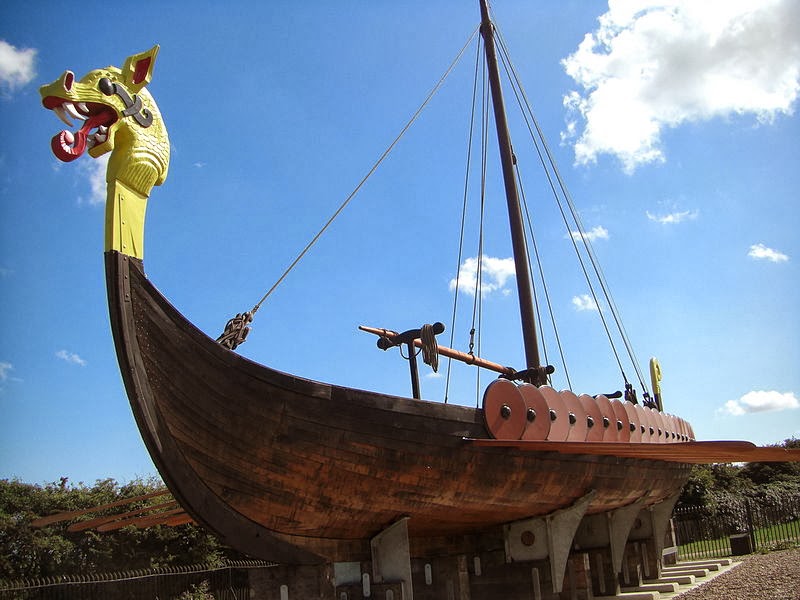
Viking Longship Reconstruction
Extorting Money from Vermont Yankee

On ANS Nuclear Cafe today,  I have posted a history of the extortion against Vermont Yankee, and some advice for the nuclear industry going forward:

Millions for education, but not one cent for tribute.

Vermont Yankee made  certain agreements with the Vermont Public Service Board. They made these agreements in order to get permission to run their plant and upgrade their equipment. These agreements were straight extortion.

According to these agreements, Vermont Yankee paid for cleaning up Lake Champlain (it's the other side of the state from the power plant) and for wind turbines.  In other words, in order to keep operating, Entergy paid for pet projects of the legislature and Public Service Board.

But to save money, Entergy closed the visitor center.

Keep the Visitor Center, Lose the Extortion

In my opinion, this was a backward strategy.  The visitor center was important.  The money for legislative-pet-projects was counter-productive.

I suggest nuclear plants should fund outreach (visitor centers and more).  They should fund their lawyers, when necessary.  They shouldn't give in to extortion and to paying Dane-geld.  Paying off the Vikings doesn't work.

Rudyard Kipling has a memorable poem about Dane-geld. It explains why trying to pay off the Vikings is a bad idea.  "Once you have paid him the Dane-geld, you never get rid of the Dane."  The extortionists will certainly come back later, for more money.

Deliver the Public Service Board From Temptation

The Kipling poem includes some surprising advice. It suggests you should save the Vikings from
John McClaughry
themselves
by not paying the Dane-geld:

"It is wrong to put temptation in the path of any nation,
  For fear they should succumb and go astray;"

John McClaughry of the Ethan Allen Institute wrote about this shake-down back in 2005, though he called it the extortion "simony" instead of "dane-geld."  In that article, McClaughry quotes the state auditor, who also wants to protect the Public Service Board from itself:

In November 2003, in return for Public Service Department support for a reactor power uprate, Entergy agreed to pay $7.8 million to cleanup algae in Lake Champlain, 180 miles away, plus $2.1 million to subsidize low income home heating. The deal was criticized not only by the anti-nuclear activists, but also by state Auditor Elizabeth Ready: “(Vermonters) health and safety could be placed at risk if utility regulation is allowed to become a pay-to-play endeavor, fueled by extracting millions from applicants for pet projects in order to get the Public Service Department’s stamp of approval.”

In other words, this sort of thing is just too tempting for the Danes and for the Public Service Board.

Instead of giving money to clean up Lake Champlain, or whatever pet project the Public Service Board requires, nuclear plants should spend money on outreach. And, if necessary, on lawyers.

Kipling and State Auditor Ready would agree: Do not put temptation in the path of any nation...or any Public Service Board.

Don't pay.

--------

I am sorry.  I cannot easily find a link to McClaughry's 2005 Commentary: "New State Revenue Technique: Simony."

John McClaughry is the founder of the Ethan Allen Institute. The Energy Education Project is part of that Institute, and I am the director of the Energy Education Project.

Tuesday, October 29, 2013

A State of Extortion: Conditions for a Vermont Yankee Certificate

John McClaughry
at a dinner in his honor
The Prediction: John McClaughry

Shortly after Entergy announced it would close Vermont Yankee in 2014, Governor Peter Shumlin decided that people should work together, not fight with each other.  Specifically, Shumlin said that his administration would “use this opportunity to build better relations with Entergy.”

John McClaughry doubted that statement.  McClaughry is one of the founders of the Ethan Allen Institute, and he predicted that better relations between Entergy and Shumlin were not going to happen.  Better relations weren't in the cards (to use a fortune-teller analogy).   Governor Shumlin would continue to behave the way Governor Shumlin behaves.  

In early September, a few days after Shumlin's announcement, McClaughry wrote an op-ed which was published many places in Vermont:  Governor Shumlin's Unlikely Olive Branch to Entergy. Here's the quote with the prediction:

With this long, outspoken, and unbroken record of opposition to the nuclear plant and its corporate owner, can we expect Peter Shumlin to now seek “better relations” with Entergy? It’s far more likely that he, his regulators and lawyers, and his legislative friends will spend the rest of his time in the Governor’s office extorting every last dime out of Entergy to fund their own pet projects, and when that is pushed as far as it can go, forcing Entergy to spend as much as possible through more of the “cumulative regulation” that Entergy says contributed to its decision to close the plant.

The Pondering: State Weighs Conditions for Entergy


When Entergy announced it was closing the plant, the state "weighed the conditions" they would put
Commissioner Recchia
from DPS site
on Vermont Yankee's continued operation for a final year. 


The Public Service Board was still considering a Certificate of Public Good (CPG) for Vermont Yankee when Entergy announced it was closing the plant.  Entergy quickly filed an amended petition with the Board, asking for a CPG for through the end of 2014, instead of through 2032.  Under Shumlin's administration, the Department of Public Service (DPS) had opposed the 20-year extension.  Would they also oppose a one-year extension? 

When Entergy filed for a one-year extension,  Chris Recchia, commissioner of the department, said the department was considering its options about the one-year extension. Here's a quote from Andrew Stein's article in Vermont Digger

“The options are to support it (the one-year certificate) with conditions or oppose it unless there are conditions,” he (Recchia) said.

The Prediction Fulfilled: Also Known As The Shake-Down


First, we have to admit that the state learned some very expensive lessons in various courts.  The DPS considered recommending a time-table for decommissioning, or recommending how the plant should handle spent fuel.  But then they thought better of it. Recchia noted that these areas fall under the purview of the Nuclear Regulatory Commission.  

“We felt we needed to focus on areas where we have jurisdiction,” Recchia said.  (From Oct 25 article Terri Hallenbeck in the Burlington Free Press.)

If DPS tried to regulate safety, they could lose in court. Gathering money from Entergy seemed a more reasonable tactic.  DPS recommended that the Public Service Board should extract money from the plant in return for a fourteen month CPG.  Specfically, DPS recommend that Entergy must
  • Put $60 million dollars in a separate trust fund for decommissioning within 21 days of receiving a certificate of public good from the state (Anne Galloway article in Vermont Digger)
  • Put $4.65 million dollars into a fund "for the state to disburse" for dislocated worker assistance (Terri Hallenbeck  article). 
Another justification given for Entergy contributing $4.65 million to the state is that the state will lose its "generation tax" revenues when Vermont Yankee stops generating power.  As Galloway wrote in Vermont Digger:

"Once the plant closes, that source of state revenue (the generation tax) will disappear. Recchia says Entergy should be required to continue to make some kind of payment to the state to make up for the economic impact of the sudden, unplanned shutdown."

In other words, McClaughry predicted the situation accurately.  The scenario (extract money and attempt to make decommissioning as expensive as possible) is unfolding exactly as McClaughry predicted it would unfold.


Note from blogger: "Sudden unplanned shutdown"?  Huh?

Second note from blogger:  Will these "generation tax" substitutes actually be used for Vermont Yankee employee assistance?  Your guess is as good as mine....

The Good News and the Bad News


Good News:  This is the state's final chance to extract money. In Andrew Stein's article in Vermont Digger (State Weighs What Conditions to Place on Vermont Yankee Closing) Stein quotes Ray Shadis, a long-time plant opponent.

"It is unclear at this point if Entergy VY, if it closes in 2014, will ever have to appear before the VPSB (Vermont Public Service Board), or for that matter, any state regulatory body ever again,” he (Shadis) wrote to the board. “Chopping the proposed period of extended operation really appears to narrow that possibility and proportionally heightens the need for the VPSB and the parties to ‘get it right.’”

Bad News:  It's not really bad news. More like "major uncertainty."  If the Public Service Board puts tens-of-millions-of-dollars of conditions on a certificate of public good, and Entergy had planned to operate the plant only for a few more months--what will Entergy do?  

It may not be worthwhile for Entergy to litigate in the hopes of merely several months operation.  Also, if Entergy doesn't sign the new CPG, they don't have to abide by its multi-million dollar conditions.  In other words, Entergy might quite reasonably decide not to sign, not to litigate, and simply to close the plant a few months earlier. 

I hope this would not happen, but it could. 

"Building better relations with Entergy" indeed!

------------

You can link to the complete, 50-page DPS filing from the Vermont Digger article.  I link to it here for convenience. I am always grateful when Vermont Digger links to the original documents. 

John McClaughry, the man who made the prediction, is vice president of the Ethan Allen Institute (www.ethanallen.org). The Energy Education Project (directed by Meredith Angwin) is part of the Ethan Allen Institute.

Sunday, September 8, 2013

Governor Shumlin's Unlikely Olive Branch to Entergy: Guest Post by John McClaughry


Just over a year from now Vermont Yankee will go offline, putting an end to 42 years of safe, reliable, competitively priced baseload electricity delivered to the New England power market.  The anti-nuclear forces that have ceaselessly agitated against Vermont Yankee for decades have jubilantly declared victory. And in truth, they are entitled to congratulate themselves for the plant’s final closure, since it was they who created the poisonous anti-nuclear atmosphere in Montpelier that contributed in some measure to Entergy’s decision to shutter the plant.

 In his remarks about Entergy’s announcement, Gov. Shumlin went out of his way to say that he would “use this opportunity to build better relations with Entergy.”  Anyone who has watched the Shumlin mode of operation should take this olive branch with a boulder of salt.

Peter Shumlin founded his political career on opposition to Vermont Yankee, and accelerated it when
Governor Shumlin
Vermont’s utilities sold the plant to what he calls “Entergy Louisiana” in 2002. He ardently supported, though he did not initiate, the extortion of $28 million from Entergy in return for allowing an unexceptional uprate of the plant’s power output in 2003.

He supported the continued extortion of Entergy to extract another $28 million in 2005 in return for allowing Entergy to store spent fuel rods in concrete casks at Entergy’s expense on its own property.

He strongly supported the two judicially overturned acts of the legislature that put 180 politicians – the great majority of them anti-nuclear Shumlin supporters - in charge of whether Entergy could be allowed to continue operation of the plant beyond its scheduled closing date of March 22, 2012.

 When Entergy applied for Public Service Board authority to extend the plant’s operation, Shumlin notoriously tried to extort it again to sell power to Vermont utilities at below market prices. This is not rumor. This was found to be fact by the Federal District Court in its 2012 ruling against the state.

 He rarely if ever passed up the opportunity to advise us that “Entergy can’t be trusted” – when it was the legislature, not Entergy, that broke the 2002 Memorandum of Understanding. And of course he strongly supported attorney general William Sorrell’s costly but futile efforts to persuade a court to allow the legislature to have total control – with no appeal – over Vermont Yankee’s future.

With this long, outspoken, and unbroken record of opposition to the nuclear plant and its corporate owner, can we expect Peter Shumlin to now seek “better relations” with Entergy? It’s far more likely that he, his regulators and lawyers, and his legislative friends will spend the rest of his time in the Governor’s office extorting every last dime out of Entergy to fund their own pet projects, and when that is pushed as far as it can go, forcing Entergy to spend as much as possible through more of the “cumulative regulation” that Entergy says contributed to its decision to close the plant.

In return for agreeing to allow Entergy to operate one more year, look for Shumlin’s Public Service Department to side with the anti-nuclear advocates to insist that the site be “greenfielded” by digging down forty feet to remove ordinary (non-radioactive) concrete foundations, instead of just covering them over with a few feet of dirt. This pointless digging, trucking and burying would require millions more in decommissioning dollars and possibly, along with other cost-inflating demands, force Energy to contribute tens of millions of dollars more into the Decommissioning Fund.

Look for the Department to push for Entergy to begin decommissioning immediately, instead of the more sensible practice of “Safstoring” the plant for twenty years, when it will be a lot easier and safer to dismantle. (Shumlin has emphatically but wrongly denied that the state ever agreed to allow Entergy to choose to Safstor.)

John McClaughry
at a dinner in his honor
The only reason for such a foolish demand is to pander to the anti-nukies’ desire to return the defiled Vernon site to the way it was when the Abenakis roamed it, so that aging demonstrators can assemble each year to celebrate the triumph of  their glorious crusade. (Let’s hope they aren’t unnerved by the concrete spent fuel cask farm, which will remain until the Federal government provides a permanent storage facility.)

There are many more issues that will be raised in the coming year, not the least of which is Shumlin’s extraordinary claim that “decommissioning is a job creator”. That is the governor’s desperate effort to convert into some kind of “jobs program” his  now-successful decades-long campaign to shut down Vermont Yankee, lay off most of its 630 well-paid employees, and kiss off their income tax payments. Stay tuned.

-------

John McClaughry is vice president of the Ethan Allen Institute (www.ethanallen.org). The Energy Education Project (directed by Meredith Angwin) is part of the Ethan Allen Institute.


Tuesday, July 23, 2013

Nuclear Power for the Anti-Nuclear Set: Guest Post by John McClaughry

John McClaughry
at a recent dinner in his honor

Nuclear Power for the Anti-Nuclear Set
A Guest Post by John McClaughry


 For decades, the various New England anti-nuclear groups have waged incessant warfare against the Vermont Yankee nuclear plant and Entergy, which bought the plant from a coalition of Vermont utilities in 2002. The outcome of that struggle now lies in the Federal court system, where Entergy has already won one signal victory.

 It’s important to keep in mind that, leaving the particulars of the Vermont Yankee battle aside, the anti-nukies are fundamentally opposed to nuclear energy in any form whatever. Only old timers now remember that the Sierra Club was once pro-nuclear, which it viewed as the saving technology that would make the damming of California mountain streams unnecessary.

Interestingly, the Sierra Club, at least, does not totally slam the door on nuclear even today. In its 2006 energy policy statement it said “while it is possible that a different approach to nuclear power might substantially address these issues, the likelihood is remote given the decades of research and investment already made.”

 What different approach to nuclear power might conceivably avoid the environmental issues that caused the Sierra Club’s opposition? To answer that question it’s necessary to review the origins and development of nuclear power, dating back to the 1950s.

That story is ably told in a book published in 2011 by Richard Martin, entitled Super Fuel. Martin
LFTR Image from Energy From Thorium blog
http://energyfromthorium.com/lftradsrisks.html
details the long battle between the demanding and acerbic Admiral Hyman Rickover, who wanted nuclear engines based on known technology right now to propel his fleet of submarines, and the gentle visionary Alvin Weinberg, longtime director of Oak Ridge National Laboratory, who envisioned a nationwide fleet of thorium-powered electric plants, using molten fluoride salts as moderator and coolant.

Rickover, a savage bureaucratic infighter, got what he wanted, and in 1972 Weinberg was fired. The nuclear industry put its muscle behind the hugely expensive liquid metal fast breeder reactor. It in turn was shelved in 1984 after Congress spent $8 billion on the Clinch River Breeder without turning a shovelful of dirt.

As Martin puts it, "Light water reactors and their younger cousin, the liquid metal breeder, won out because of technological intransigence rooted in the military origins of the U.S. nuclear program."

From 1965 to 1969, however, Weinberg's molten salt reactor experiment had operated successfully, in the later months with thorium-derived U-233 fuel. By 1973, with Weinberg gone, molten salt was rejected, and thorium was dead. Rickover's uranium-based industrial empire was preserved. any cheaper, safer and environment-friendly alternative was shelved.

Now, forty years later, the liquid fluoride thorium reactor (LFTR) is again emerging as one of the six “Generation Four” nuclear power technologies now viewed as most promising alternatives to traditional light water reactors.

Without going too far into technical details, the LFTR would almost certainly produce electricity cheaper than coal, because of lower capital and fuel costs; use a fuel that is in almost inexhaustible supply, both in the U.S. and elsewhere; operate continuously, in baseload or peaking mode, for up to 30 years; be factory-built and deployed in compact 100-megawatt modules close to the end use of the power; contribute nothing to air or water pollution and need no water for operation; safely consume long-lived transuranic waste products from current nuclear fission reactors; produce high-temperature process heat that can make hydrogen fuel for vehicles; and be walkaway safe.

This is not pie in the sky. The physics is sound, and every part of the LFTR has been successfully tested. What has not been accomplished is the efficient integration of all of the technology features into a marketable product.

The reason it has not is the determined opposition of companies that offer competing nuclear technologies: either light water reactors like the current improved version of Vermont Yankee, the AP-1000, or liquid metal fast reactors like the Russian BR-600, or exotic helium cooled pebble bed reactors under development in China.

Most of the present anti-nuclear groups are so mindlessly opposed to anything nuclear that they’ll probably denounce the LFTR if and when it appears. Still, more rational anti-nuclear groups like the Sierra Club, which is terrified at the menace of global warming, could possibly find in the LFTR the “different approach” that would win their support (and put coal out of business.)

---------
John McClaughry, formerly a nuclear reactor physicist, is vice president of the Ethan Allen Institute (www.ethanallen.org).

 Meredith Angwin is director of the  Energy Education Project which is part of the Ethan Allen Institute.

Note from Meredith: When speaking about the LFTR, I always want to be sure people are aware of Dr. Robert Hargraves excellent book: Thorium, Energy Cheaper Than Coal.


Wednesday, July 3, 2013

Vermont Governor Salmon Supports Vermont Yankee

Governor Salmon Speaks in Favor of Vermont Yankee 

On June 19, the Ethan Allen Institute celebrated its 20 year anniversary with a dinner "roasting" its founder, John McClaughry.  I am director of the Energy Education Project, which is part of the Institute. Two former governors spoke at the dinner: Jim Douglas and Tom Salmon.

Tom Salmon was Governor of Vermont from 1973 to 1976.  He is a Democrat. During his term, financial crises in Vermont caused his fiscal viewpoints to become more conservative.  More recently, Salmon testified in favor of Vermont Yankee's continued operation at the Public Service Board hearings in November 2012.

Last month, Salmon again supported Vermont Yankee, this time at the anniversary dinner. I embed the video of Governor Salmon's remarks at the dinner.

I encourage you to move the slider to the 8:30 minute mark, where Salmon talks about the policy areas in which he now agrees with John McClaughry.  He starts with a spirited defense of Vermont Yankee: the state's "assault on Vermont Yankee" makes no sense, and turning our back on baseload power will not help people in Vermont.  Governor Salmon is inspiring.


More information:

For more videos from the dinner, visit the Ethan Allen Institute website page on videos and highlights from the dinner.

Here is Vermont Digger's report on the dinner.

I feel a little guilty about not including more information about Governor Douglas or John McClaughry at the dinner. So I decided to include their pictures, at least! The video-highlights link includes their remarks.


Governor Jim Douglas

John McClaughry


Saturday, May 4, 2013

Renewable Subsidies for the Rich: Guest Post by John McClaughry

Renewable Subsidies for the Rich by John McClaughry

Renewable electricity costs from two to five times (depending on the technology) as much as electricity from the New England grid, generated by natural gas, hydro, coal, and nuclear. Therefore no utility would rationally buy it but for an astounding assortment of subsidies and mandates.

Consider just these: The federal investment tax credit subsidizes 30% of the capital costs of small scale solar photovoltaic and wind projects. Some investors may also claim a 50% first year depreciation bonus, plus five years of ordinary depreciation of the remainder, regardless of the actual lifetime of the equipment. Wind generated electricity on any scale earns a 2.3 cents/kWh federal Production Tax Credit.

The Vermont legislature has added to this cornucopia a 7.2% investment tax credit for small wind and solar PV electricity produced from commercial properties. The Clean Energy Development Fund, until it ran out of money, also added 45 cents per residential installed watt for solar panels (40 cents per watt for commercial and industrial projects).

The legislature has also required Vermont utilities to buy solar PV (up to 2.2 MW) and small wind electricity (up to 100kw) at prices up to five times the wholesale price available on the New England power grid.  In an effort to lure enough new investors to stay on target toward the 127.5 MW program goal, the PSB has now pushed the feed in tariff rate for new solar PV projects up to 25.7 c/kWh for the next 25 years; and to 26.2 c/kWh averaged over 20 years for small wind.

To summarize: governments shower lucrative capital and operating subsidies on wind and solar entrepreneurs, then force the utilities buy their electricity at up to five times the New England wholesale price for 20 to 25 years, charging the extra cost to their ratepayers. What a sweet deal!

Willem Post of Woodstock is a retired electric engineer whose career took him all over the United States and Europe. One of his hobbies is running calculations on the economics of energy, especially renewable energy.

Post describes a $10.5 million 2.2 MW solar PV facility in White River Jct., created by high-income Boston investors. About 15 acres of topsoil and trees were cleared, leveled, and shielded by an eight foot high fence. The facility almost certainly features Chinese-made solar panels and German-made inverters. It will generate electricity only when the sun is adequately shining, which is about 35% of the hours of the year. The expected annual generation is 2,755 MWh.

Under the legislature’s feed-in tariff law, the Public Service Board mandated that Green Mountain
Power write a check to the investors each year for 25 years in the amount of $661,415.  Since the cost to GMP is about four times the cost of electricity from the New England grid, the utility will charge its customers $509,840 a year more than they would otherwise have had to pay for grid power.

The generous tax benefits appeal to people in the highest income tax brackets. In 2011 the Shumlin administration made it even more attractive to the rich by allowing them to take half of the lifetime projected tax benefits from the Clean Energy Development Fund as an upfront grant, an option eagerly taken by 64 of the first 68 investors in the program.

The state’s Comprehensive Energy Plan of 2011 recommended adoption of a Vermont Renewable Portfolio Standard, by which utilities would be required to increasingly higher percentages of their electricity from renewables (including HydroQuebec). Achieving this goal would mean that ratepayers would be hammered all the harder, while the investors pocket even greater profits. Nice.

Last spring the House was about to enact a Renewable Portfolio Standard. At the last minute Shumlin, an erstwhile advocate, instructed the House not to do it. We don’t know why he suddenly got cold feet, but 14 of the 29 states with RPS laws are currently watering them down.

That suggests that a lot of voters forced to pay for the renewable mandates have discovered that they are a very bad deal – unless they have allowed people like Peter Shumlin and Bill McKibben to terrify them about the Menace of Global Warming, which has disappeared since 1999.
-------------
John McClaughry is vice president of the Ethan Allen Institute (www.ethanallen.org). I am a director of the Energy Education Project of the Ethan Allen Institute.


This article first appeared at Vermont Digger
http://vtdigger.org/2013/04/15/mcclaughry-renewable-subsidies-for-the-rich/

Thursday, February 9, 2012

The Commerce Clause, the Role of Vermont Yankee, and the Troubles with NRC Meetings

I rarely do a post which is mostly about links to other sources, but here goes. Three important articles, none written by me.

The Commerce Clause and the Shakedown Attempts: When I read the Judge's ruling, I was astounded at the directly-illegal stuff that the Vermont legislature did. As Cavan Stone noted in his guest post on the Control-H defense: what kind of legislature goes on the record with a statement with "Okay, we have to find another word for safety"?

That's all about the pre-emption part of the ruling.

Then there's the part of the ruling about the commerce clause. John McClaughry quotes from the Judge's ruling on that section. The legislature wrote letters to Entergy that could have been written by an assistant to the Godfather. It was basically a shakedown of Entergy. Read McClaughry's post: The Other Part of the Yankee Decision. Reading his post is like watching a gangster movie.


A Victory For Vermonters: The local headlines on the ruling tended to be statements like "A Stinging Defeat." In True North Reports, Guy Page explains why the Murtha Decision was a Victory for Vermonters. Workers, ratepayers and the environment all benefit. He puts Vermont Yankee in context with Vermont power needs, Vermont revenues, ISO-NE and grid stability. A very rational report.

NRC Public Meetings Need Improvement. In July, I wrote about the difficulties of getting on the agenda to speak at the NRC meeting in Brattleboro. Yesterday, at ANS Nuclear Cafe, Suzanne Hobbs Baker wrote of attending an NRC meeting in South Carolina. Her experience had many similarities to my experience in Brattleboro. The NRC has got to make some improvements about how they sign up speakers! Read How to Survive an NRC Public Meeting, and read the comments, too.

BREAKING NEWS AND A FOURTH LINK:

VOGTLE REACTORS APPROVED BY NRC TODAY!

--------
For the record: I head the Energy Education Project of the Ethan Allen Institute in Vermont, and John McClaughry is vice-president of that Institute.

Thursday, December 29, 2011

Will Vermont Yankee be Replaced by Unicorns? Pictures of the Rally, and a Critique of the Vermont Energy Plan

The Rally

Thank you to Kay Trudell for the photos of the rally in support of Vermont Yankee this October! We just put an entire album of pictures on the Save Vermont Yankee Facebook page. These four pix are just a sample.


I couldn't resist putting in a picture of Howard Shaffer carrying a great sign


The Energy Plan for Unicorns

There's a new Vermont Energy Plan. It says that we are going to use 90% renewable energy by 2050. It says that we don't need Vermont Yankee, but we do need a new natural gas pipeline. That's the plan.

John McClaughry of Ethan Allen Institute has a great critique of the energy plan today at Vermont Tiger. McClaughry's title tells where Vermont's energy supply is heading: Unicorn Power for Vermont! Read it. You'll laugh. You'll cry. You'll laugh and cry, both at the same time. (Full disclosure: The Energy Education Project that I direct is part of the Ethan Allen Institute. John McClaughry is vice president of the Ethan Allen Institute.)