Showing posts with label grid reliability. Show all posts

Tuesday, August 14, 2018

New England Governor's Meeting: Guest post by Guy Page


Toronto, Evening of August 14, 2003, Wikipedia
On eve of 15th anniversary of Big Blackout, governors push more reliable power grid

By Guy Page
AUGUST 13, 2018 - Maybe the timing was just co-incidence. But today, on the eve of the 15th anniversary of the August 14, 2003 Big Blackout that put 50 million North Americans in the dark, Gov. Phil Scott and four other New England governors announced plans to prevent crippling power blackouts.

The 2003 outage blacked out an estimated 50 million people and 61,800 megawatts (MW) of electric load in eight northeastern states, including parts of southern Vermont, and Ontario.

Maybe the governors remember the Big Blackout, but it’s more likely they are heeding this winter’s scary wake-up call. For three weeks of record cold in December and January, New England homeowners burned record amounts of natural gas to stay warm. Power grid operators lacked adequate supply to power regional natural-gas fired plants. The New England grid was already playing with a thin bench, due to recent closures of coal and nuclear power plants. Things got worse when a transmission line failure separated an operational nuclear power plant from its customers. In extremis, grid operators burned backup stockpiles of dirty, expensive coal and oil. Soon even these supplies began to run low. Had sub-zero temperatures persisted, the grim reality of blackouts, frozen pipes and frostbitten New Englanders was imminent.  

In the aftermath, grid operator ISO-New England warned that preventing blackouts will require action. Yesterday, the governors agreed:
“The New England states and ISO New England have recognized the challenge of increasing reliance on natural gas-fired generation during cold periods when the region’s natural gas is used primarily for heating. These concerns have been heightened as non-natural gas-fired generation resources, such as nuclear, coal, and oil, have retired in recent years. During recent winters, ISO-NE has been relying on more expensive, carbon-intensive oil-fired units to ensure sufficient generation to meet hour-by-hour demands on our energy system.” 
The governors in particular praised the low-carbon, energy security value of nuclear power:
“Effective next June, the region will have two nuclear power plants that represent approximately 3,500 MW of baseload energy that is not dependent on natural gas infrastructure and also helps to meet emission goals. ….It is important to continue to evaluate cost-effective policies that properly value existing clean energy resources which have significant fuel security implications.”

Proposed energy policies, to be adopted state-by-state, could include:

  • Public “cold weather” education to conserve non-essential electricity and heating fuel, similar to messaging during summer heat waves;
  • Charging customers more at peak hours of consumption, hopefully to reduce demand;
  •  Energy efficiency, including weatherization and combined heat and power, which reduces overall consumption of electricity and natural gas; and
  • New, generation such as large-scale hydropower and off-shore wind;
  • Working with Congress to ensure Liquid Natural Gas can be delivered in a timely manner during winter;
  • More backup generation, fuel storage and transmission. 

For those of us who may have forgotten the 8/14/2003 Big Blackout, or vaguely remember seeing news coverage on our (electric) television sets – power was not restored for 4 days in some parts of the United States, according to the official EPA final report April, 2004. According to August 13 2013, ISO Newswire, New England was largely spared from the effects of the outage because protective equipment installed on the transmission system sensed the disturbance and automatically closed the ‘electricity border’ with New York, splitting New England away from the collapsing power system to the west.

But that’s history. New England’s governors have taken the important first step of acknowledging a serious, life-threatening problem exists. Whether they can prevent another Big Blackout is a question for historians of the future.

---------
 Guy Page, a frequent guest blogger at this site, published this in his newsletter: State House Headliners. 

Copyright © 2018 Guy Page, All rights reserved.

Reprinted by permission

Thursday, July 5, 2018

The Not-Stressed Grid in Summer

The grid is not stressed

The Northeast is using a lot of power, but the grid is not particularly stressed.  "Using a lot of power" and "stressed grid" are not the same thing.  Many local utilities are urging conservation...but this is not because the grid is stressed.  More about conservation in the next post.

How can I say the grid is not stressed? We're having a major heat wave! For days, Vermont temperatures have been in the high nineties. A number of communities opened "Cooling Stations" in public building such as fire departments. People were encouraged to go to air-conditioned malls, drink water, check in on elderly people who may need assistance, etc.

Okay, it's hot.  But I will start by comparing the grid situation on this heat wave with the grid  situation in the cold snap in December-January.

Hot weather electricity use and prices

Let's look at the ISO-NE electricity usage  chart for July 3.  The peak is near 25,000 MW. The LMP (local marginal price) prices for electricity were between about $25 and $80 per MWh, or about 3 cents to 8 cents per kWh.

Cold weather electricity use and prices

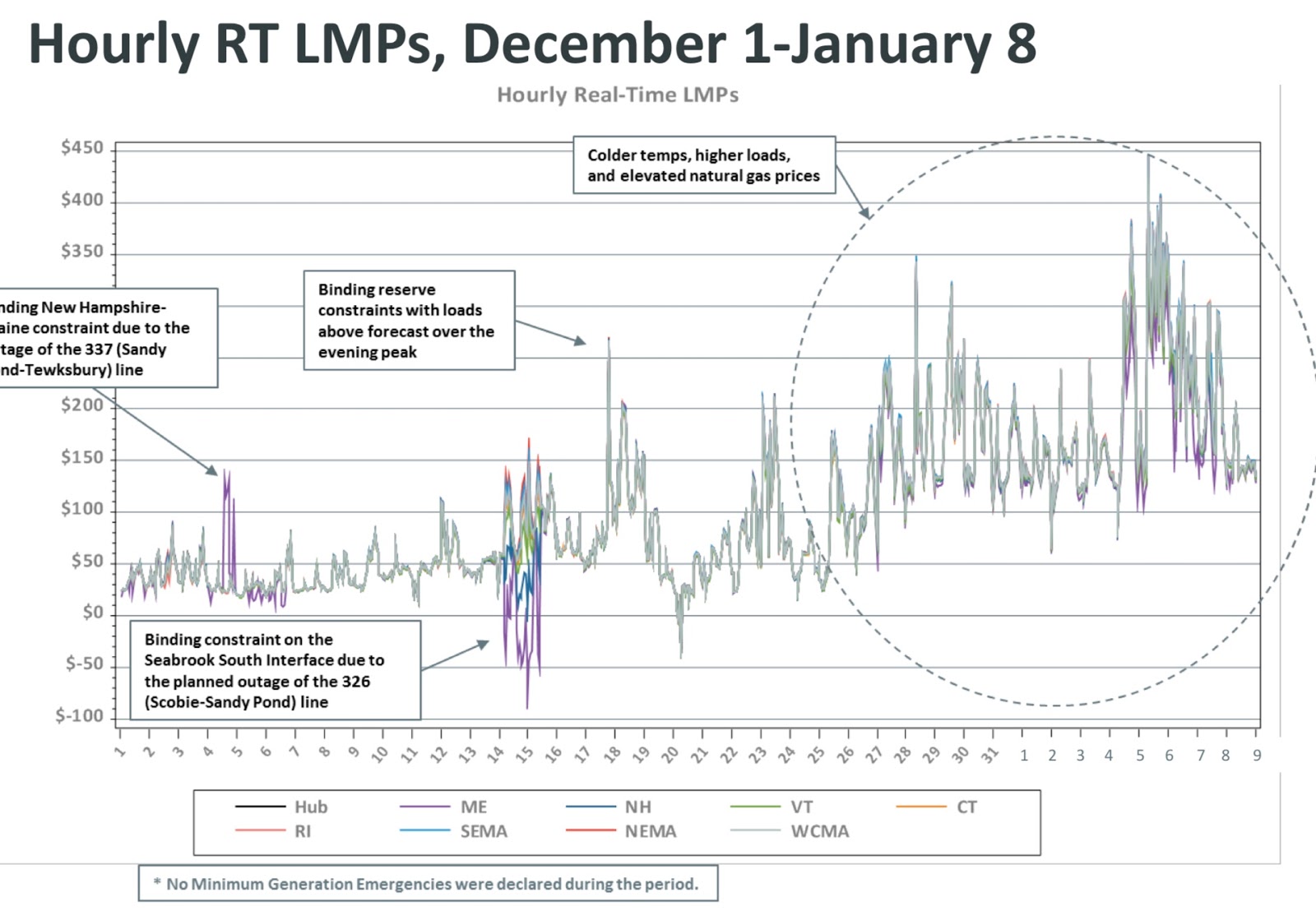
In contrast, during the cold snap at the beginning of this year, electricity use never got much higher than 22,000 MW, as shown in this graph from the ISO report on cold weather operations.

However, in  the cold snap, the LMP prices spent a lot of time between $150 and $300 per MWh (15 cents to 30 cents per kWh). The circled area on the graph below, from the same ISO report.


In short, during the cold snap we used less electricity and paid higher prices than we do now.

Conservation and fuel usage

Using more electricity in New England means making more carbon dioxide and burning more fossil fuels.  So conservation is always good. But is conservation in summer particularly wonderful? Not really.

Right now, we have a fairly clean grid. The fuel mix is mostly natural gas, nuclear,  hydro and renewables.  The grid was running 60% gas, 20% nuclear 16% hydro and renewables.  Pretty good, in terms of emissions!  Here's a recent fuel mix graph.


A fuel mix chart for the grid on July 4


In contrast, in the winter, when natural gas was not available, oil and coal were in heavy use (Oil Kept the Power Grid Running op-ed). During the cold snap, the mix was 30% oil, not "less than 1%" oil, as it is now.  Coal use was higher, also, up around 5%. 

Surplus Capacity

So far, there's no particular reason to conserve right now instead of conserving some other time.  But let's look at something else.  Perhaps, even with natural gas available, the grid is close to maximum capacity in hot weather? Perhaps, if we don't conserve, the grid will fail?

Nope. The grid is doing well.  If you look at the ISO-NE website,  it lists "surplus capacity" right on the front page.  At this moment, as I am writing this, on a very hot day, surplus capacity on the grid is 1,180 MW.  That is the capacity available above the maximum predicted peak power use for today (23, 000MW) and above the grid's operating reserve requirement for today (2,492 MW). You can always check these types of figures in the ISO-NE morning report

Or, you can simply remember that when ISO-NE predicted the possibility of rolling blackouts in the future, ISO was concerned with winter stress on the grid leading to blackouts. They were not concerned with high summer electricity usage. 

 In short, conserving electricity this summer doesn't save more money or more carbon dioxide then it would save at many other times. As a matter of fact, it saves less of both than it would save in a winter cold snap.  Conserving now also doesn't "save the grid" from blackouts.  The grid is operating at high capacity, but nowhere near its capacity limits.

 So why are the utilities pushing conservation right now?

Game of Peaks

The utilities are urging conservation right now because they are playing the Game of Peaks.  It's  a utility game about money. If they play the Game of Peaks well, they can shift some costs from themselves over to neighboring utilities.  Yeah, it's a zero-sum game.  ("I win" can only happen if "you lose.")

 Learn the rules for the Game of Peaks in the next post.

Thursday, May 17, 2018

Rolling Blackouts for New England? Angwin Op-Ed

Mystic Power Station

Rolling blackouts

Rolling blackouts are probably coming to New England sooner than expected.

When there’s not enough supply of electricity to meet demand, an electric grid operator cuts power to one section of the grid to keep the rest of the grid from failing.  After a while, the operator restores the power to the blacked-out area and moves the blackout on to another section. The New England grid operator (ISO-NE) recently completed a major study of various scenarios for the near-term future (2024-2025) of the grid, including the possibilities of rolling blackouts.

In New England, blackouts are expected to occur during the coldest weather, because that is when the grid is most stressed. Rolling blackouts add painful uncertainty – and danger – to everyday life.  You aren’t likely to know when a blackout will happen, because most grid operators have a policy that announcing a blackout would attract crime to the area.

Exelon announces plan to close Mystic Station

In early April, Exelon said that it would close two large natural-gas fired units at Mystic Station, Massachusetts. In its report about possibilities for the winter of 2024-25, ISO-NE had included the loss of these two plants as one of its scenarios. The ISO-NE report concluded that Mystic’s possible closure would lead to 20 to 50 hours of load shedding (rolling blackouts) and hundreds of hours of grid operation under emergency protocols.

When Exelon made its closure announcement, ISO-NE realized that the danger of rolling blackouts was suddenly more immediate than 2024.  ISO-NE now hopes to grant “out of market cost recovery” (that is, subsidies) to persuade Exelon to keep the Mystic plants operating. If ISO-NE gets FERC permission for the subsidies, some of the threat of blackouts will retreat a few years into the future.

Winter scenarios and natural gas

The foremost challenge to grid reliability is the inability of power plants to get fuel in winter.  So ISO-NE  modeled various scenarios, such as winter-long outages at key energy facilities, and difficulty or ease of delivering Liquified Natural Gas (LNG) to existing plants.

Ominously, 19 of the 23 of the ISO-NE scenarios led to rolling blackouts. The worst scenarios, with the longest blackouts, included a long outage at a nuclear plant or a long-lasting failure of a gas pipeline compressor.

A major cause of these grid problems is that the New England grid is heavily dependent on natural gas. Power plants using natural gas supply about 50% of New England’s electricity on a year-round basis. Pipelines give priority to delivering gas for home heating over delivering gas to power plants. In the winter, some power plants cannot get enough gas to operate. Other fuels have to take up the slack. But coal and nuclear generators are retiring, and with them goes needed capacity. In general, the competing-for-natural-gas problem will get steadily worse over time.

All the ISO-NE scenarios assumed that no new oil, coal, or nuclear plants are built, some existing plants will close, and no new pipelines are constructed. Their scenarios included renewable buildouts, transmission line construction, increased delivery of LNG, plant outages and compressor outages.

Natural gas and LNG

The one “no-problem” scenario (no load shedding, no emergency procedures) is one where everything goes right. It assumed no major pipeline or power plant outages. It included a large renewable buildout plus greatly increased LNG delivery, despite difficult winter weather. This no-problem scenario also assumes a minimum number of retirements of coal, oil and nuclear plants.

This positive scenario is dependent on increased LNG deliveries from abroad. Thanks to the Jones Act, New England cannot obtain domestic LNG. There are no LNG carriers flying an American flag, and the Jones Act prevents foreign carriers from delivering American goods to American ports.

We can plan to import more electricity, but ISO-NE  notes that such imports are also problematic.  Canada has extreme winter weather (and curtails electricity exports) at the same time that New England has extreme weather and a stressed grid.

New England needs a diverse grid

To avoid blackouts, we need to diversify our energy supply beyond renewables and natural gas to have a grid that can reliably deliver power in all sorts of weather.  When we close nuclear and coal plants and don’t build gas pipelines, we increase our weather-vulnerable dependency on imported LNG.

We need to keep existing nuclear, hydro, coal and oil plants available to meet peak demands, even if it takes subsidies.  Coal is a problem fuel, but running a coal plant for a comparatively short time in bad weather is a better choice than rolling blackouts.

This can’t happen overnight. It has to be planned for. If we don’t diversify our electricity supply, we will have to get used to enduring rolling blackouts.
-----
Meredith Angwin is a retired physical chemist and a member of the ISO-NE consumer advisory group. She headed the Ethan Allen Institute’s Energy Education Project and her latest book is Campaigning for Clean Air.

______

This op-ed has now appeared in several websites and news outlets. Links below to the post in other publications, some of which have comment streams.
This post at Ethan Allen Institute, The Caledonian Record, Vermont Business Magazine, VTDigger, True North Reports,  The CommonsNew England Diary   Providence JournalRhode Island and New England May Get Hit with Rolling Blackouts in the Future, including an interview with me, appeared in GoLocalProv.com

Special note: My op-ed has now appeared in my local paper, the Valley News, on the front page of the Sunday "Perspectives" section.  It is always a thrill to see my work in my local paper!

Thursday, September 8, 2016

New England Grid Operator Meeting September 15

The purpose of the Consumer Liaison Group (CLG) is to be the voice of the electricity consumer in advising the grid operator, ISO-NE.  As the annual report states: The Consumer Liaison Group (CLG) is a forum for sharing information between ISO New England (ISO) and those who ultimately use and pay for electricity in New England.

The next meeting of the Consumer Liaison Group will be next Thursday, September 15,  in Providence RI. The topic is Energy Infrastructure.  (I am on the Coordinating Committee for the CLG.)

CLG meetings are free, but you should register in advance if you want lunch.  Here's the information.  The graphic is merely a screen shot,  I supply the relevant links below the graphic.  I hope to see some of you there.


Providence Marriott Downtown
CLG webpage
Register

------
The following letter was sent  to those who have attended previous CLG meetings. (The meetings are open to the public.)  I was given permission to include the letter in this announcement.
----------

Good Afternoon,

As a past (and hopefully future!) Consumer Liaison Group (CLG) participant, you may find this information interesting as you consider your attendance at the September 15th CLG meeting in Providence, Rhode Island.  Earlier this week, the six New England Governors joined with five Eastern Canadian Premiers for their 40th Annual Conference.  The Conference, hosted by Governor Charlie Baker of Massachusetts, convened on Sunday and Monday and a variety of regional issues were discussed, including trade, energy diversification, and combating the opioid crisis.  Much of the Governors’ and Premiers’ focus was on energy as the Conference heard from Federal Energy Regulatory Commission Chair Norman Bay, a panel on “Emerging and Innovative Technologies,” and a second panel on “The Benefits and Importance of Diverse Energy Generation.”  While the Conference produced no action items or resolutions, participants and media accounts (see below) alike report productive conversations on a variety of regional energy issues.

In September, the CLG will continue these important discussions.  The CLG will hear from Rhode Island General Treasurer Seth Magaziner and a panel on “Energy Infrastructure Projects Progressing in Rhode Island:  Challenges and Consumer Impacts Regionwide.” Panelists from Deepwater Wind, Invenergy, National Grid, and Spectra Energy will discuss a variety of generation, transmission, and pipeline projects.  The CLG meeting will be held at the Providence Marriott Downtown on September 15, 2016, beginning at noon with lunch.  All are invited to continue this discussion of regional energy issues.

To register for the meeting, please click here.

40th Conference of the New England Governors and Eastern Canadian Premiers: Agenda


Sincerely,

The CLG Coordinating Committee

Rebecca Tepper (MA)
Chair, Consumer Liaison Group Coordinating Committee
Chief, Energy & Telecommunications Division
Massachusetts Attorney General’s Office

Meredith Angwin (VT)
Director, Energy Education Project
Ethan Allen Institute

Robert Espindola (MA)
Energy Systems Program Manager
Acushnet Company

August Fromuth (NH)
Managing Director
Freedom Energy Logistics

Douglas Gablinske (RI)
Executive Director
The Energy Council of Rhode Island

Agnes Gormley (ME)
Senior Counsel
Maine Public Advocate

Guy Page (VT)
Communications Director
Vermont Energy Partnership

Robert Rio (MA)
Senior Vice President, Government Affairs
Associated Industries of Massachusetts

Joseph Rosenthal (CT)
Principal Attorney
Connecticut Office of Consumer Counsel

Donald Sipe (ME)
Partner
PretiFlaherty

Mary Smith (MA)
Associate Director of Energy Supply & Utility Administration, Harvard University

The CLG is governed by a Coordinating Committee of up to 12 members with no more than four members from any one of the New England states.  The Coordinating Committee sets the agenda for four quarterly meetings each year, which the ISO helps facilitate.  Governance of the Consumer Liaison Group is fully explained in the “CLG Purpose and Structure” document available here.


Tuesday, June 14, 2016

New England Grid Operator Meeting This Friday

The purpose of the Consumer Liaison Group (CLG) is to be the voice of the electricity consumer in advising the grid operator, ISO-NE.  As the annual report states: The Consumer Liaison Group (CLG) is a forum for sharing information between ISO New England (ISO) and those who ultimately use and pay for electricity in New England.

The next meeting of the Consumer Liaison Group will be the day after tomorrow: Friday June 17 at the Double Tree Hotel in Westborough MA. The topic is grid security from the consumer point of view.  ( I am on the Coordinating Committee for the CLG. )

CLG meetings are free, but you should register in advance if you want lunch.  Here's the information.  However, since the picture is merely a screen shot,  I supply the relevant links below the picture.  I hope to see some of you there.


Double Tree Westborough

CLG web page

Register

Mary Louise "Weezie" Nuara mnuara@iso-ne.com


Wednesday, May 25, 2016

The Distribution Grid: Christine Hallquist on Grid Controversies

Hallquist and the grid

Christine Hallquist, CEO of Vermont Electric Cooperative, presented the third class in my course: The Grid: What Your Electricity Bill Won't Tell You.

On May 3, 2016 at my class on grid issues, Hallquist described the grid  from the perspective of a rural electric cooperative in Vermont. She heads Vermont Electric Cooperative (VEC). This utility was one of the rural Cooperatives of the Rural Electrification movement: it was founded in 1938 to bring electricity to rural Vermont.  It is now the largest locally-owned electric distribution utility in Vermont.  VEC is dwarfed by Green Mountain Power, a utility with a very Vermont-y name. However, Green Mountain Power is actually a wholly-owned subsidiary of Gaz Metro of Quebec.

In my opinion, Vermont Electric Cooperative is the quintessential Vermont utility. It started in the Rural Electrification movement of the 30s, and and it is a cooperative in which the owners and the consumers are the same people.

Update 2018: The videos still exist, but their URLs have changed. Here's the link to this video.
https://www.youtube.com/watch?v=4zN0D_CAkKE


As CEO of VEC, Hallquist is concerned with the cost shifts involved in net metering, since  VEC's service area includes low income areas of Vermont. When your owners are your customers, you pay sincere attention to the economic issues.

Late in the talk, Hallquist also discusses grid stability.  Intermittent power tends to be destabilizing: the grid was set up for rotating electric machinery. Rotating machinery has a healthy inertia which helps keep the grid stable. Starting at about 1:20 (1 hour 20 minutes into the talk), Hallquist shows the jagged effects of wind and solar, and the almost un-analyzable harmonics of the intermittents on the grid.  Few utilities collect this type of data.

I am very grateful to Christine Hallquist for sharing her information and her wisdom with our class.

It happens first in a village

Agatha Christie's Miss Marple is able to solve crimes because she has carefully analyzed many (supposedly) smaller issues in a small village.

To a large extent, Vermont Electric Cooperative is a "village" for the growth of renewables.  The owner/customers are not rich, and they need to keep electricity costs low.  While places like Germany can boast of their renewables while simultaneously building lignite-fired plants, VEC is actually adding renewables and dealing directly with the costs and stability issues that renewables  present.

For example,  the owner/customers have made decisions, very recently,  on how to keep wind energy from being curtailed on their grid.  They are making decisions, right now, on how much net metering the customers can afford.

VEC is hopeful about advances in energy storage and weather forecasting and so forth. (See Hallquist's last slide on "What are we doing about it.")  But right now, there are very real limits for renewables on a small grid, and VEC is reaching those limits.

-------
Previous sessions 

The first session was The Grid: Power and Policy Introduction, and Howard Shaffer on the Physical Grid.  The second session was Payments on the Grid: What Every Citizen Should Know.  This post is the third session.  The fourth session was a field trip to ISO-NE, the grid operator headquarters.


Tuesday, May 17, 2016

Payments on the Grid: What Every Citizen Should Know

Payments on the Grid

In my opinion, payments and policy on the grid will determine our future energy mix.

Most people believe that they know about power sources: gas, nuclear, hydro, coal, solar, wind.  We know what the plants look like, and we have opinions.

In contrast, most people know almost nothing about the grid: how plants are dispatched, how plants are paid, what the controversies are.  Yet these grid-level decisions will determine our power mix in the future.


Update 2018: The video still exists, but its URL has changed.
Here's the new URL.
http://reflect-catv.cablecast.tv/vod/4853-OSHER-Grid-Class-2-April-2016-Medium-v1.mp4

I think that most people will learn something from watching this video, and pro-nuclear people will find it especially interesting.

(The first class session consisted of an introduction to the course, followed by an introduction to the physical  grid. Howard Shaffer gave the guest lecture on the physical grid. The entire first class session is posted at The Grid: Power and Policy Introduction and Shaffer on the Physical Grid.)

Tuesday, May 10, 2016

The Grid: Power and Policy Introduction and Shaffer on the Physical Grid

I gave a three session course at OSHER, called The Grid: What Your Electricity Bill Won't Tell you.

The first session was an introduction to the course (power and policy) and Howard Shaffer's explanation of the physical grid....that is, electricity and how it flows.

The second session will be about policy and controversies on the grid, and the third session was the guest lecture by Christine Hallquist, CEO of Vermont Electric Cooperative.

Because of the interest in the course, our local Community Access TV (CATV8) station videotaped it, and is also putting it on VIMEO.

I embed the first video below.


Update 2018: The videos still exist, but their URLs have changed.  Video link below.

http://reflect-catv.cablecast.tv/vod/4807-OSHER-Grid-class-April-2016-Medium-v1.mp4

Wednesday, May 20, 2015

Low-Carbon Connecticut River Hydro, Fuel Diversity, and Taxes. Guest post by Guy Page

Comerford Dam
On the Connecticut, but upriver
(I couldn't find a good picture of Rockingham Dam)
Connecticut River hydro dam tax dispute underscores need for New England fuel diversity

The glut of hydro-fracked natural gas has drastically reduced the value of a large, low-carbon power plant located in Windham County on the banks of the Connecticut River, according to expert testimony given in Vermont Superior Court May 11, as reported by the May 12 Rutland Herald.

The plant under discussion is the 40-MW TransCanada hydro dam located in Rockingham. But if the situation sounds familiar to followers of the Vermont Yankee story, it should. The Vernon plant was forced to close last year because New England's electricity purchasing and transmission system was unresponsive to the threat the natural gas glut posed to one of the region's star producers of low-cost, low-carbon electricity.

New England hydro dams and other traditionally low-cost, low carbon power manufacturers are financially vulnerable due to the glut of hydro-fracked natural gas. The glut is good news for consumers - but only in the short-term. Because New England's energy purchasing policies favor lowest-
cost generation with scant regard to fuel source and the benefits of fuel diversity, the region's hydro and nuclear power plants are suffering financially. State and regional energy planners must recognize the value of the low cost, low-carbon power plants. Our environment needs emission-free power, our state and local governments need their revenue, and when natural gas prices rise, our residential and
industry ratepayers will need them more than ever.

The TransCanada dam doesn't appear to be a candidate for closure, yet. But its reduced value -
about $41 million less than its assessed value of $108 million, its owners say - should be seen as yet another warning that if New England really wants a long-term, diverse, low-carbon power portfolio, regional power purchasing policies must change. A recent statement by New England’s governors boosts natural gas transmission and renewable power, but offers little encouragement to regional hydro and nuclear power generators. This is unfortunate. Change to protect New England’s clean, affordable energy future is long past due.

---
Guy Page
Guy Page is a frequent guest blogger at this blog.  He is  Communications Director of the Vermont Energy Partnership (www.vtep.org), a Montpelier-based coalition of individuals, businesses, and labor and development organizations promoting clean, safe, affordable and reliable electricity for Vermont. Vermont Yankee is a VTEP member.  This post first appeared on the VTEP blog.


Tuesday, March 10, 2015

Update: Consumer Liaison Group Meeting This Friday

Update: More information about the meeting is now available on this website:
You can scroll down to see the call-in number, the meeting agenda, and you can read or download the slides that will be presented.


As I have mentioned before on this blog, I am one of the two Vermont members of the Coordinating Committee for the Consumer Liaison Group (CLG) of ISO-NE. ISO-NE is the New England grid operator.

The purpose of the CLG is to bring the voice of the consumer to the grid operator.  The CLG is administered (meetings set up, website maintained etc) by the Office of the Attorney General in Massachusetts.  The Office hosts a page about the history and purposes of the group.

Meetings are free and open to the public, but are generally advertised through existing groups and not-for-profits, not in the popular press.  You can see that Vermont Energy Partnership and Vermont Businesses for Social Responsibility helped to publicize this meeting.  The meetings include a free lunch and some rather heavy-duty discussions of grid issues. I think that is why the CLG doesn't put announcements in the newspapers.  (That's my opinion, NOT an official CLG statement!)  At any rate, the meetings are free and open to the public.

The meetings are held quarterly, and they rotate from state to state in New England. This is the first time in about three years that the meeting has been held in Vermont.  I am very pleased to be the panel moderator for this meeting.

I made a jpg of the announcement in order to put it on this blog, so the links in the jpg do not work. Here is a link to the ISO-NE page about the meeting. You can register on that page.  If you plan to come to the meeting, I do urge you to register in advance, because they order food.  The presentation pdfs for this meeting will also be posted on the meeting page.

To see pdfs of presentations from earlier meetings, scroll down the main page to see documents and resources.

I hope to see some of you at the meeting!

Tuesday, October 7, 2014

Myth of the Polar Vortex: My Upcoming Webinar

Energy and Enviornment
AS
Date: Thursday, November 6, 2014 | Length: 60 Minutes
Time:1 pm ET | 12 pm CT | 11 am MT | 10 am PT
Speaker - Meredith Joan Angwin
Last winter (2013-2014) the freezing weather of the polar vortex drove grid electricity prices to new heights in the Northeast. In subzero weather, natural gas was used for home heating: therefore gas-fired power plants could not obtain the fuel they needed. Utilities made up for the missing natural gas by burning oil and even jet fuel. Expensive fuels made expensive electricity. At the end of the winter, many utilities announced electricity price rises.
Though the Polar Vortex caused a major temporary price rise, the Polar Vortex was not the true cause. Even without a polar vortex, electricity costs will probably rise rapidly in the near future, in many areas of the country. Cost drivers include coal and nuclear plant closings, overreliance on gas-fired electricity, and a strong possibility of increased prices for natural gas from shale. This course will use the Northeast as an example, but also address how similar issues are arising in other parts of the country.
As the cost of electricity increases, electricity production and distribution companies will be faced with unhappy consumers and regulators. These companies will have to meet the challenge of explaining the price increases to their customers, regulators, and the press. They will need to be effective at describing the overall situation with regard to electricity and natural gas supply. (Natural gas suppliers will face some of the same challenges). Many energy company employees have to work with regulatory bodies or members of the public. Each person in this position should know the concepts in this course. Hockey-stick price rises are probably in the near future. People, who face the public ranging from industry lobbyists to customer service representatives, need to be ready and able to explain this price rise.
Join Meredith Joan Angwin, in this riveting session to learn:
  • Electricity supply is constricting, due to coal and nuclear plants retirements and over-dependence on gas fired power plants
  • Gas-fired plants are subject to seasonal shortages and price spikes
  • Gas prices set the overall grid price. All generators who bid into the grid market get the "market-clearing" price. This is the highest price that the grid operator accepts for that time period. All bidders get this price, whatever they bid
  • Incentives for renewables may meet certain goals that society holds, but they tend to increase the price of power and do very little to alleviate supply crunches
  • Grid operators attempt to ensure reliability, but this often means encouraging the use of more expensive fuels, such as oil or jet fuel
  • Only partial cost protection is possible at end-user levels. This will probably increase local outrage against the power plants, power companies, etc.
  • Learn three key points about the electricity supply that can be used to explain the de facto shortages and actual price rises.
  • Learn three strategies that end-users can use to partially control their electric bills.
  • And much more!
Benefits of the session:
  • Learn how pricing works on the electricity grid
  • Discover the factors and decisions that determine electricity prices
  • Learn why many areas are probably at an inflection point in electricity prices, and can expect rapid price rises
  • Predict how prices are likely to move in the near future, in many parts of the country
  • Learn the strategies the grid operators are using to ensure reliability and partially control costs
  • Learn strategies that end-users can use to partially control costs
Register Now!
Use discount code "MJA20" to get $20 off.
About Our Speaker:-

Meredith Joan Angwin has thirty years of experience covering almost every aspect of utility operations. She is inventor on two patents in pollution control methods for gas-fired power plants. She was a project manager at the Electric Power Research Institute (EPRI) in renewable (geothermal) energy. In that position, she supervised building a computer code to predict corrosion in geothermal systems, and assessed the economic viability of the Los Alamos Hot Dry Rock project, and of potential projects in the Gulf Coast geopressured zone. Read More!
Ask a question at the Question and Answers session following the live event and get advice
unique to your situation, directly from our expert speaker.

Thursday, January 23, 2014

The Art of the Grid

It's Cold Out.  Everywhere.
Extremely cold weather is stressing the grid all over the United States.


Like the rest of the grid, the New England grid is stressed and the power is expensive.

The Art of the Grid

In the past few days, I have taken screenshots of various graphics on the ISO-NE (New England grid operator) website. These graphics are kind of like art.  The graphics are not the whole story of the grid in cold weather, but they are a start.

The graphics come from these two web sites:  http://www.iso-ne.com/ and http://isoexpress.iso-ne.com/guest-hub  Each graphic includes the day and time it was taken.

January 23, 2014--today

Here's the grid at about 4:45 on Thursday afternoon.
Map of the spot prices in the ISO-NE region


Fuel mix in the ISO-NE region. Note the heavy use of oil

$360 per MWh is the same as 36 cents per kWh. The average price on the grid last year was around $36 per MWh or less than 4 cents per kWh.  The price of power right now is ten times the average price for last year.

Yesterday's Greatest Hits January 22

These are a few more pix.  The dates and times are on the graphics.

It seems that the grid operator winter reliability program is working as planned: look at the high percentage of oil! (ISO-NE made $75 million dollars capacity factor payment to oil generators because natural gas is less available in cold weather.  This payment was part of the Winter Reliability Program.)


------

Also: Infrastructure article

Cold weather stresses the grid infrastructure as well as stressing fuel availability. There's an excellent article today on grid infrastructure: Why Does the Power Go Out When It's Cold? by Eric Gunther at the National Geographic blog. 

Tuesday, December 10, 2013

Reference list about effects of closing Vermont Yankee

My op-ed, Vermont Yankee Closing Will Hurt Vermont,  was based on many references. This list of links helps support it, but no simple list can be a complete set of references on these subjects.

Wind Projects in Vermont

Representative Klein on not-expecting wind projects in Vermont for about ten years
http://vtdigger.org/2013/10/30/vlct-director-argues-local-input-energy-project-permitting/

Natural Gas

ISO says natural gas dependence is key strategic risk
http://www.iso-ne.com/nwsiss/pr/2013/iso_new_england_issues_statement_vy_retirement_final.pdf


FERC Market Assessment of price nationally


Matt Wald of the NYTimes on natural gas and New England
http://www.nytimes.com/2013/02/16/business/electricity-costs-up-in-gas-dependent-new-england.html?_r=0

20% electricity price rise expected in Boston this winter

Portland at Forbes on the gas crisis in New England

Winter Reliability with Oil

ISO Winter reliability program---burning oil
http://isonewswire.com/updates/2013/9/18/ferc-accepts-iso-nes-proposed-winter-20132014-reliability-pr.html

Hydro Quebec and more

When HQ exported only half the electricity during a cold snap...
http://yesvy.blogspot.com/2013/01/cold-weather-winners-and-losers-on.html

HQ Planning document:
Note page 6 on 97% of electricity goes to Heritage Pool in Quebec
Note page 32 on plans for profits from exports
http://www.hydroquebec.com/publications/en/strategic_plan/pdf/plan-strategique-2009-2013.pdf

An older blog post about HQ and profits.
HQ charts showing where their profits come from.  This post is old, but HQ puts equivalent charts in every annual report.  Look at the blue charts...also see page 32 of planning document above
http://yesvy.blogspot.com/2010/12/you-better-be-good-to-your-in-state.html#.UnztaChfWec

The great ice storm of 1998
http://en.wikipedia.org/wiki/North_American_Ice_Storm_of_1998

Careful review of who-owns-what in the weird structure of Gaz  Metro and HQ. My basic conclusion---ordinary shareholders do not influence these companies.  The government of Quebec controls the actions of these companies.  It's hard to figure out, however.  Good links within the post.
http://vtuncommontaters.wordpress.com/2012/05/02/who-owns-green-mountain-power/


Sunday, April 7, 2013

The Oversold Smart Grid: Dismissing the Work of Women

Comes the Smart Grid

On Friday, most of the members of the Coalition for Energy Solutions attended a Jones Seminar at the Thayer School of Engineering at Dartmouth.  The topic was Harnessing Distributed Flexible Resources for Sustainable Electric Energy Systems and the speaker was Dr. Johanna Matheiu of the ETH Power Systems Laboratory in Zurich.

Dr. Matheiu was a clear and well-organized speaker.  Most of her talk was about methods of damping out short term fluctuations in the grid due to intermittent power providers.  The fluctuations she was concerned about were short-term: changes in wind speed, clouds over the sun.  When asked about long-term issues (the wind blows more at night when the demand for power is low anyway), she made some suggestions such as pumped storage.  Among other things, she suggested running clothes dryers late at night.

I don't blame her for this suggestion.  It is what everyone suggests.  For example, my local Green Mountain Power ad for their upcoming smart grid suggests that washing machines be run at three in the morning.  It's right there in the commercial.


Comes the Revolution?

Three in the morning?  Really?

I have been married for over forty years, and we raised two children.  I have run many loads of laundry in my time.  I know something about laundry.  Laundry doesn't "do itself" at three in the morning.  If laundry is running at three in the morning, someone is running it.

Doing laundry requires human intervention:
  • If wet clothes sit around in the washing machine for a long time before being transferred to the dryer, the clothes are likely to grow some serious wrinkles.  
  • When the dryer finishes, it signals (buzzes) so you can retrieve the clothes and hang them up quickly.  This is important, unless you don't mind looking as if you slept in your clothes.  
from Wikipedia
Every dryer I have owned for the past twenty years had a "cool-down" part of the cycle to prevent wrinkles, plus an end-of-cycle buzzer.  The dryers usually also have some kind of wrinkle-saver feature: the dryer keeps tossing the clothes about and buzzing yet again, so if you don't catch the first end-of-cycle signal, you will still have clothes that aren't wrinkled.  These are pretty important features for most women.  I remember the old days before permanent press fabrics and dryer-cycles.  It was all about ironing.  I still do some ironing on occasion, but not nearly as much as I did when I was first married.

In my opinion, this business of dryers running in the wee hours of the morning is simply insulting to the work that (mostly women) do in order to keep their households in clean clothes, sheets and towels. The assumption seems to be that such human work is not necessary.  The washing machine will run itself.

Unless, perhaps, comes-the-smart-grid-revolution, fabrics will also be quite different, quite high-tech, and  these fabrics will be able to sit around in washing machines and dryers for hours without getting wrinkled.  (I'm not holding my breath.)  Also, these amazing new fabrics (if they are planned for the smart grid) are never mentioned in the ads.

Midnight and Laundry

First of all, I want to say that I try to spare the grid.  For example, it is quite painless to start the dishwasher around ten at night instead of starting it right after dinner.  I also avoid doing laundry at truly prime-time.  I would welcome some level of time-of-day pricing, so more people would avoid stressing the grid.

But still it puzzles me: why all this emphasis on laundry-at-midnight?

I finally figured it out. Laundry at midnight is pretty much the only activity that seems to be available for time-of-day shifting.

Midnight and Real People

 It would be over-the-top to suggest that people cook meals at three a.m., go to baseball night games that start at three a.m. and so forth.  People won't do this. Some parts of our social structure need to work all night (hospitals, police stations, freeway gas stations, some industrial processes). These already operate all night.  Shifting other processes to midnight doesn't usually work out well.

For example, when my husband worked for a start-up digital mapping company, they decided to add a midnight shift of digitizers (map-makers).  Unfortunately, after a few months, they realized that the quality of the maps produced on the graveyard shift was much worse than maps from other shifts. The graveyard shift maps often required expensive reworking. It turned out to be more cost-effective to add workstations and workers in daylight hours.  I think other companies have made similar discoveries, over time.

In other words, humans are daylight creatures, not nocturnal.  When busily over-selling the smart grid, the sellers run right up against that fact. Somehow, they think midnight laundry is the solution.

Midnight laundry is not the solution.  Suggesting that clothes should be washed at three a.m. is insulting to the work of running a household.  Suggesting that clothes wash themselves is equally insulting.

Almost as important, this suggestion is an insulting oversimplification of the challenges of running a stable grid.

Note: I mentioned Dr. Mathieu's comments about the dryer to show how pervasive the "midnight laundry" idea seems to be.  Dr. Mathieu herself is doing research about the smart grid, not overselling it.  Green Mountain Power, on the other hand, is over-selling it.

-------

The Carnival of Nuclear Energy #151 is at Next Big Future today.  It has relatively few links, and they are all significant. The economics of small modular reactors, Arnie Gundersen's less-than-amazing career in the nuclear industry, future prices of natural gas, planting apple trees and building nuclear plants to benefit future generations, a moving memorial to Ted Rockwell, and carbon-counting in Canada. Well worth a visit!


Friday, August 31, 2012

Where's the Magic Switch? Guest Post by Howard Shaffer about the Grid

Where's the Magic Switch?

Panasonic Electric Drive bike chain
In March 2012, Vermont Yankee’s contract with Vermont utilities ended.  Ever since then, plant opponents have said that Vermont no longer uses any power from the plant.  The plant opponents have a certain conception of how the grid works.

Is there a switch somewhere that shifted at the stroke of midnight, March 21?  Did this switch send the electric current from Vermont Yankee to other places, while the plant continued at full power?  This would be something like a valve in a municipal water system.

There is no switch.  Electric current doesn’t flow like water.

The Source of  Confusion

The confusion arises because the electric power industry talks about current and power flow as if it were like water.  We talk as if the current from a particular plant could be identified, just as water could be identified with a little food coloring.

A Helpful Picture

To get a picture of what is going on physically, think of the electric power circuit connecting all the supplying plants and all the loads using power--think of them as all connected together by a giant bicycle chain.  All the suppliers and all the loads are connected to the chain by sprockets.  There are spare sprockets for suppliers and users who are not on the grid at the moment.

Each supplier and each user has a meter that shows how much they are supplying or using.  In this system, the chain needs to run at an almost constant speed.  In the U.S., it runs at 60 hertz (cycles per second for us old-timers). On this big chain, each supplier and user knows what they are doing, and they know the chain's speed.

No user can say: “My power is coming from that supplier over there, or those suppliers.”  All any supplier can say is: “I’m supplying my power to the chain (grid)."  All any user can know is: "I am getting my power from the chain (grid)."

Supplying Power, Using Power, Paying for Power

This can be maddening to explain.

Let's start with supplying and using power. The language has gotten scrambled by the way the chain system is used and paid for.

Some users are taking power all the time, some only part time.  Some suppliers provide power all the time, some only part time.  The chain must run at a nearly constant speed, and any supplier might break down and quit at any time.

To keep the chain going, the other suppliers must have some extra capacity to make up for the loss, at least for a short time.  In addition, the manager of the chain needs to be able to tell other suppliers to start when needed.

If the chain manager can’t get enough suppliers started and supplying, the chain will slow down (brownouts and low frequency).  In severe shortages some users may have to be disconnected from the chain (dropped load, rolling blackouts).  In the worst case, the chain stops (blackout).

Paying for Power

All the suppliers need to be paid.  All the users need to pay for what they get.  The chain owner and manager needs to be paid too.

Different kinds of supply and use cost different amounts.  If you are a supplier who is always ready to start supplying if another supplier breaks down, it costs money to stay ready.  The same is true if you back up a supplier that is only available for a few hours a day.  If you are a supplier who promises to stay ready to do backup, you usually get paid more.

If you are a user and know how much you want to use over time, it is cheaper for you to have a contract with certain suppliers.  Then these suppliers are  “on the chain” for you.  If you don’t have such a contract, you take the “chain’s price”-- a complicated average price from all the suppliers.

Careless Descriptions

People in the utility industry say: “X utility has a contract with Y plant for so much power.”  In reality the contract is for Y plant to supply power to the chain while X utility is using power from the chain.  Since everyone in the utility industry knows that power is put on the grid (on the chain), not sent specifically to a user, the shorter expression ("has a contract for so much power") came to be used.

The shorter expression was OK until the public wanted to know more.  Then the short expression caused confusion about how the physical system actually works.

Big Ben at Midnight
The Midnight Accountant

If you are a user, and your contract with a supplier ends, the chain will keep you going.  The chain doesn't know about your contract.  The chain just keeps moving, and you keep taking power off the chain the same way you did before.

However, when your supplier contract ends, you must pay the chain’s price. This price includes the higher cost "stay-ready" suppliers.

On March 21, at midnight Vermont Yankee kept right on powering the chain (grid).

No physical switch shifted.  The accountants shifted -- the billing.  At midnight, Vermont utilities no longer paid specifically for Vermont Yankee.  Vermont Yankee put power on the grid, and they took power off the grid, same as before.  However, at midnight the utilities began to pay specifically for other suppliers: Seabrook for example.  They pay the chain (grid) price when they don't have enough contracts with suppliers. Some of Vermont Yankee’s power is mixed in that price.

The accountants arrange the pricing, but the power to move the bicycle chain (grid) in Vermont was the same after midnight as before midnight.  The work of the accountants changed at midnight, but the work of the power plant continued.

-----


Howard Shaffer is a Licensed Professional Engineer in nuclear engineering in Vermont, New Hampshire and Massachusetts.  He has a Bachelor's in Electrical Engineering from Duke, and was a nuclear submarine officer. Subs have their own ac-dc grid. Later, he was startup engineer for EBASCO when they designed and built Vermont Yankee.  From Vermont, he went  to the Ludington, Michigan Pumped Storage plant as Lead Startup Engineer.  When pumping, that  plant draws 2040 MW, which is twice the power that all of Vermont uses.  Working with this pumped storage unit, Shaffer  learned a great deal about grid operations.  After Michigan, Shaffer went to MIT and received a Masters in Nuclear Engineering.  He then continued his career with assignments in plant startup and plant support.  He has been active for many years in nuclear public outreach, including service on the Public Information Committee of the American Nuclear Society.


Tuesday, June 28, 2011

The Grid Operator Says: We Need Vermont Yankee for Reliability.

The 2013 Power Auction

About a year ago, the New England Grid operator, ISO-NE, had a forward power auction for electricity supplies in 2013. Vermont Yankee, unsure of its future, tried to drop out of the auction.

ISO-NE would not let Vermont Yankee drop out of the auction. ISO-NE can't ensure that Vermont Yankee is operating past 2012, but they insisted Vermont Yankee stay in the auction. This puzzled me, and I finally figured it out. You can read my extensive blog post, but the bottom line is:
  1. Without Vermont Yankee, the grid would become unreliable.
  2. When grid reliability looks like it is going down the tubes, ISO-NE must take action: it must order diesel generators, arrange for transmission line upgrades, etc.
  3. These steps would mean millions of dollars of expense, and ISO doesn't want to start the process unless they have to.
  4. So ISO had Vermont Yankee stay in the auction, therefore avoiding grid expense that may not be necessary.

I hope Vermont got the message.

Yesterday, the 2014 Auction: Vermont Yankee is Needed

If Vermont didn't get the message: this is another year, another auction, and the same message again.

Yesterday ISO-NE announced the results of the 2014 forward auction. Once again, ISO refused to let Vermont Yankee drop out of the mix. This time, the story was even more dramatic, in my opinion. According to Reuters, ISO received 201 requests to de-list (withdraw) from the auction. ISO granted 200 of these requests, representing about 1170 MW of capacity. It found that these withdrawals would not affect grid stability.

However, it did not grant one request to withdraw: Vermont Yankee. ISO found that Vermont Yankee withdrawal would affect grid stability and Vermont Yankee had to stay in the auction. As the Reuter's article continues: To prepare the grid, the ISO said it was working with power transmission owners to develop short-term "special operating plans" and long-term transmission upgrades in case the reactor does not continue to operate.

Do you remember the short-term "special operating plans" ISO implemented in Connecticut? Lots of diesels. I hope we can avoid this in Vermont.

ISO-NE is Sending Vermont a Message

Vermont Yankee is a unique plant, with an important role in stabilizing the grid. Closing it down will lead to unpleasant consequences of grid instability such as voltage drop, unplanned outages, or rolling blackouts.


California Dreaming

On the radio today, I was asked what "grid instability" really meant. It can mean brownouts, sudden blackouts, or rolling blackouts. Since I lived through the rolling blackouts (and other weird voltage stuff) in California, I was able to answer from personal experience.

For me, rolling blackouts meant you want to own a home near a police station or hospital. The grid managers kept such areas safe from blackouts. People who had houses for sale would advertise "home in hospital-protected block." Actually, there was a power-company code number for such areas, I think it was 728 or 528 or something. So the ad would look like this: 3/2, rdwd deck w spa, 728 pwr.

Ah, the good old days! (sarcasm alert) I didn't live in a protected area, so I lived with the fear and the reality of sudden, two-hour power shutoffs. Nobody would tell you in advance where they were shutting off the power, for fear of looters and criminals flocking around.

We forget how much electricity adds to public safety. Until someone shuts it off.

Though Enron was partially to blame for the California shortages, California's botched deregulation was also to blame. Enron couldn't have done its manipulations if the fundamentals of the California grid had been stronger.

Let's not be California. Let's not compromise our grid.

ISO-NE is sending Vermont a message for the second year in a row. I hope we are smart enough to get it.

The grid needs Vermont Yankee.


Transmission Line from Wikimedia.

Sunday, November 7, 2010

Without Vermont Yankee, ISO NE Predicts Possible Transmission Line Melting

The Auction and the Melting Transmission Lines


Since it is not clear that Vermont Yankee will be operating in 2013, I found this announcement strange. The grid operator (ISO-NE) won't let Vermont Yankee drop out of an auction? Huh? The news appeared and disappeared in local newspapers with the speed of a greased pig escaping its captors. Now you have it, now you don't. Where did it go?

Yesterday, ISO-NE explained the situation more clearly. "Melting transmission lines" is more understandable than the statement: "Vermont Yankee must stay in the forward power auction."

ISO-NE Talks About Reliability


The computer simulated assessment from the Independent System Operator (ISO) New England reports Vermont and New York could face overloads -- defined as more electricity flowing through the system's equipment than it can handle, which could lead to the lines heating up, sagging, possibly melting and eventually shutting down -- in the system if the nuclear facility goes out of service once its license expires in roughly 17 months.....

The head of VELCO, a Vermont transmission utility, doesn't see Vermont as having a problem, but he does see New Hampshire as possibly affected:

Chris Dutton, CEO of Vermont Electric Power Company, Inc. (VELCO), said problems within the state would likely revolve around low voltage issues -- such problems are likely resolvable with minor equipment modifications in different substations.
"In New Hampshire, however, it appears the situation is more acute and that there will actually be lines that overload if Vermont Yankee is not relicensed," he said.

Dutton then talks about N minus one reliability criteria a bit, but I didn't find the article particularly easy to follow on this point. Also, ISO says there will be a problem in Vermont, but Dutton thinks it will be a problem in New Hampshire, not Vermont. I think more clarity is still in order.

The Energy Education Project Presentation

In the first meeting of the Energy Education Project, I gave a presentation on grid reliability and electricity pricing. I include a short YouTube of the reliability section of the talk.


Despite the disagreement about what state will get creamed, the bottom line is very simple. Local grid reliability requires Vermont Yankee.