Recently, the World Nuclear Association made two pro-nuclear videos which are short, accurate, and charming. Each one-minute video sends a clear message about the importance of nuclear energy for the future of the world.
These videos support the positive vision of the role of nuclear energy. In two minutes, these videos show the reasons that most of us prefer nuclear energy to fossil fuels.
World Nuclear Association recently started a website nuclearfootprints.org. The site includes a public declaration in favor of nuclear. You can sign the declaration here.
Enjoy!
Nuclear Energy Leaves More Space for Nature
Nuclear energy has a tiny footprint from World Nuclear Association on Vimeo.
Nuclear Energy Helps Solve the Climate Puzzle
Nuclear energy helps solve the climate puzzle from World Nuclear Association on Vimeo.
Showing posts with label land use. Show all posts
Showing posts with label land use. Show all posts
Friday, June 10, 2016


Sunday, April 19, 2015
Vermont and Renewable Sprawl: Perspective from Platts
 |
| SunGen Solar Farm Sharon, VT |
Platts tracks world-wide energy prices and issues. It is part of McGraw Hill Financial Services, and it offers a variety of subscriptions and analysis reports. Platts is known to be a premier source for energy information.
Platts covers the whole world, which means it doesn't spend a lot of time covering Vermont. But sometimes Vermont energy issues "lead the way." In that case, Platts has articles and blog posts about Vermont.
On that theme, Platts has a recent blog post about Vermont. Before nuclear opponents start their happy dance, however, ("Oh yes we led the way, we did!"), we should look at the subject of the Platts article. Guest post: Out of sight, out of mind? Vermont considers its renewables describes how people in Vermont are pushing back against renewable sprawl.
As Long As It's Not Too Severe
The blog author is John Kingston, president of McGraw Hill Financial Institute. He notes that people in Vermont support renewables in the same way that Edith Bunker supports capital punishment: "as long as it's not too severe." Local towns want more say in the siting process: they feel shut out of the conversation. (Well, the towns are shut out of the conversation. When the Public Service Board okays a project, the towns have little recourse.)
 |
| Vivien Leigh as Scarlett O'Hara |
This won't work. I mean, Vermont may get some renewable projects built in gravel pits, but the "90% renewables mandate" in Vermont means that there simply aren't enough gravel pits. To quote the Platts post:
So like the civil New Englanders they are, everyone is agreeing to listen. But that’s not going to solve the problem. ….
The replacement for that (Vermont Yankee) power is going to need to occur with a lot of the population making Edith Bunker-like declarations about renewable energy which, as the growing disputes in Vermont show, can not take a major role in electricity generation unless it takes a major role in real estate consumption too.
 |
| Romaine River from Wikipedia |
I encourage you to read the comments on the Platts post. One commenter from Quebec is cynical about Hydro Quebec (HQ) secrecy. Apparently, HQ has claimed to be able to supply Vermont, Ontario and even more places. But HQ doesn't actually share much information on its excess capacity to generate electricity.
HQ is definitely looking south to new markets, and constructing new dams on the Romaine River.
Meanwhile, despite the 90% renewables mandate, Vermont is planning to remove small dams, rather than renovate them. Apparently, in Vermont, dams affect the local ecology.
In recent weeks, the Vermont legislature has been considering new energy siting rules. However, as noted above, the bottom line is that the legislature plans to Wait Till Next Year.
Thursday, October 3, 2013
Steel, Land, Concrete and Vermont Yankee: Guest Post by Timothy Maloney
 |
| Timothy Maloney |
You’re celebrating the shutdown of Vermont Yankee nuclear plant. Presumably you intend to replace its 620 megawatts with wind and solar, thereby improving the condition of the biosphere.
Here’s the rub: the condition of the biosphere doesn’t respond to good intentions expressed in words; it responds to technical ideas expressed in numbers.
Let’s look at five numbers that accompany wind and solar replacement of Vermont Yankee.
- Amount of steel required to build that wind and solar;
- Concrete requirement;
- CO2 emitted in making that steel and concrete;
- Money spent;
- Amount of land taken out of crop production or wildlife habitat.
To make up Vermont Yankee’s 620 MW then, we’ll need:
- 310 MW(average) for wind
- 155 MW(avg) for PV solar
- 155 MW(avg) for CSP.
The North America wind capacity factor is about 24%. That is, a wind turbine produces an annual average of 24% of its peak capacity – what it can produce when the wind is blowing nicely. So to obtain 310 MWavg we must build
310 MW ÷ 24% (0.24) = about 1290 MW peak capacity
Selecting the General Electric model 2.5xl wind turbine (Shepherd’s Flat farm in Oregon), with 2.5 MW peak capacity, we will need this many turbines: 1290 MW ÷ 2.5 MW = 515 turbines.
Each model 2.5xl uses 390 tonnes of steel and 1080 tonnes of concrete. Its installed cost is about 4.7 Million dollars for erection of the tower and connection to a neighboring transmission line. That $4.7 M does not include the cost of the land, bought or leased; nor does it include the cost of a branch transmission line, if needed, to make connection to an existing line.
With land costs and branch connecting costs included, let us say about $5 Million per turbine.
Steel production emits about 1.8 tonnes of CO2 per tonne of steel; concrete production emits about 1.1 tonnes CO2.
So each turbine, in manufacture, produces this much CO2: Steel: 390 x 1.8 = 700 t CO2; Concrete: 1080 x 1.1 = 1190 t CO2; Combined: 700 + 1190 = 1890 tonnes CO2 per turbine.
Each such turbine needs land area of about 0.3 square kilometer – about 500 x 500 meters.
So for 515 turbines, here’s the tally:
- Steel: 515 x 390 t = 200 thousand tonnes
- Concrete: 515 x 1080 t = 560 thousand tonnes
- CO2 emitted: 515 x 1890 t = 970 thousand tonnes
- Cost: 515 x $5 M = 2.6 Billion dollars
- Land: 515 x 0.3 km2 = 155 square kilometers (12×12 km, 7×8 miles)
The North America solar capacity factor is about 17%. It’s worse in the northeast, but let’s say 17% anyway.
To obtain 155 MWavg we must build 155 MW ÷ 0.17 = 910 MW peak capacity.
Working from the Aqua Caliente PV project near Yuma Arizona, here are the numbers:
- Steel: 110 tonnes per megawatt of peak capacity. 110 t x 910 MW = 100 thousand tonnes of steel
- Concrete: negligible
- CO2 emitted: From steel:100 e3 t x 1.8 t CO2 = 180 thousand tonnes;
- From panel manufacture (at 130 tonnes CO2 equivalent per megawatt peak): 910 MW peak x 130 t /MW = 120 thousand tonnes CO2eq; Total: 180 + 120 = 300 thousand tonnes CO2eq
- Cost: Aqua Caliente is costing $4.5 M per MW peak . So $4.5 M x 910 MWpk = about $4 Billion.
- Land: PV solar needs about 0.025 km2 per megawatt peak. 910 MW x 0.025 km2 = 23 km2 (4.8×4.8 km, 3×3 miles)
Again 155 MWavg at 17% = 910 MW peak
Working from the Andalusia Spain plant that connected to the grid in 2009, called ANDUSOL1, here are the numbers.
- Steel: 170 tonnes per MW peak. 170 t x 910 MW =150 thousand tonnes
- Concrete: 870 tonnes per MW peak. 870 t x 910 MW= 800 thousand tonnes
- CO2 emitted: 150 e3 t steel x 1.8 t CO2 + 800 e3 t concrete x 1.1 t = 1.2 million tonnes CO2
- Cost: Removing from the tally the cost for 7.5 hours of molten-salt energy storage, the generation equipment itself at ANDUSOL1 cost about $7 M per megawatt peak.
- So for our CSP needs, 910 MW x $7 M = about 6 Billion dollars.
- Land: CSP solar needs about 0.012 km2 per megawatt peak. 910 MW x 0.012 km2 = 11 km2 (3.3 x 3.3 km, 2 x 2 miles)
- Steel: 450 thousand tonnes; that’s 0.6% of our U.S. total annual production, JUST TO REPLACE ONE SMALLISH PLANT.
- Concrete: 1.4 million tonnes; about 0.2% of our annual production
- CO2: 2.5 million tonnes
- Cost: about 12 Billion dollars
- Land: about 190 square kilometers (14 x 14 km); that’s 73 square miles, larger than the District of Columbia, JUST TO REPLACE ONE SMALLISH PLANT.
Sure it’s easy to piggyback on those baseload generators with your intermittent, poor quality, non sine-shaped, non 60-Hertz, electrical energy. The transmission circuit (voltage between wires) is sine-wave stable only due to the low-resistance thick copper wires in the ac alternators that are attached to those steam turbines. Which work 24/7.
With a stable transmission circuit like that, anybody can assert his little bit of extra energy into the mix without causing much disruption. But don’t try that without a stable baseload – it won’t work.
Other Alternatives: Generation 3+ PWR
Well, if we want to shut down a 40-year-old Generation2 boiling water reactor, we could replace it with a Generation3+ pressurized water reactor, the Westinghouse /Toshiba model AP1000.
It produces 1070 MW baseload, nearly twice the output of Vermont Yankee. Normalizing 1070 MW to Vermont Yankee’s 620 MW, the AP1000 uses:
- Steel: 5800 tonnes – about 1% as much as wind + solar.
- Concrete: 93,000 tonnes – about 7% as much.
- CO2 emitted: 115 thousand tonnes – about 5% as much
- Cost: We won’t know until the Chinese finish their four units now abuilding. But it will sure be less than our “levelized” cost because you can betcherbippy the Chinese State Nuclear Power Technology Corporation isn’t really paying any bank interest or insurance premiums or licensing and inspection fees.
They’re going to find out what it actually costs just to build one. That will be the meaningful number. Why should we let the banks and insurance companies stick their noses into our energy supply? The lifeblood of our society.
- Land: The AP1000 needs about 0.04 km2 for the entire plant site. (200 x 200 meters). Smaller than CSP by a factor of 2000. Smaller than PV by a factor of 4000. Smaller than wind by a factor of 13,000.
Or, we could all get on board the thorium molten salt energy bandwagon. We at the Thorium Energy Alliance are morally certain that our idea will beat even the Generation3+ model AP1000 by wide margins in all 5 aspects – steel, concrete, CO2, dollar cost, and land.
See http://www.thoriumenergyalliance.com or http://www.dirkpublishing.com or http://www.timothymaloney.net.
-------
About Timothy Maloney
Timothy Maloney is a retired community college professor, in the fields of electronics and machine control. He is inventor of "A Digital Method for DC Motor Speed Control" (1974). IEEE Transactions on Industrial Electronics and Control Instrumentation, February 1976, Volume IECI-23. He is the author of Modern Industrial Electronics (now in its fifth edition) and other books.
He is an advocate for advanced thorium reactors, especially the Liquid-Fuel Thorium Reactor (LFTR) technology. Maloney is available for speaking or slideshows to any interested group.
Maloney wrote a rebuttal to someone who was celebrating the demise of Vermont Yankee and expecting to replace it with wind and solar energy. He sent his rebuttal to a few people (including me) by email. I asked him if I could use that email as a blog post, and he graciously gave me permission.
Thursday, July 18, 2013
The Live and Local Podcast: Assessing the Energy Plan in Vermont:
 |
| Energy Safari group at Lempster Wind Farm |
The Comprehensive Energy Plan and My Op-Ed
The Vermont Comprehensive Energy Plan, issued in 2011, asserted that Vermont would obtain 90% of all its energy from renewables by 2050. I have been studying the land-use implications of that plan, and my husband and I are preparing a report for the Ethan Allen Institute. (I am the director of the Energy Education Project, which is part of that Institute.)
With our preliminary results, I wrote an op-ed: Vermont Renewable Plan is Wishful Thinking. This op-ed was printed in several newspapers in Vermont. Most particularly, the op-ed was printed in The Commons, a weekly independent, nonprofit paper in Brattleboro. I want to give a hat tip to Jeff Potter of The Commons, because he truly welcomes voices from both sides of this controversy.
Chris Lenois is host of the Live and Local radio program in Brattleboro (WKVT 1490 FM). Lenois saw the op-ed in The Commons, and he invited me to speak on his show. I was on Live and Local yesterday.
The Podcast
WKVT mounted a podcast of the discussion on their site: Meredith Angwin --VT Energy Policy.
Lenois asked me:
- How I estimated Vermont's future energy use
- Whether an ambitious renewables policy could encourage innovation in renewable energy
- How I derived numbers such as "400 miles of ridge line for wind turbines"
- The role of efficiency and conservation in Vermont's energy policy
Thank you to Chris Lenois for inviting me and asking me serious questions. I also thank him for his role in quickly mounting the podcast on the WKVT website.
Tuesday, May 14, 2013
The 90% Solution: What 90% Renewables Would Look Like in Vermont
What going to 90% renewable energy would do to Vermont’s landscape
In 2011, the Vermont Department of Public Service published a Comprehensive Energy Plan (CEP) for Vermont’s future. The CEP states that Vermont will get 90% of all its energy, including the energy we use to drive our cars and heat our homes, from renewables by 2050. There’s another section titled “25 by 25”, meaning that Vermont should get 25% of its energy from renewables by 2025. There are no concrete directions or roadmaps for accomplishing either of these goals.
In a hearing before the newly formed Energy Siting Board, one woman stated that the CEP was a collection of slogans, not a plan. She was correct. Nevertheless, it does represent the goals Montpelier has made for our state, they are acting on it, and we have to take it seriously. I am attempting to see how we could possibly meet these goals, and to answer the question what does moving to 90% renewable energy – or trying to – really mean? In particular, what impact would it have on our natural environment and signature Vermont landscape?
Here’s the reality: If we are going to build enough renewables to generate 90% of our energy needs, we will have to devote much of our state land resources to the cause of energy production.
 |
| Renault ZE electric car |
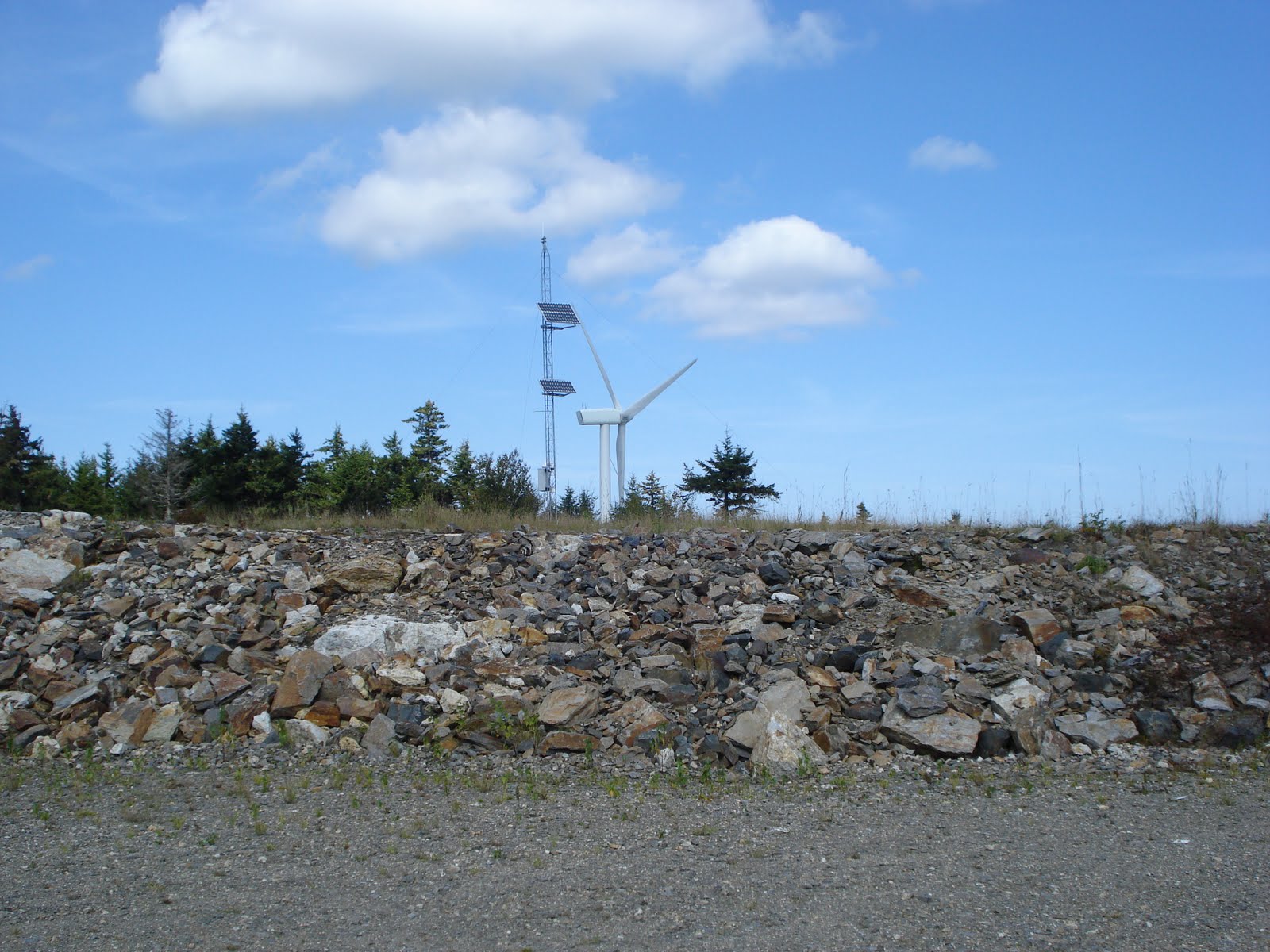
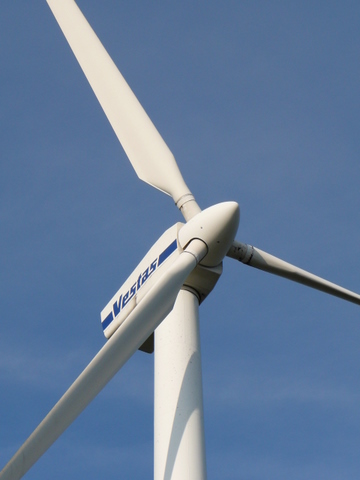
Let’s take wind turbines. Most people are immediately struck by how big the things are. A 3 MW wind turbine has blades that sweep the entire area of a football field. The Vestas at Kingdom Community Wind (Lowell Mountain) have blades that sweep 112 meters (367 feet). Why so big? Because wind is not energy-dense. Think about it: a windy day can blow some trash around, but the wind usually can’t lift even a tiny dog and blow it around. If you want to make electricity with wind — enough electricity to make it worth the trouble to put in a transmission line — you have to capture a lot of wind. So, you build turbines that sweep more than the area of a football field.
 |
| Solar and Wind at Lempster NH |
If we do move to a 90% renewable energy portfolio, much of Vermont’s high country would need to be sacrificed to meet the CEP’s goals. Still, that wouldn’t cover the electricity we would need, because sometimes the wind doesn’t blow.
 |
| Logs at Springfield NH biomass plant |
Biomass? It is difficult to calculate the wood required by biomass plants. Using information from the McNeil and Ryegate biomass plants gives different results from calculations based on wood heat content and power plant efficiencies. Basically, making 18,000 GWh with wood biomass will require between 8 and 14 million cords per year. In contrast, the current wood harvest from Vermont is about 1 million cords per year.
 |
| At the Springfield plant |
How much forestland does, say, 12 million cords represent? Estimates of a sustainable wood harvest vary from 0.5 to 2 cords per year per acre. Assuming one cord per acre, we would need 12 million acres to be devoted to wood for the biomass power plants. The total area of the state of Vermont is 5.9 million acres, of which 4.6 million is forested.
Any (or any combination) of the above mentioned options necessary to meet a 90% renewable policy would have a tremendous impact on the look and feel of Vermont for generations to come. Tourism plays a very important role in the economy of this state, and a pristine and rural landscape is an important part of the Vermont brand. We really have to decide if “90%” is worth its tremendous cost to our environment. (And to our pocketbooks. Electricity made from renewables costs two to ten times as much as standard “grid” electricity. We can expect Vermont’s electricity prices to double or triple, if the CEP is actually put into effect.)
People who are against large-scale renewable energy development are often ridiculed as NIMBYs. However, they may simply be aware that achieving renewable-energy goals will have huge effects on Vermont’s landscape and ecosystem, and they don’t want that to happen. In other words, people opposed to renewable developments are often true environmentalists. It is time to reject the impossible goals of the CEP, and implement only the renewables that are reasonable and cost-effective for the citizens of our state.
-------
This is a preliminary version of the Vermont Land Use report that George and I are writing for the Ethan Allen Institute. This post first appeared on the Ethan Allen Institute site.
Tuesday, April 30, 2013
The Big Green Energy Mountain: A Song
The Big Green Energy Mountain
In the year that oil had reached its peak a New Age lad came biking
He rode right in with a progressive grin and a hubris that was striking
"I'm heading for a land that's far away from the greenhouse gas cloud mountin’;
and if you’re all wise, you’ll subsidize the Big Green Energy Mountain."
On the Big Green Energy Mountain, the sun shines day and night.
The solar cells that run the wells provide abundant heat and light.
And you can site them miles away ‘cause the power lines have no loss.
The windmills all drive, spinning nine to five,
the birds are all happy just to be alive,
On the Big Green Energy Mountain
On the Big Green Energy Mountain, the cars burn alcohol.
And to make these stocks of ethanol takes no farm land at all.
The trucks all run on water and surplus cooking oil.
Their engines respond to biodiesel spawned
from the algae that’s grown in a big koi pond,
On the Big Green Energy Mountain
On the Big Green Energy Mountain, the cordwood has no soot;
the forests can be clear cut miles around without a tree uproot.
The dams don’t block the canyons and the fish can swim right through.
The geothermal brings many shallow hot springs
the stoves use methane that the compost pile brings
On the Big Green Energy Mountain
Well I’ve been all around that verdant hill and now I must say frankly
For energy safe and clean and true, I’ll take Vermont Yankee
I’m tired of being taxed by political hacks
For boondoggle schemes that belie all facts
On the Big Green Energy Mountain
----------
My friend Dana Krueger wrote this song, and I decided to run it on the day of the NRC meeting. Plant opponents may be better at intimidation, but we have better songs!
The original Big Rock Candy Mountain song is below, just for fun.
In the year that oil had reached its peak a New Age lad came biking
He rode right in with a progressive grin and a hubris that was striking
"I'm heading for a land that's far away from the greenhouse gas cloud mountin’;
and if you’re all wise, you’ll subsidize the Big Green Energy Mountain."
On the Big Green Energy Mountain, the sun shines day and night.
The solar cells that run the wells provide abundant heat and light.
And you can site them miles away ‘cause the power lines have no loss.
The windmills all drive, spinning nine to five,
the birds are all happy just to be alive,
On the Big Green Energy Mountain
On the Big Green Energy Mountain, the cars burn alcohol.
And to make these stocks of ethanol takes no farm land at all.
The trucks all run on water and surplus cooking oil.
Their engines respond to biodiesel spawned
from the algae that’s grown in a big koi pond,
On the Big Green Energy Mountain
On the Big Green Energy Mountain, the cordwood has no soot;
the forests can be clear cut miles around without a tree uproot.
The dams don’t block the canyons and the fish can swim right through.
The geothermal brings many shallow hot springs
the stoves use methane that the compost pile brings
On the Big Green Energy Mountain
Well I’ve been all around that verdant hill and now I must say frankly
For energy safe and clean and true, I’ll take Vermont Yankee
I’m tired of being taxed by political hacks
For boondoggle schemes that belie all facts
On the Big Green Energy Mountain
----------
Dana Krueger (with apologies to Harry McClintock http://www.stlyrics.com/lyrics/obrotherwhereartthou/inthebigrockcandymountains.htm
Land Use For Renewables
The Comprehensive Energy Plan for Vermont (CEP) says that Vermont will use 90% renewables by 2050. My husband and I are doing a report on the land-use implications of this 90% renewable path for Vermont. An early report on land-use is at the Ethan Allen Institute site right now. The 90 Percent Solution. You can expect a longer report later in the year.
Back to the Song
Land Use For Renewables
The Comprehensive Energy Plan for Vermont (CEP) says that Vermont will use 90% renewables by 2050. My husband and I are doing a report on the land-use implications of this 90% renewable path for Vermont. An early report on land-use is at the Ethan Allen Institute site right now. The 90 Percent Solution. You can expect a longer report later in the year.
Back to the Song
The original Big Rock Candy Mountain song is below, just for fun.
Saturday, February 16, 2013
Transitioning to Renewable Power: What It Might Look Like
Transitioning to Renewable Power: An Expert Describes What it Might “Look Like”

By Guy Page
How many in-state, renewable power plants would it take to generate five percent of all energy used in the state?
This isn’t just an academic question for energy policy wonks. The State of Vermont has hitched its wagon to the star of 90 percent renewable power by 2050, and is pulling mighty hard to build more wind turbines, solar farms, and other renewable power generators. And some Vermonters are pushing back just as hard.
There’s no lack of spirited debate, but sometimes it’s hard to find good, solid facts. On February 7, the State of Vermont’s Director of Energy Policy and Planning, Dr. Asa Hopkins, performed and important and very informative public service as he addressed the Vermont Energy Generation Siting Policy Commission at a public hearing in Montpelier. Using “just the facts, ma’am” tone and detail, Dr. Hopkins described what a five percent increase in Vermont-generated renewable electric power would look like.
The Five Per Cent Non-Solution
Hopkins emphasized that there’s nothing magic about five percent. It’s just one intermediate step from the 23 percent renewable energy level of 2010 to the 90 percent goal of 2050. He also clarified that electricity is a third of Vermont’s total energy sector. Heating and transportation, both more heavily dependent on fossil fuels, account for the other two-thirds. The state energy analyst described several possible paths to increasing total energy by five percent solely through instate renewable power generation:
How Much Do We Need?
Dr. Hopkins noted that the expected reduced demand through conservation will cancel out the projected annual growth in demand for electricity. There is a notable exception: when demand for electricity rises by one-third due to the transition to plug-in electric vehicles. Energy conservation can’t keep up with a power demand spike of that size. At that point, Vermont ‘s power supply would need a real boost.
Vermonters know, more than we knew several years ago, the challenges that wind and solar projects present. We are developing opinions of a future of renewable power, based on our actual experience. Dr. Hopkins’ scenarios may help some of us inform those opinions. Knowing what we know, do we want five more Lowell Mountain wind projects, or solar farms everywhere, or hundreds more small dams, or heavier harvesting of woodlands in and around Vermont? Or an energy buffet of smaller servings of “all of the above?” For others, the answer might be “none of the above.”
Two years ago there was just a single ridgeline wind facility, now there are four. Solar power production on rooftop homes, on large buildings, and in pastures are on the rise. Plug-in car registrations grew 57% in 2012, but only to 188 in total.
Can we build (and afford) enough renewable power? If we can, do we want to? These are questions that Vermonters will continue to debate. But with the help of Dr. Hopkins’ illustrations, at least we can better understand what the finished work might look like.
-----------
Guy Page is Communications Director of the Vermont Energy Partnership. He has several excellent guest posts on this blog. His most recent post was Energy Policy is Key to Vermont's Future.
Vermont Energy Partnership is a diverse group of more than 90 business, labor, and community leaders committed to finding clean, affordable and reliable electricity solutions. Entergy, owner of Vermont Yankee, is a member of the Vermont Energy Partnership.
Asa S. Hopkins is the Director of Energy Planning for the Vermont Department of Public Service. He holds a Ph.D. in physics from California Institute of Technology. He previously held positions at the Department of Energy and Lawrence Berkeley Laboratory.

By Guy Page
How many in-state, renewable power plants would it take to generate five percent of all energy used in the state?
This isn’t just an academic question for energy policy wonks. The State of Vermont has hitched its wagon to the star of 90 percent renewable power by 2050, and is pulling mighty hard to build more wind turbines, solar farms, and other renewable power generators. And some Vermonters are pushing back just as hard.
There’s no lack of spirited debate, but sometimes it’s hard to find good, solid facts. On February 7, the State of Vermont’s Director of Energy Policy and Planning, Dr. Asa Hopkins, performed and important and very informative public service as he addressed the Vermont Energy Generation Siting Policy Commission at a public hearing in Montpelier. Using “just the facts, ma’am” tone and detail, Dr. Hopkins described what a five percent increase in Vermont-generated renewable electric power would look like.
The Five Per Cent Non-Solution
Hopkins emphasized that there’s nothing magic about five percent. It’s just one intermediate step from the 23 percent renewable energy level of 2010 to the 90 percent goal of 2050. He also clarified that electricity is a third of Vermont’s total energy sector. Heating and transportation, both more heavily dependent on fossil fuels, account for the other two-thirds. The state energy analyst described several possible paths to increasing total energy by five percent solely through instate renewable power generation:
- Using large wind only, the state would need to generate 288 megawatts (MW), equal to 96 three- megawatt turbines. That is 4.6 times the capacity of the Kingdom Community Wind project.
- Using solar only, the state would need to generate 576 MW (5.4 square miles – half the size of Burlington or 1.3 times the size of Barre City), equal to 262 2.2 MW solar generators – the maximum size allowed under the state’s “standard offer” subsidized power program. Hopkins himself liked it to placing slightly more than one 2.2 MW solar plant in every town, city, and gore in Vermont.
- Using small hydro only, the state would need to generate 173 MW, almost twice the estimated capacity available from powering 300 of the 1200 existing dams. Hopkins noted that the federal permitting process for small hydro can be lengthy and complex.
- Using biomass (woodchips) only, the state would need to generate 139 MW, which would require an additional 1.1 million tons of fuel per year. At present, Vermont now uses 1.5 million tons/year total.
How Much Do We Need?
Dr. Hopkins noted that the expected reduced demand through conservation will cancel out the projected annual growth in demand for electricity. There is a notable exception: when demand for electricity rises by one-third due to the transition to plug-in electric vehicles. Energy conservation can’t keep up with a power demand spike of that size. At that point, Vermont ‘s power supply would need a real boost.
Vermonters know, more than we knew several years ago, the challenges that wind and solar projects present. We are developing opinions of a future of renewable power, based on our actual experience. Dr. Hopkins’ scenarios may help some of us inform those opinions. Knowing what we know, do we want five more Lowell Mountain wind projects, or solar farms everywhere, or hundreds more small dams, or heavier harvesting of woodlands in and around Vermont? Or an energy buffet of smaller servings of “all of the above?” For others, the answer might be “none of the above.”
Two years ago there was just a single ridgeline wind facility, now there are four. Solar power production on rooftop homes, on large buildings, and in pastures are on the rise. Plug-in car registrations grew 57% in 2012, but only to 188 in total.
Can we build (and afford) enough renewable power? If we can, do we want to? These are questions that Vermonters will continue to debate. But with the help of Dr. Hopkins’ illustrations, at least we can better understand what the finished work might look like.
-----------
Guy Page is Communications Director of the Vermont Energy Partnership. He has several excellent guest posts on this blog. His most recent post was Energy Policy is Key to Vermont's Future.
Vermont Energy Partnership is a diverse group of more than 90 business, labor, and community leaders committed to finding clean, affordable and reliable electricity solutions. Entergy, owner of Vermont Yankee, is a member of the Vermont Energy Partnership.
Asa S. Hopkins is the Director of Energy Planning for the Vermont Department of Public Service. He holds a Ph.D. in physics from California Institute of Technology. He previously held positions at the Department of Energy and Lawrence Berkeley Laboratory.
Saturday, February 2, 2013
The Vermont Energy Land Use Report
The Energy Education Project of the Ethan Allen Institute (I am the director of the Energy project) has a new initiative: the Vermont Energy Land Use Report. We announced the report in the Ethan Allen Institute February newsletter, and I copy that announcement below. Later, there will be press releases and so forth.
To donate to preparing this report, click the Donate button on this blog or the Support Freedom button on the Ethan Allen Institute website. Please donate to help build a solid report which will be of interest to everyone in Vermont.
Energy Education Project Keeps Close Watch on Energy Issues
In the last few months, the Energy Education Project has focused in two main areas:
- Educating people about the value of the Vermont Yankee power plant, and encouraging them to testify in favor of the plant at the Public Service Board hearings
- Writing op-eds and letters to the editor about the economics of renewable energy and the problems with over-investing in these technologies.
Both these areas are the source of fierce debate within Vermont. Here's the gist:
Vermont Yankee:
 The Public Service Board must rule on a Certificate of Public Good for Vermont Yankee. The PSB evaluated this subject between 2008 and 2010, but then the Senate voted in 2010 to forbid the Board from releasing its findings. The Federal Court decision in 2012 told the state that it could not make decisions about nuclear plants based on nuclear safety. Nuclear safety evaluations are the purview of the Federal government.
At that point, the Public Service Board decided its docket about Vermont Yankee was contaminated with inappropriate material. It opened a new docket, and held two public hearings about the Certificate of Public Good. In general, anti-nuclear groups completely mob these hearings, often with many people from Massachusetts. The Energy Education Project encouraged supporters of clean efficient energy to come to the PSB hearings. Other groups (such as Associated Industries of Vermont and the main Vermont Yankee union) did the same. Therefore, the meetings had a high proportion (in one case, a majority) of plant supporters.
 |
| Plant supporters line up to make statements at hearing |
Since the supporters were not outnumbered, more of them chose to speak. We made an effort to have the Public Service Board hear both sides of the Vermont Yankee story, including the supporter side. That effort was successful. There were only two public hearings on this docket. Plant supporters were there.
Renewable Energy:
In 2011, newly-elected Governor Shumlin was "shocked" to discover that the state's energy plan assumed that Vermont Yankee would keep operating. His appointees at the Department of Public Service put together an ambitious energy plan: the state will use 90% renewable energy for everything (including home heating and transportation) by 2050.
 |
| Wind resource map of Vermont |
 The new Comprehensive Energy Plan for Vermont has striking similarities to the German plan. The Energy Education Project has written several op-eds about this issue.
 We will write a white paper in the near future about the land use consequences of the current Vermont Energy plan. Renewables are not only intermittent, they are diffuse energy sources, and require a lot of land to make a relatively small amount of power. Land use has only been addressed in a fragmentary way in the media, and we will rectify that.
--------------------
The Energy Education Project
I am director of the Energy Education Project of the Ethan Allen Institute. The Ethan Allen Institute was founded in 1991 and is Vermont's independent, nonpartisan, free-market-oriented public policy think tank. The Institute was kind enough to take my interest in Energy Education seriously, and form a Project under the general heading of the Institute. We founded the Energy Education Project of the Ethan Allen Institute in September, 2010. Here's my blog post about the Energy Education Project launch.
The Ethan Allen Institute just revitalized its website, to a great, modern site. I encourage you to visit ethanallen.org. The new site is attractive and very easy to navigate! Most of the topics are far removed from energy, but I expect energy will be higher on the agenda in the near future. You can donate to the Ethan Allen Institute by clicking the "support freedom" button on the web page.
Tuesday, August 31, 2010
Solar and Nuclear: Economics and Land Use

Today, I am pleased to host this guest blog written by Willem Post.
Willem Post, Bob Hargraves, Howard Shaffer, Peter Roth, Steve Fox and I are all members of the local group, Coalition for Energy Solutions. Willem has both an MS in Mechanical Engineering and an MBA. He has many years of experience in financial estimation and oversight of large energy projects. Willem has written several reports on energy subjects. The Coalition For Energy Solutions Research and Reports page includes links to these reports. This is his first guest post for Yes Vermont Yankee.
Introduction
A recent article on the New York Times Greenwire describes the Blythe Solar Power Project, BSPP. BSPP is a 968 MW thermal solar plant on 7,025 acres, or 11 square miles, of Bureau of Land Management, BLM, land in the California desert. The plant consists of (4) 242 MW units. Expected total energy delivered to the grid is 2,200 GWh. The capital cost will be $6 billion. It will take at least 6 years to complete. (A more complete description can be found in the project application documents.)
The BSPP will utilize solar parabolic troughs to generate electricity. Arrays of parabolic mirrors collect heat energy from the sun and refocus the radiation on a receiver tube located at the focal point of the parabola. A synthetic hydrocarbon is used as a heat transfer fluid (HTF). The HTF attains high temperatures (750 degrees F) as it is piped through the receiver tubes. The HTF is then piped through a series of heat exchangers where it releases stored heat to generate high- pressure steam. The steam is fed to a traditional steam turbine generator where electricity is produced. The plant is started in the morning and shut down in the evening.
Power Production
The annual production from the plant will be = 968 MW x 8,760 hrs/y x CF 0.26 = 2,200 GWh. The power varies daily and seasonally with the strength of the sun and is available only during the sunshine hours of the day.
For reference: Vermont uses about 6,000 GWh/yr
The NYTimes article states this power is enough for roughly 800,000 households. As a California household uses about 6,000 kWh/yr, about 4,800,000,000 kWh/yr would be required by these households.
The NYTimes statement is grossly inaccurate, unless the writer meant that the power is enough only during the sunshine hours of the day. This is a sizable difference of 2,600,000,000 kWh. For a NYTimes writer to report on thermal power and not understand the real world and the numbers is truly incredible.
Other power sources, such as pumped storage hydro, nuclear, wind, stored biogas (CO2 emitting) and fossil (CO2 emitting) will be needed to supply the 2,600,000,000 kWh during low-sun and sunless hours.
Note: Wind power also varies daily and seasonally with the strength of the wind, and is not available at all when wind strength is too little or too much.
As such variable power becomes a greater percentage of the power mix, one approach is to have a greater capacity of CO2-emitting spinning reserves. These are usually fossil power plants that are running without sending power to the grid, but they can be called on to instantly increase their outputs when required. Spinning reserves allow the grid to maintain its required steady voltage. If there is too much voltage variation, all sorts of electrical equipment will automatically shut down.
Environmental Effects of the Project
The land will be leveled by bulldozers to accommodate the arrays. Even though it is desert, no fauna and flora lives there?
The 11 square miles of surface will create a heat island in the desert, hotter than an equivalent desert surface that is partially covered with vegetation, as in New Mexico. Some of that heat will be radiated outwards and some of that will be reflected back. A new, hotter eco-balance will be created in that area. Building a large number of such plants will add to global warming. It runs counter to having white roofs on buildings to reduce the heat island effect and global warming.
Legislative Requirements and Tax Credits
The force that drives this project is California's renewables mandate for utilities and the 30% federal tax credit; about $2 billion in this case.
If a developer cannot use the tax credit, he can opt to get a check for $2 billion from the federal government. In other words, a check from all of us.
Thermal Solar Compared with Nuclear Power
A standard 1,000 MW nuclear plant for about the same cost as the above thermal solar plant would produce = 1,000,000 kW x 8,760 hrs/yr x CF 0.90 = 7,884,000,000 kWh/yr, 3.58 times the power of thermal solar plant.
This power is steady and 24/7/365, i.e., it is available during all hours of the day, CO2-free, and will serve ALL the power needs of 1,314,000 California households for a year.
New nuclear plants are designed to have useful service lives of about 60 years. A spreadsheet comparison of the lifetime costs of PV solar and nuclear plants would need to include the replacement of all PV panels and disposal of the old PV panels at a multi-billion dollar capital cost around the 25th year of the comparison.
The 1,000 MW nuclear plant would require about 100 acres. This is only 1.5% of the land area required for the 1,000 MW PV solar plant.
Given the above, it is to be expected that the smart and knowledgeable power industry experts in at least 30 major nations, such as the US, the UK, France, Germany, Sweden, Japan, China (building about 50% of the nuclear plants being built), India, etc., have convinced their governments to continue to opt for nuclear power as a major component of their future power mix.
To do otherwise is a folly.
A German Renewable Power Demonstration
Several German power industry experts created, for demonstration purposes, a “renewables utility company” that uses several field-mounted, sun-tracking PV solar plants in southern Germany, several wind farms in northern Germany, several biogas-fueled combined cycle gas turbine plants with biogas storage tanks and several pumped storage hydro plants, all controlled from a central point to maintain a nearly constant output to the grid, as would any traditional utility company.
The experts maintain that as it was shown to be technically feasable for a small combination of renewable power plants, it will be for increasingly larger combinations as well.
This works in Germany because its national grid is designed as their cars and trains. For this to work in the US, its national grid, with about 1,000,000 MW of power plants connected to it, will need to be rebuilt at a cost in the order of $200-$300 billion during the next 10-15 years. Going “variable and renewable” has its costs.
As an alternative, that level of funding could be used to replace 33,000-50,000 MW of the older US nuclear plants; no significant changes to the grid would be required.

Subscribe to:
Posts (Atom)