Showing posts with label podcast. Show all posts

Wednesday, April 5, 2017

Ecomodernist Podcast on "Campaigning for Clean Air"

I was recently invited to talk about my book, Campaigning for Clean Air, on the Ecomodernist Podcast.  The podcast was released, and here's the link.  I hope you will listen to it: I think you will enjoy the conversation.

The Ecomodernist Podcast:

Part of the podcast was talking about my book, There are many books about the virtues of nuclear power, but this is the first book (as far as I know) on how to support nuclear power in the public sphere.  It's the "then what" book:

"Now that I know about the importance of nuclear power, then what can I do to support it?"

My book is a major answer to that question.   I encourage you to read its excellent reviews on Amazon.

However, a good podcast goes beyond just discussing the book.  Gabriel Ignetti and Rick Maltese were great interviewers.

We discussed combustion versus nuclear energy for electricity. Specifically,  we discussed the nasty effects on air quality that are caused by nitrogen oxides from gas and coal-fired plants. Nowadays, carbon dioxide gets all the press, but nitrogen oxides are still out there, making smog and acid rain. We discussed  being members of environmental groups that are fighting climate change, and the importance of sticking up for nuclear within these groups.  Ignetti, especially, had good stories about his involvement in the environmental movement in Florida.  We discussed hecklers and people who really get "in your face" against nuclear, and possibly-effective versus certainly-ineffective ways to deal with them.

At the end of the podcast, Ignetti and Maltese have a short, separate section, sharing some research they did about how nitrogen oxides affect people's health, forest health, and even our sculpture and our buildings.

Ecomodernism

Painted trillium in Pisgah National Forest
A not-power-plant near a waterfall.
I was on the  "Ecomodernist Podcast," and now you may be wondering: what is "ecomodernism"?  Ecomodernism is a movement that started in 2015, with the publication of the Ecomodernist Manifesto. The ecomodernist goal is human prosperity and an ecologically vibrant planet.

This goal will be achieved by humans choosing technologies that can lift people from poverty and supply abundant energy, while using less of the of the world's area for human endeavors.  This means, for example, using compact energy sources like nuclear power, and leaving the ridges, the tides, the woodlands,  the pastures, and the streams to benefit the ecologies that need ridges, tides, woodlands,  pastures and streams.  In other words, giving nature room to breathe, while giving humans enough abundance to live healthy lives.

Ecomodernism hadn't been invented yet, in 2013, when I had an article in ANS Nuclear Cafe: Farmers, City Folk and Renewable Energy. But the idea in my article substantially the same: don't look at every woods and every waterfall as a source of energy, ready for "biomass" burning, or building a nice big concrete dam.

Let much of nature be nature.  Use compact sources of energy, rather than bulldozing the woods.

That is also a goal of ecomodernism.

Monday, January 25, 2016

Podcast and my book

Podcast and my book

Rod Adams
Last night I was on the Atomic Show podcast, hosted by Rod Adams.  Here's the link: Atomic Show #250---Being nice nukes.   My fellow guests were Steve Aplin of Canadian Energy Issues, Gwyneth Cravens, author of Power to Save the World, and Bob Apthorpe, a nuclear safety professional who is most well known as @arclight on twitter. We had a fine conversation on the nuclear energy outlook worldwide.  

For me, some of the conversation was very special.  I have written a book Campaigning for clean air: secrets of pro-nuclear advocacy and community.  The draft is complete, but the book is still being reviewed by various people.  

Two of those people happened to be on the podcast with me:  Adams and Cravens.  At the beginning of the podcast, Adams asked me why I mentioned my blogs but not my book.  Good question indeed!  I don't know the answer to that one!

Meanwhile, people commented on the book (with praise) and asked me questions about it.   Adams and Cravens said very nice things. I was blushing.  Luckily, you couldn't see me.

I hope you will listen to the podcast.

Thursday, July 18, 2013

The Live and Local Podcast: Assessing the Energy Plan in Vermont:

Energy Safari group 
at Lempster Wind Farm
The Comprehensive Energy Plan and My Op-Ed

The Vermont Comprehensive Energy Plan, issued in 2011, asserted that Vermont would obtain 90% of all its energy from renewables by 2050.   I have been studying the land-use implications of that plan, and my husband and I are preparing a report for the Ethan Allen Institute. (I am the director of the Energy Education Project, which is part of that Institute.)

With our preliminary results, I wrote an op-ed: Vermont Renewable Plan is Wishful Thinking. This op-ed was printed in several newspapers in Vermont.  Most particularly, the op-ed was printed in The Commons, a weekly independent, nonprofit paper in Brattleboro.  I want to give a hat tip to Jeff Potter of The Commons, because he truly welcomes voices from both sides of this controversy.

Chris Lenois is host of the Live and Local radio program in Brattleboro (WKVT 1490 FM).  Lenois saw the op-ed in The Commons, and he invited me to speak on his show.  I was on Live and Local yesterday.

The Podcast

WKVT mounted a podcast of the discussion on their site: Meredith Angwin --VT Energy Policy.

Lenois asked me:
  • How I estimated Vermont's future energy use
  • Whether an ambitious renewables policy could encourage innovation in renewable energy
  • How I derived numbers such as "400 miles of ridge line for wind turbines"
  • The role of efficiency and conservation in Vermont's energy policy
To answer Lenois' questions, I needed to go into depth about land-use issues and my research methods.   I think you will find the podcast interesting.  

Thank you to Chris Lenois for inviting me and asking me serious questions.  I also thank him for his role in quickly mounting the podcast on the WKVT website.

Tuesday, June 4, 2013

Catching Up With the Diesels: Updated

A Diesel Deadline

Vermont Yankee needs new diesel generators as a safety back-up system. There will be two court hearings about this: today and tomorrow.

Basically, the Public Service Board (PSB) has been dragging their feet about granting permission to install the diesels.  Vermont Yankee must begin pouring the concrete for the diesel pad in mid-June to meet a Nuclear Regulatory Commission requirement to have the diesels in operation by mid-September.

The PSB has been seriously dragging their feet.  First the PSB took months to even set up the docket and open it (Vermont Yankee applied for the permit in August, the PSB issued a statement opening the docket in late December).  The PSB gave "intervenors" status in this matter, and plans to hold public hearings to hear what these groups have to say. (Hint to the PSB: the intervenors always say the same thing. If you want, you can ask me what they are going to say. I think I can tell you.) Recently, the hearing officer recommended that the diesel permit be granted, but the PSB did not amend the timing on its docket.

I blogged about the diesel time-line in two posts: The PSB, the Diesels and Sherlock Holmes about non-action also being action (like the famous "incident of the dog in the night-time") and A Court Case With A Deadline: The Black Start Diesels.  In that case, the deadline I was considering was Entergy's requirement to get the diesel pads ready.

Court Deadlines

Now, as the deadline approaches, two hearings are under way, today and tomorrow.

Andrew Stein of Vermont Digger has a post on these hearings: State, Entergy head to federal court Tuesday. Stein's article includes a quote from an intervenor's lawyer, Brice Jordan.  Jordan claims that since the state does not need Vermont Yankee, the diesel permit should not be granted. (Jordan also has said that he does not have to share information on hydro plants, but that was a different hearing.) In other words, in Jordan's opinion, the diesel hearings are a stand-in for the hearing on the certificate of public good for the whole plant. 

Jordan's opinion is not shared by the State Department of Public Service (DPS). The DPS makes a clear distinction between 
  • the diesel permit, which they think should be approved
  • the certificate of public good (CPG) for the plant operation, which they think should not be approved.
  In an earlier Vermont Digger article, the DPS commissioner, Chris Recchia, said: “This [the generator permit] has no relationship to the overall CPG for operation of the facility; it’s specific to the back-up generator, and we think they’ve done what they need to do."


Meanwhile, the state and Entergy are once again busy in court.  In my opinion, these court cases could have been avoided if the Public Service Board just knew how to spell "pre-empted." Court hearings are a very expensive way to learn to spell.  Yes. I'm a blogger, and I have opinions. 


Update: At the Federal Court hearing today, the state argued that Vermont Yankee didn't actually need all that time to put the diesels in place.  Meanwhile, nuclear opponents made statements implying: "Of course VY was going to get the diesels, why are we even in court about it?"

Well, let's see.  The long gap between when Entergy applied for the permit and when the PSB started working on the docket: that might be one reason they were in court.  The PSB's snarky "if Entergy is not in compliance with our earlier orders" comments: that might be another reason. I am sure you can think of more reasons.

Here's my link to John Dillon's VPR report on today's hearings.

Second Update: Andrew Stein's Vermont Digger article on the federal court hearing was just published.  It includes Cheryl Hanna's masterful description of the different possible outcomes of the diesel case before the PSB, and the implications of those outcomes for the federal hearings. Also, Hanna points out that the legal wrangling about "how many days does it take to install a diesel" isn't very relevant. Cheryl Hanna is a professor of constitutional law at Vermont Law School.   


Two links on other subjects

I was proud to be a participant in an important pod-cast on nuclear communication.  Peter Sandman Teaches Nuclear Communicators.   This was an Atomic Show podcast at Rod Adams blog, Atomic Insights.  Peter Sandman, Rod Adams, myself, Margaret Harding, and Suzy Hobbs-Baker participated. I expect to blog about this in a few days. 

I also recommend the 159th Carnival of Nuclear Energy at Next Big Future. Great posts, including updates from Japan and China, and an apology from a nuclear opponent for factual errors. This may be the first time in history such a thing has happened. Read about it!


Tuesday, March 19, 2013

Black Start, Intervention, plus some links

Vermont Yankee
 Vernon Dam in the foreground
Vernon Dam and the Diesel Generator, Again

ISO-NE recently reclassified Vernon Dam.  The dam is no longer a Black Start facility, that is, it is not one of power plants charged with re-energizing the grid after an extensive power outage.  Because of this reclassification, Vermont Yankee may (or may not) have to obtain a new diesel generator, and may (or may not) need a Certificate of Public Good (CPG) for the generator.   You can read my post about the Vernon Dam reclassification at: Black Start, BlackOut, and Diesels: Some Clarity

In all this uncertainty, two things are certain:
  • Vermont Yankee applied for a Certificate of Public Good for the diesels
  • One of the old-line intervenors, New England Coalition against Nuclear Pollution, took this as an opportunity to intervene, and was granted intervenor's status.
A recent article by Bob Audette in the Brattleboro Reformer describes this latest intervention Board Grants NEC's Request to Intervene in VY Diesel Case.  The article quotes the Public Service Board hearing officer, Lars Bang-Jensen, as follows:

Bang-Jensen noted that the PSB hasn't even concluded whether it "can or should" grant a CPG for the diesel generator "on any schedule." The diesel generator application is being processed on the assumption that it will not become effective unless the extended operation CPG is approved, he wrote.

And so, in Vermont, with the help of intervenors, a simple request for safety equipment becomes a complex issue.

----------

Some links worth following:

Carnival: The 148th Carnival of Nuclear Energy Bloggers is up at Hiroshima Syndrome. Leslie Corrice has done a great job on this post.  I don't think there is anywhere else on the web where you can find so comprehensive a collection of pro-nuclear retrospectives on Fukushima.  (The Carnival covers other topics, including Vermont Yankee, but the Fukushima coverage is spectacular.)


Podcast: Rod Adams has been hosting Atomic Show podcasts for years.  More than seven years, as a matter of fact, and this week he hosted a spectacular podcast, Atomic Show #200, with atomic communicators and experts on three continents (Australia, Europe and North America).  Congratulations to Rod for his unceasing and effective efforts in favor of nuclear energy.  Enjoy the podcast!

Tuesday, February 19, 2013

Friendly Nuclear Bloggers, Carl Sagan, and More

Lifestyles of the Galaxies Next Door
Compendium of Galaxies from the Spitzer Space Telescope
(My tribute to Carl Sagan)
On Sunday night, I took part in an Atomic Show podcast with Rod Adams, Margaret Harding, Andrea Jennetta, and Cal Abel.   The title of the podcast is Atomic Optimists,  and you can hear it or download at the link.

The group was very optimistic about the future of nuclear energy. We are a group of friends, at least the on-line variety, and we had a great time talking about our favorite subject: nuclear energy.

We were optimistic, as reflected in the title of the podcast: Atomic Optimists.  However, we weren't optimistic about everything. As Rod Adams wrote: We worried together about the fact that some leaders in our nation seem to be happy to be directing a post industrial economy despite the fact that people still want things, not just services like those provided by lawyers and accountants.

Carl Sagan

Shortly after the podcast, my friend Bob Hargraves, author of Thorium, Energy Cheaper than Coal, sent me a quote from Carl Sagan that seems very relevant to Rod's comment.  Here's the quote from Sagan:

“I have a foreboding of an America in my children's or grandchildren's time -- when the United States is a service and information economy; when nearly all the manufacturing industries have slipped away to other countries; when awesome technological powers are in the hands of a very few, and no one representing the public interest can even grasp the issues; when the people have lost the ability to set their own agendas or knowledgeably question those in authority; when, clutching our crystals and nervously consulting our horoscopes, our critical faculties in decline, unable to distinguish between what feels good and what's true, we slide, almost without noticing, back into superstition and darkness...

The dumbing down of American is most evident in the slow decay of substantive content in the enormously influential media, the 30 second sound bites (now down to 10 seconds or less), lowest common denominator programming, credulous presentations on pseudoscience and superstition, but especially a kind of celebration of ignorance”
Carl Sagan, The Demon-Haunted World: Science as a Candle in the Dark

Carnival 144

Carnival of Nuclear Energy Bloggers number 144 is now up, hosted at ANS Nuclear Cafe and compiled by Will Davis.  This Carnival takes on the big picture (is biomass green? do radiophobia and chemophobia have similar roots?), the small picture (Vermont Yankee, sigh), and the really big picture (fusion, economics). And more, much more!  Visit the Carnival and have a good time!


Wednesday, November 7, 2012

Areva and Helen Caldicott, plus More on Hurricanes

Areva and Helen Caldicott

Helen Caldicott recently went to Canada to talk about uranium mining.  She called the nuclear industry "immoral" and compared it to Hitler.  On a radio show, she refused to back up her statements, becoming angry instead.  The radio interviewer wrote that  she “sounded like a person unhinged.”  Today, I was pleased to see Jarret Adams of Areva refute her statements about Canadian mining in his blog post: Helen Caldicott Stays One Step Ahead of the Facts.

I thought I should illustrate this post with a picture of Caldicott, but I couldn't bear to do so.  Instead, here's a picture of a bunch of us at Areva's nuclear fuel recycling facility in France, about two years ago.  That's Jarret standing behind me (I'm the white-haired woman on the right).  Rod Adams is standing next to Jarrett and behind Gwyneth Cravens.

Okay, the rest of the names are Jack Gamble (next to Rod) and Steve Aplin (next to Jack) and a very knowledgeable Areva manager at the left side of the picture.  I am so sorry I don't have his name in front of me!  I guess that is why you can amend blog posts.

Update: We are standing in front of the Melox facility, and the man on the left is Regis Faure of Areva. Thank you to Jarret Adams for this update!

Do read Jarret's post: Helen Caldicott Stays One Step Ahead of the Facts.

More About Hurricanes

Since I have already mentioned Rod Adams, I want to say that Margaret Harding, William Davis and I were on Rod's most recent podcast.  Atomic Show #190: Nuclear Plant Performance During Hurricane Sandy. I linked to  the announcement of the podcast. Here's a link to the podcast itself.  It was a great discussion. I learned a lot from Margaret Harding's honest, blunt and basically optimistic discussion.

Meanwhile, my blog post Hurricane Sandy and Nuclear Plants in the Main Stream Media has been posted at The Energy Collective.  I am always proud when they choose one of my posts.


Monday, March 12, 2012

Why Nuclear is Regulated at the National Level

On Sunday, March 4, my local paper, the Valley News, published a letter to the editor about nuclear safety and Vermont. The letter was written by David C. and Shirley J. Montgomery. I quote part of their letter below:

"For about 60 years, we've been subjected to a seemingly endless Republican advocacy in favor of "states rights."....a decision to run the aged Vermont Yankee reactor above its rated capacity for another 20 years could be seen as indifference to events (such as Fukushima)...The legalistic arguments seem to have carried the day to date (as far as we can see, the Vermont state government is being dismissed for being concerned about the well-being of its citizens)...Where are the states righters when something as concrete as this is at stake?"

States Rights in Vermont

Many anti-nuclear protesters carry Vermont flags to the protests. (They wrap themselves in the flag?) They claim to stand for Vermont though they often live in Massachusetts. As I noted in an earlier blog post, states rights is no longer a dirty word to some people in Vermont.

Here is my letter that was was published in the Valley News on March 9.
--------------

Why the Feds Regulate Safety

A recent letter from David and Shirley Montgomery inquires why Vermont Yankee is regulated at the Federal level. The letter-writers would prefer state control.

Some complex technologies are regulated at the federal level by federal law. Airplanes (inspection, pilot licenses, mechanics licenses) are regulated by the Federal Aviation Administration. New drugs are approved by the Food and Drug Administration. Nuclear plant safety and inspections are in the charge of the Nuclear Regulatory Commission. Determining the safety of airplanes, drugs and nuclear plants takes significant specialized expertise. Also, it is best that important safety rules be applied on a nation-wide basis, not just locally.

It Could be a Race to the Bottom

However, these laws can be changed through our democratic process. If Mr. and Mrs. Montgomery want individual states to test drugs, inspect airplanes, or inspect nuclear plants, the federal laws can be changed. However, the probable result will be a race to the bottom. The states with the least oversight will get the most business. Drug approval and aircraft maintenance would move to "friendly" states, and nuclear regulation could vary widely between states.

This type of differentiation already happens in other areas. For example, Delaware's laws are welcoming toward corporations, and many American companies are incorporated there. Poorly-maintained ships fly the Liberian flag (flag of convenience).

In general, small governmental units are not well equipped to regulate complex subjects. The current system of federal regulation is better and safer. State regulation would be a change for the worse.

A Little About States Rights Advocates

Perhaps an aside, but I wanted to say this. The writers also claimed that "for sixty years, we've been subjected to a seemingly endless Republican advocacy in favor of 'state's rights'.." This is not correct. The state's rights segregationist movement was run by Democrats, not Republicans. The infamous State's Rights governors Orville Faubus and George Wallace ran and served as Democrats.

----
Endnote: After the letter was published, I received a note from a friend that Delaware is not mainly a pushover for corporations. Delaware's main attraction is that it set up an effective chancery court for civil lawsuits that involve companies in different states and different countries. I live and learn!

-------
Podcast: Yesterday, I was proud take part in this Atomic Show Podcast A Year After Fukushima. Rod Adams, Steve Aplin, Suzy Hobbs, Gwyneth Cravens and I talked about the accident, the coverage of the accident, and the implications for nuclear power. It was great to be on a program with such knowledgeable people!

Monday, January 9, 2012

Podcast Discussion of Vermont Yankee (and more)

Vermont Yankee Discussion

Last night, Margaret Harding and I were guests on the Atomic Show podcast, hosted by Rod Adams. Adams is the blogger at Atomic Insights, while Harding blogs at 4 Factor Consulting.

The main subject of discussion on our podcast was the Vermont Yankee lawsuit, especially the interstate commerce aspects of the case. As Rod wrote in his description of our conversation:
It still confuses me why people who live in Vermont have such a basic misunderstanding of the country in which they live; no state has the right to control interstate commerce. All of them gave that up when they signed on as members of the United States of America.

Sigh. Rod doesn't live in Vermont. As I wrote in a recent post, Vermont also passed a blatantly illegal law requiring Vermont Yankee to pay Vermont's costs in the ongoing lawsuit. Governor Shumlin and his obedient legislature seemed determined to pass law after law that get argued right up to the Supreme Court. Where Vermont loses.

Here's a link to the podcast of Atomic Show #177, Vermont Nuclear Energy Politics.

Nuclear Communications, Then and Now

Vermont Yankee was not the only topic of discussion on the podcast. We take a detour into nuclear communications, and especially, how nuclear communications were messed up in the early days. At first, some of the "silent service" aspects of the nuclear navy dominated the nuclear power communications style. Adams was in the nuclear navy, so we weren't talking behind the backs of the many fine Navy Nukes that run our power plants! But the Navy communications style was a problem in the 70s and early 80s, and it is good to admit that.

I also recommend Rod's post Greetings from a proud member of the 'nuclear party'. This post was also briefly discussed on the podcast, and is up this morning at ANS Nuclear Cafe.

Wednesday, December 7, 2011

Vermont Notes: Films, Fukushima, Statehouse Flaps

Blog posts, podcasts, and letters about Vermont and Vermont Yankee.

An Anti-Nuclear Film, and a Pro-Nuclear Person on the Panel Discussion

Howard Shaffer and I work closely together on Vermont Yankee advocacy. He is head of the Vermont Pilot Project of the American Nuclear Institute.

A film about nuclear power was developed at the Gund Institute for Ecological Economics of the University of Vermont. As we expected, this film was anti-nuclear. You can see a trailer for it here. Last week, at University of Vermont, Howard Shaffer and Arnie Gundersen were on a panel discussing the film. Today Shaffer has a blog post at ANS Nuclear Cafe: Transparent Radiation--A Film.

In his post, Howard Shaffer describes the film, the audience questions, and the panel members answers. This film and panel was a Vermont event, but the film will be entered in many film festivals. How it is received will be relevant beyond Vermont.

Fukushima Podcast

People who lived near the Fukushima Power Plants want to go home. What should be the criteria for ending the evacuation? Rod Adams has a podcast: Let Fukushima Residents Go Home. Participants are Rod Adams, me, and Cal Abel. Adams is the blogger at Atomic Insights (and an ex-submarine officer). Abel is an ex-submarine officer and current grad student at George Tech. The conversation includes
  • Why are the local Fukushima cattle dying? (because nobody is feeding them),
  • Is the Linear Non Threshold Theory reasonable?
  • How come people drive cars, smoke, and have dental fillings? Driving, smoking and mercury can be considered "Linear Non-Threshold" activities or substances.
Warning. There are sound quality issues with the podcast. I talk too softly and Rod breathes too loudly.

High Jinks and High Rollers in the Vermont State House

High Jinks: John McClaughry posts in Vermont Tiger: It Takes One to Know One. Tony Klein is chairman of the Vermont Natural Resources Committee in the Vermont House of Representatives. Klein is upset about proposed anti-wind legislation. Klein is a fierce opponent of Vermont Yankee. I was in a committee room when Klein said that the existence of Vermont Yankee on Vermont soil could ruin the Vermont Brand.

Klein is also a proponent of wind turbines, and he is very upset that the proposed legislation could "pocket veto" wind without a vote. McClaughry points out that the Vermont House illegally "pocket vetoed" Vermont Yankee by not voting. (The famous vote was only in the Vermont Senate.) As McClaughry says: It Takes One to Know One.

Full Disclosure: The Energy Education Project that I direct is part of the Ethan Allen Institute that was founded by John McClaughry.

High Rollers: In the Bennington Banner (unfortunately behind a paywall) L.A. Leonard of Rutland wrote a letter to the editor. An excerpt is below:

Vermont recently lost a federal lawsuit trying to prevent companies from selling patient information to pharmaceutical companies. The Supreme Court rejected the law saying it violated free speech of companies and the law lacked coherence. We now learn taxpayers will be responsible for $1. 8 million not counting $600,000 for fighting the court case. This could be just the tip of the iceberg as experts believe there are still more plaintiffs to come.

Leonard then compares this case to the Vermont Yankee case. He predicts similar losses to the taxpayers from that lawsuit, and ends his letter as follows:

The legal fights could go on for years. May one suggest the governor, Attorney General Bill Sorrell and other state officials start picking up the tab rather than continue to burden taxpayers with no end in sight.

An excellent suggestion, which will be ignored. When it comes to Vermont Yankee, our legislators are addicted to Other People's Money.

---------------------

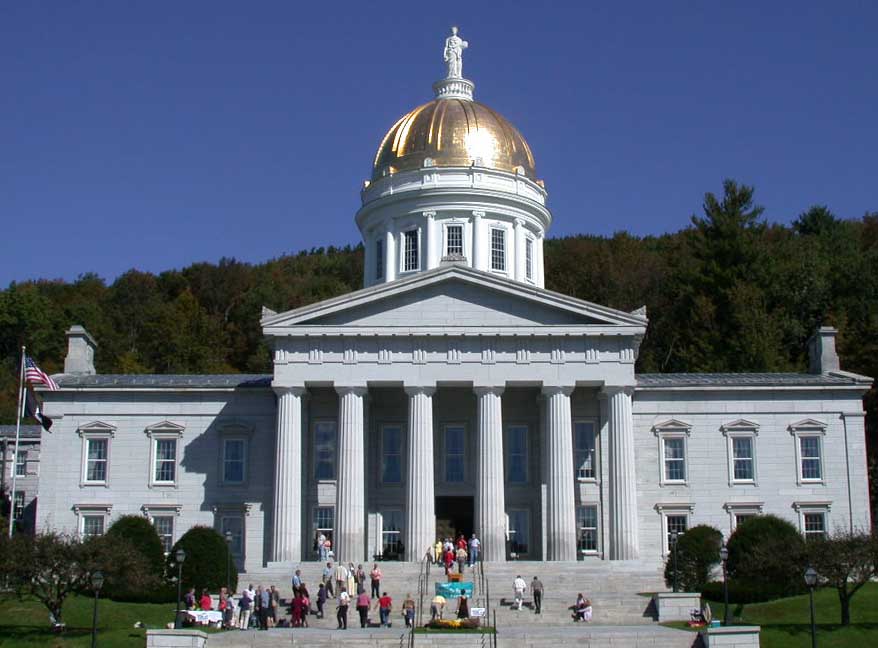
I decided to illustrate the Leopold letter with a picture of the Vermont Statehouse Dome, captured from Wikipedia. Note that that the dome is covered in gold.


Sunday, August 22, 2010

Monday Mop-Up: More on Genes, Carnival, Podcasts and Internet Privacy

A Retrospective About Posts that I Posted and Posts I Meant to Post

Grannies and Genes: A Set of Blogs

At various public meetings, the Vermont Yankee "Raging Grannies" hand out a quote from Alice Stewart. This quote is basically a summary of eugenics. Over the past week I have had four blog posts on the subject. The first post described the grannies. The next three posts talked about how the quote fits into the eugenics agenda, and why we should care.

My first post, Older and Unthinking, described the Grannies trespassing and arrest at Vermont Yankee. Some of the women have been arrested at the plant nine times, but charges are never brought against them. I suggested that being old shouldn't give you a pass on repeated lawbreaking.

My next three posts were about the Alice Stewart quote and its implications. The quote is distributed at public meetings by the grannies. Stewart claims that any mutation will spread through the population and contaminate the gene pool. A "bad seed" will build "defective genes into the population" and these will "never be rooted out."

This is the standard form of the eugenics argument: discrimination against people who are "defective" and have "defective genes." The argument has been used to forcibly sterilize imbeciles. Often, "imbecile" is defined as "person of another race" (such as the Abenaki First Nation in Vermont).

When I objected to receiving the eugenics handout at a Public Service Board meeting, I was roundly booed by the plant opponents.

My first post on this topic described the prinicples of eugenics: Grannies and Eugenics, the Cruelty of Ignorance.

The second post talked a little about Alice Stewart and her philosophy, and also explained why Vermonters, especially, should avoid making the eugenics argument. Eugenics frequently starts by trying to rid the world of "defective" genes and people, but it usually moves on to outright racism. That is what happened in Vermont with the Abenakis. My post: Alice Stewart's Work. Also, How Eugenics Affected Vermont.

My third post described modern genetics, and why "defective" genes don't actually build up in a population: Genes in Populations: A More Modern View.

The bottom line on all of this: The eugenics model is not how genes spread. Believing that eugenics is the correct model is cruel and eventually racist. The grannies should stop handing out eugenics literature at public meetings.

A Retrospective on the Posts: What About the Grannies Themselves?

There is another bottom line. Do I think the Grannies themselves are racist? No. I think they are ignorant of what they are doing, rather than racist.

They found a quote from Alice Stewart, and it fit with their ideas about how bad radiation is: "See, one bad gene can ruin the whole gene pool!"

I think that the Grannies:
  • know very little about science (modern genetics)
  • know even less about the history of science (the rise and fall of eugenics)
  • know very little about many aspects of regular history (Hitler and eugenics, Vermont and the Abenaki and eugenics).
I think they simply don't know they are distributing a quote that summarizes the world-view of eugenics, from a person (born in 1906) who may have written these words during the hey-day of eugenics in the 30s. That's why I titled my first post: the cruelty of ignorance, rather than the cruelty of racism. That's also why I refer to them as the "eugenics grannies" not the "racist grannies."

Ignorance can lead to very bad results, however. Including racism.

Carnival

I announced the Fifteenth Blog Carnival of Nuclear Energy in one of the eugenics posts. It was pretty well buried in the post, so I repeat it here.

The Fifteenth Blog Carnival of Nuclear Energy is up at Next Big Future. Nuclear Townhall notes that the Bellefonte plant at TVA is set to move forward again (construction was stopped in the 70s). Dan Yurman discusses the license process for Small Modular Reactors, and Charles Barton has a post about Australian climate scientist Barry Brook and his move to nuclear. Steve Aplin reviews the movie Countdown to Zero, about nuclear proliferation, including important insights about Iran's program. Brian Wang has put together a very interesting and eclectic mix of blog posts. Thank you Brian.

Come to the carnival! You always learn something, and it's fun, too!

The Atomic Show Podcast

I was honored and flattered to be on Rod Adams Podcast yesterday evening. Three of us discussed various topics, including the slowdown of the nuclear renaissance in this country. The three participants were Rod Adams of Atomic Insights blog, Charles Barton of Nuclear Green Revolution blog, and myself.

Download Atomic Show Podcast #160, Bumps in the Renaissance Road to hear what we said about the Renaissance, nuclear art, and more.

Internet Privacy

Yes. I'm off topic and talking about our daughter again.

In a previous post I noted that our daughter Julia Angwin is a Wall Street Journal tech editor. She just finished spearheading a major WSJ investigative project on "What They Know." This project explores what Internet marketers know about you. The WSJ web site for the project has databases and interactive graphics so you can explore your own experience.

Since then, Julia has been on several radio and television programs, talking about the project. Here is a link to see her on C-Span (forty minute interview). And here's a link to her appearance on the the NPR radio show On Point. This episode had the intriguing title of Creepy Commerce. In this program, Julia was on a panel that included an internet advertising executive. Nothing like controversy to make a show exciting!


Carnival Image is the Carousel in the square at Avignon.

Sunday, January 31, 2010

State of the Union


In general, I focus my posts on Vermont Yankee. Like most people in nuclear, however, I was completely delighted with the support of nuclear in Obama's state of the Union address, and the applause his pro-nuclear statement received. Rod Adams of Atomic Insights made a thoughtful annotated video of relevant parts of Obama's address. I share it above.

I am also doing a little BSP (Blatant Self Promotion). I will be on the Atomic Show podcast with Rod this evening. We will discuss the State of the Union address, but we will also discuss tritium. Rod will post a link later, and I will be sure to include that link in a blog posting.

Here's a link to the State Of The Union discussion podcast. The last half hour is about Vermont Yankee.