Showing posts with label Jaczko. Show all posts

Monday, August 19, 2013

Yucca Mountain and Vermont: Scofflaws in High Places

Yucca Mountain

Last week saw two court decisions that favored the nuclear industry. Both were about groups (the Vermont legislature, the NRC) that had taken actions that were illegal for them to take.

 The first court decision was the appeals court victory for Vermont Yankee. The Vermont legislature cannot regulate nuclear safety.  This decision was discussed in my post Vermont Yankee Wins in Appeals Court.

The second decision was a Writ of Mandamus about Yucca Mountain. With this Writ, a federal Court required the NRC to continue the license review process for the Yucca Mountain repository.  Billions of dollars have been spent on building this repository for high-level nuclear  waste in Nevada. However, Senator Harry Reid of Nevada is determined to keep the repository from opening.  So far, he has managed keep it closed.

Jaczko in Brattleboro, 2010
Former NRC Commission Chairman Gregory Jaczko was appointed to his NRC position in order to please Senator Reid.  As Commissioner, Jaczko stopped the Yucca Mountain license review process when it was nearly complete.

Jaczko had no legal right to stop the review process, but he did it anyway.  Jaczko also refused to release the Safety Evaluation Reports which were due to be released to the public.

Winning the Lawsuit

 A consortium of groups brought a lawsuit against the NRC to force them to continue the Yucca Mountain review; the plaintiffs included the National Association of Regulatory Utility Commissioners.  They won. This week, the Circuit Court in the District of Columbia ruled in their favor, issuing the Writ on August 13.

The Wall Street Journal described the legal outcome in  Problems with Authority: Lawless Regulators and the White House earn a Judicial Rebuke.  A quote:  In a  major rebuke on Tuesday, the D.C. Circuit Court of Appeals issued an unusual writ of mandamus, which is a direct judicial order compelling the government to fulfill a legal obligation. This "extraordinary remedy"(was taken in a case that)..."raises significant questions about the scope of the Executive's authority to disregard federal statutes."

The Lawsuit Explained

ANS Nuclear CafĂ© has an excellent review of the case, written by one of the petitioners: Court Finally Rules on Yucca Mountain NRC License Review, by Robert L. Ferguson. Ferguson has also written a book on the subject.  Also, this video clip is short but clear.


And Yet, Scofflaws Are Still Scofflaws

Writ of Mandamus or no Writ of Mandamus, it doesn't look as if the license review will continue. Senator Harry Reid of Nevada, Yucca Mountain's chief foe, has kept the funding for the review at zero.   As Senator Reid said: “With no disrespect to the court, this decision means nothing,”

Well, to me, that sounds just a little disrespectful of the court.

The Reid quote comes from the Las Vegas Review Journal article: Federal court order NRC to restart licensing process for Yucca Mountain. The video clip above is from the same article. In the video, you can see Reid make a similar statement about the meaninglessness of the court decision.  You can also see Energy Secretary Ernest Moniz whine  about lack of funding for the license review process.

The Money is There, If They Want It

Lack of funding?  Oh Puh-leeze.

Moniz talking about "lack of funding" (a lack arranged by Harry Reid) is pretty funny, because the utilities pay $800 million dollars a year into the Nuclear Waste fund. They pay a tenth of a cent to the fund for every kilowatt-hour generated by nuclear energy.  This fund is supposed to provide a repository for spent nuclear fuel. In other words, they pay almost a billion dollars a year, and the fund has been growing for about thirty years.

While $10 billion was paid from this fund to develop Yucca Mountain, more than $20 billion remains in the fund. (Unspent balance of $25 billion according to Wikipedia.) In other words, if some of the money already paid by utilities..say, maybe $20 million of the $20 billion, was freed for the license process expenses, the license process could go ahead.

It might take a small amount of maneuvering to free this money from one federal pocket to another. But the government is good at moving money, when it wants to. (Sometimes it moves money to non-existent pockets, but let's not get into that.)  Apparently, the government doesn't want to move this money or use it.  So much for the court case, I guess.

Vermont and Yucca Mountain

U.S. Constitution
First page
Here in Vermont, we also have scofflaws in high places.  Last week, Vermont legislators were also given clear notice by the courts that they were breaking the law (attempting to regulate issues that are regulated at the federal level) and pretty close to violating the Constitution (though the commerce issue was not "ripe").

Will our legislators and governor find a way to ignore the courts and go on their merry way against Vermont Yankee? Nevada seems to be doing this. I know the situations are quite different.  Still,  I fear our legislators will use some methodology that will be illegal, but perhaps not stoppable in time, even by injunctions.

I hope not.  I think not.  I hope the rule of  law will prevail.

I'm basically an optimist.

Saturday, May 18, 2013

NRC Meeting about Vermont Yankee: What Wasn't Shown

Tension at the NRC Meeting

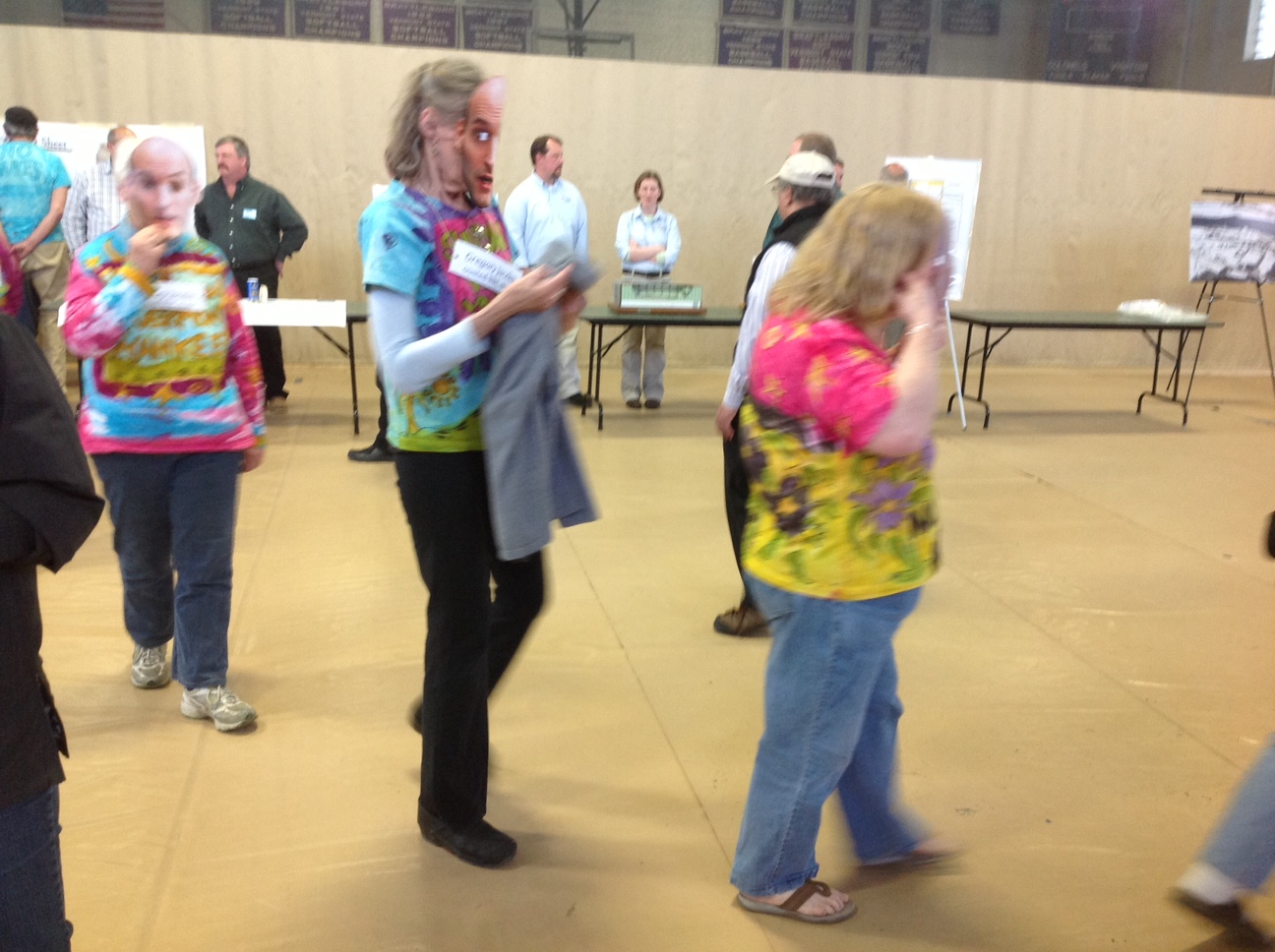
The day after the NRC meeting about Vermont Yankee, I wrote a post Mellow Meeting of the NRC in Brattleboro.  Actually, the meeting was only mellow in comparison with last year's meeting: The Politics of Intimidation.  This year, women with Jaczko masks once tried to disrupt the meeting by standing behind the NRC people, chanting and making speeches (photo at left). Once again, the NRC members left the room and then came back into the room.  Once again, the women stood behind the NRC after the NRC came back.

However, the women didn't succeed this year.  Eventually the women sat down and the meeting proceeded.

Eventually, I took action

Um, did I say "eventually?" I should have said something stronger.  The problem is that I don't like to toot my own horn.  But I did take action that helped get the meeting back on track, and it is worth sharing that action with my readers.

At the meeting, the women were chanting, the NRC was trying to talk over them, a man from the audience shouted "It's about Democracy!" and I had personally had enough.  I went up to an open mike that was standing in the middle of the room, and I interrupted the whole thing. I said, quite loudly:

“No, it’s about diversity! It’s about whether people with different opinions and different views and different backgrounds will be allowed to talk at this meeting! Apparently not!

Then I left the microphone. The meeting had grown quiet while I spoke (it was so unexpected) and the police soon persuaded the women to sit down.

I blogged about this incident at ANS Nuclear Cafe: Speaking Out of Turn at the NRC Meeting. On that post, I treasure a comment from a man who was at the meeting and wanted to thank me after the meeting.  Unfortunately,  I was feeling sort of shaky from the strain of doing something like that, and I left the meeting a bit early.

OMG, It Isn't There

A few days later, I found that community TV had recorded the meeting.  I thought: "Oh dear. What did it look like when I went up to that microphone?" I was scared to look at the video, but I needn't have worried.  The incident wasn't there at all.

The TV people apparently felt that the women chanting, the NRC leaving the room and coming back, the NRC trying to talk above the chanting, me making my statement, the police approaching the women..none of that was worth recording.  I don't know how they concluded this: in retrospect, it was all rather dramatic theater. But none of it is on the video.

If you look at the video below, a man from the NRC refers to the incident with some statement like: "if there is more disruption, we will have to take a break."  The video cameras follow the women walking peaceably around the "science fair" part of the meeting and then you see them sitting peaceably in the chairs during the question period.  In the video, you see me and my friend Guy Page (frequent guest blogger) speak to the NRC once the meeting was underway. Our remarks start at about the 11 minute mark on the video.

The TV video makes the situation look darn mellow.  That is not how it happened, my friends.  That is not how it happened.


Wednesday, May 1, 2013

Mellow Meeting of NRC in Brattleboro

Low Attendance, Mellow Meeting

Last night's NRC meeting about Vermont Yankee was relatively mellow.  The meeting took place at Brattleboro High School, and was lightly attended.  The first part of the meeting was a science-fair set up, in which people talked and looked at exhibits. As  you can tell by the two pictures, there weren't many people there.

As they did last year, the Shut It Down Affinity Group (aka Raging Grannies) came in again, wearing costumes and masks. Once again, they walked single file around the room.  I hope you can tell (despite my lousy photography) that they were wearing tie-dyed shirts and wore masks of former NRC commissioner Jaczko.

Later, when the more formal presentation was supposed to start, the women once again stood behind the NRC people. The women refused to sit down, and delayed the start of the meeting. They read long letters and repeated quotes from Jaczko about how all nuclear plants must be shut down.

However, unlike last year, the crowd did not swarm up and surround the NRC people in solidarity with them. (There wasn't much of a crowd, anyway.) So the Jaczko impersonators  eventually sat down and the meeting proceeded.

Vignettes from the meeting

Being Friendly: During the open house, Cheryl Twarog (plant supporter), Mike Mulligan (plant opponent) and myself had a very friendly and upbeat conversation about children, the Navy, where we grew up, high school experiences, and so forth.

Aside: My husband was a baby during WWII, but later served on a destroyer (a "tin can"). I remember urging Cheryl and Mike (both associated with Navy nuclear) to read this book about destroyers in a major battle in WWII --  The Last Stand of the Tin Can Sailors.  I also recommend it to the readers of this blog.

Being Unfriendly:  During the meeting, a woman with a heavy German accent (I don't know her at all) gave the usual anti-Vermont Yankee spiel, including lots of comments about Fukushima.   She ended it with the question: "How did you [addressing the NRC people] ever become so contemptuous of other human beings that you encourage nuclear power?" (I didn't record the question, but this was the gist of it.)  At that point, the NRC people began talking about what happened at Fukushima and what we have learned. She interrupted them to say: "I had ONLY ONE question: how did you became so contemptuous of your fellow human beings?" This woman sure had an advanced case of self-righteousness!

Update: My blog post on the meeting is up at the ANS Nuclear Cafe today: Speaking Out of Turn at the NRC Meeting.  The post is about how I spoke out of turn, and how that helped the meeting get back to order.

Further Reading:


----------
One of the people in masks was kind enough to stop and pose while I took a picture, but I did a bad job of taking that picture, and so it isn't on the blog. I apologize.  My camera is old and is getting unreliable.

Sunday, July 1, 2012

111th Carnival of Nuclear Bloggers Here at Yes Vermont Yankee

Yes Vermont Yankee is pleased to host the 111th Carnival of Nuclear Energy Bloggers.

Fitness for Duty: Nuclear Workers and Chairman Jaczko

Gail Marcus on Drug Testing:  At Nuke Power Talk, Gail Marcus discusses Fitness for Duty for workers at nuclear power plants.  Random drug testing has long been required at U.S nuclear plants, and will now be required in Canada.

At Nuke Power Talk, Gail Marcus tells tales of poppy-seed bagels and helicopter pilots flying "high."  Her thoughts are triggered by the announcement from Canada about introducing a random alcohol drug testing requirement at nuclear power plants. Her post is based on her experiences working for Commissioner Kenneth Rogers at NRC during the period when NRC introduced its random drug testing requirement.

Rod Adams on Jaczko:  Rod Adams at Atomic Insights asks about Jaczko's fitness for duty: Why Was Jaczko Asked To Resign?

NRC Chairman Greg Jaczko was asked to resign from his position of authority over the Nuclear Regulatory Commission because the agency charged with independent audits of his organization found that he was not trustworthy and not discharging the duties assigned to him as the Chairman of a duly appointed group of commissioners who share equal responsibility for policy formulation, policy related rule-making, orders, and adjudication.

(I suppose the good news is that Jaczko wasn't taking drugs or eating poppy-seed bagels.)

Follow the Money: Misleading Estimates on Nuclear Costs and Money Wasted on Waste

Steve Skutnik on economic analysis. At Neutron Economy, Steve Skutnik deconstructs yet another faulty economic analysis of nuclear energy: Deconstructing anti-nuclear economic myths: A response to Veronique de Rugy

Recently, Mercatus Center economist Veronique de Rugy published a piece in Reason entitled "No to Nukes," laying out the litany of reasons why nuclear energy is incapable of surviving in a free market for energy without intense federal subsidies. There's just one problem with the argument: the facts. Steve Skutnik looks at the various factors de Rugy overlooks in her nuclear hit piece, including both the actual economics of nuclear as well as the generous subsidies (both implicit and explicit) which nuclear's chief competitors also benefit from.

(I've stolen the chart at right from Skutnik's blog post.  Ms. De Rugy claims that the French must endure high electricity costs due to their decision to have nuclear power.  I sometimes wonder why opponents make claims that are so easy to refute.)

Dan Yurman on Court Waste Rulings: At Idaho Samizdat, Dan Yurman describes how recent Court Waste Confidence Rulings bolster nuclear opponents case.  Two recent decisions by the U.S. Court of Appeals for the District of Columbia show just how much time, money, and political capital have been wasted on developing a rational solution to the political problem of managing the nation’s spent fuel.

World Wide News: Japan, Russia, Asia and the U.S.

Leslie Corrice on Japan: Leslie Corrice of Hiroshima Syndrome posted this update in the Commentary section on June 29: The most dangerous nukes in Japan...NOT!
Corrice says that should come as no surprise to anyone that the two Japanese nuclear plants alleged to be most dangerous are Oi units #3 & 4. It should be taken as little more than politically expedient speculation by a minor group of lawmakers exploiting their nation’s nuclear anxiety to gain increased exposure in the Press. The Diet Group’s nuclear hit list should not be given serious consideration. It is arbitrary, speculative, politically expedient, and clearly intended to keep Japan’s level of Fear, Uncertainty and Doubt at a fever pitch. 

Brian Wang on World-Wide Progress: Brian Wang at Next Big Future submits four stories about innovative reactor projects in Russia and Asia: 

Russian Fast Reactor: The government of the Sverdlovsk region of Russia has approved the construction of the country's first BN-1200 fast reactor at the Beloyarsk nuclear power plant. The unit will be built to replace the existing smaller BN-600 reactor at the plant, which is scheduled to be shut down by 2020.

Chinese Molten Salt Reactor. The U.S. Department of Energy is quietly collaborating with China on an alternative nuclear power design known as a molten salt reactor that could run on thorium fuel.  China plans to have a 5 megawatt molten salt reactor in 2015.

Reactors in India, including Fast Reactors: India is finishing its 500 MWe prototype fast neutron reactor and plans 2 more. India also is making more 700 MWe nuclear reactors.

Plasma Physics in the U.S:.  Lawrenceville Plasma Physics (LPP) describes how they will increase the current of their dense plasma fusion project which should boost the power by about 100 times. 

American Nuclear Society Meeting in Chicago
Wrigley Building in Chicago
Near the ANS meeting hotel

Many bloggers (myself included) spent most of the week at the American Nuclear Society annual meeting in Chicago.  Here's a few links to blog posts about that meeting.  I expect more blog posts will follow soon.

I recommend Dan Yurman's post on the Social Media meet-up, where bloggers discussed how to make good video presentations and put them on YouTube.

I recommend this post about the award that Howard Shaffer and I received.  The ANS also named three new Fellows (the highest honor) and you can read about their achievements. Margaret Harding won an award for her educational work at the time of Fukushima.   I link to an interview with her. The Young Members Group was also quite active, including working dinners and fun runs.  

Will Davis has a great post at Atomic Power Review about visiting the vendor hall and collecting information.  Among other things, this was the first ANS convention at which a Chinese nuclear company had a booth. Here's Eric Loewen, the President of ANS, welcoming people to the convention and talking about all the different events.

Monday, June 11, 2012

108th Carnival of Nuclear Energy at Next Big Future

The 108th Carnival of Nuclear Energy is up at Next Big Future.  It's a rich carnival, including blogs about the possible new NRC Commissioner, the possible issues with the soon-to-be-former NRC Commissioner, and what actually makes a good NRC Commissioner.  Other blogs discuss the recent court ruling on nuclear waste.  World-wide nuclear reports include South Africa, Jordan, and Turkey.  These countries are building or restarting reactors.

It's a great Carnival featuring quite a variety of voices!  Come and enjoy it!

Sunday, May 27, 2012

Carnival 106 of Nuclear Bloggers at Atomic Power Review

Will Davis of Atomic Power Review has posted the 106th Carnival of Nuclear Bloggers.  It's been an exciting week in nuclear, with Jaczko resignation and the nomination of his successor, and it is great to see the blog Carnival go up.  I also want to give Davis a lot of credit for devoting his time to this work during this beautiful and solemn weekend.

Several posts (Atomic Insights, Neutron Economy, Idaho Samizdat, ANS Nuclear Cafe, Next Big Future) discuss Jaczko's departure and the marginal qualifications of his nominated successor. Nuke Power Talk discusses "electricity too cheap to meter"..would that be a good thing? Hiroshima Syndrome describes the Japanese government shooting itself in the foot by objecting the World Health Organization numbers on radiation releases. Yes Vermont Yankee attends an NRC review meeting that has the characteristics of a mob scene.  Canadian Energy Issues describes world-wide CANDU construction projects, and what they have learned from the Canadian experience.  Next Big Future also debunks the latest "nuclear winter" scenario.

A good Carnival, and worth attending!


Sunday, December 18, 2011

83rd Carnival of Nuclear Energy Bloggers at ANS Nuclear Cafe

The 83rd Carnival of Nuclear Energy Bloggers is up at ANS Nuclear Cafe. Thank you to Dan Yurman for once again putting together a great Carnival! Once again, the scope is world-wide.

However, starting in Washington, Nancy Roth of Fuel Cycle Week covers the dirty laundry on display at the Jaczko hearings. The Chairman doesn't act like a Chairman of a commission, a collegial and knowledgeable group of people who come to together to share information, reason, argue and decide. It sounds as if Jaczko's "chairman" model may be closer to "Chairman Mao." Meanwhile, at Nuclear Diner, Cheryl Rofer links to background documents and summary documents for the hearings, so you can read the dirty laundry for yourself. (I know. That was a really weird metaphor.) Gail Marcus of Nuke Power Talk also reviews the hearings, from the perspective of someone very knowledgeable about nuclear regulation, both here and in Japan.

At Atomic Power Review, Will Davis begins a series of summary reporting and opinion pieces, which will supplement his detailed and careful descriptions of events in the United States and Japan. Many of us have relied on his Japan posts, and we look forward to his more wide-ranging posts in the future.

New types of reactors make news in the Carnival. At ANS Nuclear Cafe, Dan Yurman describes recent events in the evolution of the Traveling Wave Reactor, which is supported and encouraged by Bill Gates. At Next Big Future, Brian Wang links to the very positive report on Small Modular Reactors SMRs by the Energy Policy Institute of the University of Chicago.

On the smash that incorrect-information front:
  • Cheryl Rofer of Phronesisaical points out that you can't make a bomb with Na-22, even if you smuggle it to Iran.
  • Steve Aplin of Canadian Energy Issues wonders why we are not reprocessing.
  • Victoria Barq of NEI Nuclear Notes shreds an article by Sovacool that gives the "dirt" on nuclear power.
  • At Yes Vermont Yankee, I review an anti-nuclear film sponsored by University of Vermont. Among other things, the film notes with alarm that uranium 238 has a 4 billion year half-life. (You mean that fact didn't worry you?)
  • Dan Yurman wonders whether the Fukushima reactors will truly be in cold shutdown.
In a grab-bag of other news, good, bad, and maybe ugly:
  • At Idaho Samizdat, Dan Yurman notes that Areva is overextended and stopped work on the Eagle Rock Enrichment facility, despite a loan guarantee, an NRC license, and contracts in place to buy 70% of the plant output. (bad news)
  • At Nuke Power Talk, Gail Marcus discusses energy and animals. Nuclear power plants are good for endangered crocodiles. Unfortunately, wind turbines aren't good for animals in general. (good news for nuclear)
  • At Next Big Future, Brian Wang talks about Russia's plans to dominate the world uranium market (maybe ugly news? I mean, they already supply Europe with natural gas...)
  • At Idaho Samizdat, Dan Yurman celebrates the fact that many in the Fukushima evacuation area are allowed to return home (GOOD news!)

That's all the news for now! Come to the Carnival, and enjoy yourself. Visit and tell your friends!

Monday, October 17, 2011

74th Carnival of Nuclear Energy Bloggers at ANS Nuclear Cafe

The 74th Carnival of Nuclear Energy Bloggers is up at ANS Nuclear Cafe. Dan Yurman did a great job of putting this Carnival together.

Fukushima and More

Gail Marcus of Nuke Power Talk used to live in Tokyo. One of the unintended consequences of the post-Fukushima monitoring has been the discovery of an old cache of radium-containing luminous paint. The paint was stored beneath the floorboards of a house near where she lived. The paint was the cause of a "hot spot far from Fukushima." Comic relief about Fukushima, but also, good that they found it, because storing such radioactive material in the basement of a dwelling is definitely a bad idea.

Will Davis of Atomic Power Review continues his reporting on Fukushima clean-up. Following his posts are among the best ways to follow that situation and its mitigation. At Yes Vermont Yankee, I describe Dr. Swartz of Dartmouth's engineering seminar: "If Vermont Yankee had an accident like Fukushima." As Dr. Swartz explained, the problem in such a case would not be radiation sickness or increased cancer risk, the problem would be the actions of the "worried well". "Worried Well" people would not accept reassurances that they are not in danger, and might take actions (evacuating, taking KI tablets) as if they were in danger.

Dialogs are Busting Out All Over

Meanwhile, dialogs are happening, and they are very interesting. Dan Yurman organized the major dialog: Chairman Jaczko of the NRC answered 50 questions (asked by Yurman) in a ninety-minute unscripted webinar! Now THAT's communication! Read about it at CoolHand Nuke.

On his own blog, Idaho Samizdat, Yurman is engaged in a dialog with New York Times Op-Ed writer Stephanie Cooke, who has a rather dim view of the nuclear future. In my opinion, she is no match for Dan's knowledge.

(Also this Carnival, Brian Wang of Next Big Future reports on the nuclear builds in China, therefore supporting Yurman's arguments.)

Rod Adams at Atomic Insights notes that the Main Stream Media always quotes the usual list of viewers-with-alarm about Oyster Creek. However, a poll attached to to a recent article shows that 95% of the local people want to see Oyster Creek continue to run. Maybe the media should engage in a dialog with their readers?

Dialog Opportunities are Busting Out All Over

In the ANS Nuclear Cafe post, the Pro-Nuclear Community Goes Grassroots, Suzy Hobbs of PopAtomic describes the process of pro-nuclear petitioning at the federal level. Hobbs doesn't just describe the process, she provides links so you can sign the petitions.

Meanwhile, Cheryl Rofer and friends have started a wonderful new blog, Nuclear Diner, a place for discussing nuclear energy from all points of view. A new place for dialog!

Flibe: Thorium is the Future

Brian Wang of Next Big Future describes the Small Rugged Reactor Liquid Fluoride Thorium Reactor that the newly-formed firm, Flibe, will build for the military. This new type of reactor is truly good news for the nuclear industry. I also recommend Michele Kearney's Nuclear Wire post on this subject, which has several useful links about the LFTR and Flibe.

It's a glorious day for a Carnival! Come and see the attractions. Join in the dialogs, or just watch them! This a great Carnival, and you won't want to miss it!


Monday, June 13, 2011

56th Carnival of Nuclear Energy

The 56th Carnival of Nuclear Energy is up at NEI Nuclear Notes, and David Bradish has done a terrific job of putting it together.

Politics

This week's carnival includes lots of juicy political stuff, such as Dan Yurman's post in Idaho Samizdat about how Jaczko manipulated the internal process in order to stop Yucca Mountain. (Hey, that was Jaczko's job, after all!) Rod Adams describes the NRC caving to an email attack by Friends of the Earth. Rick Maltese (Deregulate the Atom blog) gives credit where it is due: INPO (Institute for Nuclear Power Operations) and WANO (World Association of Nuclear Operators) are self-regulatory nuclear organization who can tack much credit for the nuclear industry's excellent record on safety. I talk about Vermont Law School and its blog, and Steve Aplin reviews negotiations with Iran (and the situation in Libya).

New Types of Plants, and New Builds

Despite what people think, new builds are popping up all over, and the Carnival describes several. At Cool Hand Nuke, Jeff Madison, describes the move toward completion of the TVA's Bellefonte plant. Construction was halted in the late 80s. Dan Yurman posts that Areva plans to push spent fuel recycling plans in the United States. Charles Barton at Nuclear Green compares Advanced High Temperature Reactors with renewable energy in his post: Why is Renewable Energy so Expensive, while Molten Salt Reactors will be so Cheap? At Neutron Economy, Alan Rominger and Steve Skutnik describe charter cities built around small modular reactors. Brian Wang at Next Big Future describes advances in plasma research for fusion.

Germany, Germany, Germany

Once again, Germany has decided to shut down its nuclear plants, sometime in the future, and several bloggers have comments. (Comments is a nice word, so neutral...) Margaret Harding describes Germany's Nuclear Game of Chicken while Michele Kearney at Nuclear Wire and Gail Marcus at Nuke Power Talk count the costs. Brian Wang points out that nuclear generation is higher this year than last year, in the developing countries. (This includes the fact that Japan is making less nuclear power, with so many reactors off-line for so long.) Rod Adams takes a crack at the "golden age of natural gas" (and how will Germany feel about buying lots of gas from Russia?)

Japan

Only one post on Japan, but it's a good one. Will Davis at Atomic Power Review has a Fukishima update with great pictures. Highly recommended.

Come to the Carnival! It's always a treat!


Monday, February 14, 2011

The NRC Loses Its Way: Why Should Controversial Plants Take Longer to Review?

Unequal Treatment for Similar Nuclear Plants

A few days ago, two ranking Republican senators wrote a letter to NRC Chairman Jaczko about the glacial pace of license renewal for nuclear plants that are perceived to be controversial. Platts reported on the letter, quoting Senators James Inhofe and David Vitter. These two senators said that the NRC has developed a "dual standard" for license applications, granting licenses quickly in many cases, but allowing "excessive, unmanaged delays for applications perceived to be more controversial."

What kind of delays are we talking about? As I noted in a previous blog post, Vermont Yankee and Duane Arnold are sister plants, BWRs of almost exactly the same size and vintage. However, tracing back from the NRC web page on license renewal, we see that Duane Arnold submitted its renewal application on 10/01/08 and was granted its renewal on 12/16/10, slightly more than two years later. On the other hand, Vermont Yankee submitted its application on 1/27/06 and has not received its renewal yet, more than five years later. In a recent letter from a vice-president of Entergy, Duane Arnold was listed as the second-most reliable of sixteen sister plants, while Vermont Yankee was the fourth-most reliable. Duane Arnold's capacity factor is 93.1% while Vermont Yankee's factor is 92.6%. This difference is certainly not worth three extra years of license review by the NRC.

It's Not About Regulation Anymore

I'm on a private listserve of nuclear communicators, and I sent the group a link to the Platt's article, along with this provocative message:

Read it and weep. The NRC no longer has objective criteria by which it evaluates plants. It's all about what the neighbors think.

The trouble with being provocative is that people got provoked. I received two opposite types of reply from the people in the group:
  • Right on, Meredith!
  • We can't exclude ordinary people from the process of licensing nuclear plants. It wouldn't be fair.
My answer is simple: Either there are objective criteria for evaluating a plant for relicensing---or there aren't. If the criteria are not objective, the situation is horrendous.

Let's imagine politics mattered for the safety inspections for a car. Say that cars with Obama bumper stickers got a real going-over when it was time for their safety inspections. What if everyone knew that the extent of a safety inspection depended partially on your car, and mostly on how your politics matched the politics of the inspectors or your neighbors? This would be a terrible situation. Sort of like the situation we have now in the nuclear industry.

The NRC is not supposed to have politics as one of its criteria. Supposedly, it doesn't. That should mean that plants are judged against a set of regulations, not against the plant-specific contentions of pro or anti- nuclear groups.

The Voice of the People?

My comments were provocative, and people in my email group had legitimate concerns. Would my comment about unequal treatment end up as a recommendation that ordinary people be excluded from the NRC relicensing process? Such an exclusion was not my intention.

I believe the public should be involved in the licensing and re-licensing process. However, the public should be involved in as it is involved in other public issues. The public should help to make the rules. The public should not be empowered to make exceptions about enforcing the rules. In a democracy, the public make the rules, but many systems are in place to ensure that the rules are enforced fairly.

For example, think of a town that is very proud of its attractive downtown area. The town has strict rules about signs on businesses: No neon signs, and signs must be smaller than a certain standard. The people of the town made those sign rules, but they are enforced on every business equally. If some people think shoe stores are ugly, those people still can't require that a shoe store must have a smaller sign than any other store. Rules are made with general input, and enforced fairly.

Fairness to power plant owners is not some kind of wild new concept that will take decades of trial and error to achieve. The NRC can learn about fair enforcement in many areas, such as zoning. All the NRC has to think about is this:

With Justice for all.

----------

The top photo is from the NRC homepage in July. It shows Chairman Jaczko meeting with intervenors against Vermont Yankee in Brattleboro this summer. At that time, Jaczko met with plant opponents, but declined meetings with plant supporters. The image is more fully described in a previous post on this blog.

Sculpture of Lady Justice by J. L Urban. The statue is part of a court building in the Czech Republic. Lady Justice holds a book instead of scales, and is not blindfolded. I consider her to be Lady Justice for the Regulatory Process. (The usual Wikimedia license.)


Tuesday, November 30, 2010

Russia. Yucca Mountain. Serious Subjects. Silly Videos.

I'm not quite sure why I think these videos go together, but somehow I feel they do.

The first video is real. Vladimir Putin teasing Germany about not building new nuclear plants.


The second video is a satire about Jaczko and Yucca Mountain, shamelessly stolen from Dan Yurman's blog yesterday. Dan found it on a Wall Street Journal blog. Maybe I didn't steal it. Maybe it is just going viral, and I am helping.

Enjoy!

Tuesday, August 3, 2010

A Jaczko Retrospective

On July 14, the chairman of the Nuclear Regulatory Commission (NRC), Dr. Gregory Jaczko, met with representatives of seven groups opposed to Vermont Yankee. The picture of the meeting (at left) first appeared on the front page of the NRC web site. It has subsequently been replaced with another picture.

In this picture, Dr. Jaczko is the man in the white shirt. To the left of him is Sandra Levine of the Conservation Law Foundation. The man with his hands in front of his face is Bob Bedy of the Safe and Green Campaign. Next to Bedy, the woman with long hair is Deb Katz of Citizen's Awareness Network.

Others who were invited to the table were Ray Shadis of the New England Coalition (NEC), Debra Stoleroff of the Vermont Yankee Decommissioning Alliance, Ed Anthes of Nuclear Free Vermont, and James Moore of VPIRG.

Those Not at the Table

Just behind Katz and somewhat to the left is Howard Shaffer. I am sitting next to Howard and appear slightly to the right of Katz. We weren't invited to speak to Jaczko. Others who were not invited to the table included the pro-business group Vermont Energy Partnership, and various individuals (such as the state representative from the town of Vernon) who had asked to meet with Jaczko.

As Rod Adams noted in a post, the NRC explained that Jaczko met with the opponent groups (which the NRC called "citizen volunteer groups"), members of the media, and the licensee. I gather that business groups (like VTEP) and elected officials (like the representative from Vernon) weren't people he wanted to listen to. Or, alternatively, they weren't his target audience.

Not at the Table, But Noticed

I would like to publicly thank Ray Shadis of NEC and Chad Simmons of the Safe and Green campaign for making thoughtful comments to me. I do not remember their words exactly, but they acknowledged that Howard and I also represented citizens, and said that if they had been in my shoes, they would have been offended at being excluded. This made me feel better about sitting in the peanut gallery. I appreciate their kindness.

What Happened at the Table

Nothing much. In an earlier post, I predicted that Jaczko would not have much chance to hold the floor, and he would be interrupted. I was right. Jaczko got very little airtime. The opponents spoke for approximately an hour at the beginning of the hour-and-a-half meeting, and when Jaczko spoke, he rarely was able to hold the floor for two minutes at a time before being interrupted. Howard Shaffer's guest post on this blog pointed out this phenomenon, and so the Burlington Free Press also noted that he was interrupted.

The opponents made statements that I found quite interesting and basically naive. For example, James Moore said “It is a zero tolerance for error game here.” This statement makes a good soundbyte, but what does it mean? I can't think of a single human activity (driving, building a house, parenting) that can exist on "zero tolerance for error." Apparently, Mr. Moore thinks it is a reasonable requirement for a business or industrial facility.

In terms of understanding the consequences of problems at nuclear plants, the crowd was completely in tune with anti-nuclear propaganda and conspiracy theories. I have noticed that people who believe conspiracy theories always feel they are far more sophisticated than those who do not believe such theories. I tend to see conspiracy theorists as less thoughtful than average. They are unwilling to listen to complex answers if they can find a scapegoat instead. As Nuclear Townhall wrote:

The key moment occurred, however, when Jaczko made the casual and seemingly indisputable remark that “what the offshore oil industry is going through now the nuclear industry went through thirty years ago at Three Mile Island – except there was no off-site damage.”...... (The crowd objected) “What about the radiation monitors that blew out!” “What about all those cancer studies?” They are all steeped in the lore that Three Mile Island was in fact a health catastrophe that has been diligently covered up by the powers that be.

Jaczko Holds His Own

Perhaps the most important thing that happened at the table was that Jaczko didn't give in to the opponents. He stated that he heard them, that he had many of the same concerns, but he had come to different conclusions. He did not see any reason to shut the plant down immediately. He didn't see the tritium leak as a reason to shut the plant down. He didn't see the NRC as slow-moving about safety issues. He listened, but he didn't agree.

All in all, I felt I could take lessons from Jaczko. He was practicing a textbook example of effective Assertiveness, the kind of thing they teach in Assertiveness Training. As a woman fairly up in my career in the late eighties, I took Assertiveness Training through my company HR department. (Didn't we all take it, in the 80s?) When you are assertive, you acknowledge your opponent's position--without agreeing to it or conceding.

Jaczko was a master at this. His message was simple: I hear your concerns. I acknowledge your concerns and have some of the same concerns myself. I don't agree with your conclusions, and will not take action based on your conclusions.

Jaczko could have taught the assertiveness course I took. Though they didn't give grades, I knew I was only a B-minus-type student when I took the class. If I could study a videotape of this meeting with Jaczko, I could learn and improve.

Friday, July 16, 2010

Guest Post: Howard Shaffer on the Jaczko Visit

Why Did Jaczko Come to Brattleboro?

I have been boots-on-the-ground for Vermont Yankee since 2002, and before that active in Massachusetts and Maine. From this perspective, Jacczko's visit was CYA for the NRC and himself. You haven't seen this in the press reports so far and probably won't. Meredith and I were there. He stood up to the opponents and stood them down too.

The Chairman told them that the NRC regulates by focusing on safety and what is most critical to safety. He would not let the responders interrupt him, as is their custom. He told them when they were over their time limit. They all spoke beyond their limit, as is their custom.

(Interruption of Howard by Meredith: sometimes they did succeed in interrupting him. After all, there were seven of them and one of him.)

Jaczko also told them that the NRC staff is concerned about all the same issues they are, but has different judgments about them. Finally he said that the NRC does not have unlimited power, and has not seen any issue requiring immediate shutdown, as called for by the Vermont Yankee Decommissioning Alliance. He also said they can act fast if they have to.

Implications

No need to worry about this event giving a publicity opportunity to these opponents. They are experts at generating coverage and get plenty due to the plants missteps. The press is mostly on the opponents side (surprised?) and as in any story line, "If it bleeds it leads." The plant has been cutting itself and bleeding regularly.

The major problem for supporters of VY is getting them to do much more. They don't stand up to charges. They don't go face to face with the antis. What is the press supposed to think? True, the plant is stuck with responding to generic global issues too, but there is help available. What former Senator Simpson from Wyoming said recently in Newsweek is true. "A charge unanswered is a charge believed."

Deb Katz of Citizens Awareness Network spoke at a rally last year on the State House steps with the President Pro Tem of the Senate and the Speaker of the House behind her and said that they would shut down VY, then the plants in the US, then the world. These antis will be "coming soon to a plant near you."

That's what its all about.

Howard Shaffer III

--------
Other Coverage of the Jaczko Visit

Dan Yurman of Idaho Samizdat asks the question: "What Was Jaczko Thinking?" in his post on the NRC Road Show.

Rod Adams of Atomic Insights considers who was invited and who wasn't invited to the meeting. There are over 30 comments on this post.

Last but hardly least, someone from Nuclear Townhall attended the meeting in Brattleboro. An excellent post about Jaczko taking the heat at the meeting. This post also notes how the observers in the meeting booed and hooted when Jaczko said nobody was hurt at Three Mile Island.

---------
Blog Carnival

The Tenth Blog Carnival of Nuclear Energy is up at Next Big Future. This edition features Robert Hargraves discussing the importance of energy for ending poverty.

------

Guest Blogger

Howard Shaffer III wrote this guest post. He is a former submarine officer, Congressional Science Fellow in 2001, and currently a registered professional nuclear engineer in Vermont and New Hampshire. He was one of the startup engineers at Vermont Yankee.


Tuesday, July 13, 2010

NRC Chairman in Brattleboro Tomorrow

Tomorrow morning, Chairman Jaczko of the NRC will be in Brattleboro. Jaczko will be at the Ramada Inn in Brattleboro from 9:30 to 11 a.m. He will be taking questions from the seven groups that have concerns about Vermont Yankee. I don't have a complete list of groups, but VPIRG, NEC, the Safe and Green Campaign, and the Conservation Law Foundation are sure to be included.

The rest of us are allowed to watch these groups question Jaczko. Since nobody else can ask questions, this blog post is more of a call-to-inaction than a call-to-action. For most people, there's no real reason to go. I'll be there. I blog about VY, so I can't skip this event. Also, I am covering the meeting for a trade journal (press badge hat instead of blogger's hat).

At 11 a.m., after Jaczko's discussion with the intervenors, he will give a press conference. As I understand it, he will then spend the afternoon at VY.

Wagers

Two days ago, I spent three hours at a Public Service Board meeting, mostly listening to interveners express their fears. Therefore, I'm not filled with enthusiasm about attending this meeting.

Still, I like to make things interesting for myself. Gambling always spices things up. Who will take my wagers? No money will change hands. However, I hope to settle the bets in the traditional surroundings. Salt hill pub in Lebanon probably. Or a similar venue.

Take up these wagers by adding a comment to this post.

  1. I bet that the intervenors will grandstand and ask long, loaded questions, and hardly let Jaczko get a word in. My wager: more than three-fourths of the air time will be taken by the intervenor "questions." Who will wager against me here?
  2. One intervenor is famous for shouting while other people are talking. He shouts things like "It's a lie" or "Junk Science." My wager: One intervenor will interrupt Jaczko by shouting. Who will wager against me here?
  3. Another intervenor throws things. I don't think she will do so, though Da Commissioner is a very tempting target. My wager: The slinger does not sling anything tomorrow morning. Who will wager against me here?
  4. Colorful costumes are the order of the day at these meetings. My wager: Somebody in the audience will dress as a fish. Who will wager against me here?
  5. Someone will get confused, and instead of talking about tritium and accusing VY management of lying, they will accuse tritium of lying. My wager: Tritium will be accused of lying. Who will wager against me here?
I'll probably lose the last bet (number 5) now that I have warned everyone of the possibilities.

Bet against me on any of these! It will be like taking candy from a baby. Really. Easy. Place your bet in the comment section.


Late News: Business Leaders NOT happy with Jaczko's choice

Business leaders are not happy with the fact that Jaczko will listen to intervenors, and will go to the plant, but is not willing to listen to plant supporters. He acts as if there are only two groups:
  • people against the plant
  • people who work at the plant.
No. There's another group. There are also plant supporters. As the Vermont Energy Partnership states in a press release this evening:
In our view, having a one-sided stakeholder meeting with anti-nuclear activists to discuss the future of Vermont Yankee during your visit to the state sends a negative message to supporters about the NRC’s position on this issue......Though we have repeatedly sought an audience with you during your visit, we are formally requesting that you grant us time to meet with you and senior members of your staff to speak with us and other business and labor leaders in Vermont.
A Business Perspective

This morning, Rod Adams of Atomic Insights posted about excluding business leaders from the NRC meeting. Many of us know Rod as a blogger, Navy Officer, and proponent of small reactors. In his post today, Rod has the perspective of a businessman, drawing on his years as manager of a small factory. As Rod writes:

That business happened to be one of the more energy intensive operations in town; our electric bill could run as high as $8,000 per month for a little plastic product manufacturing enterprise with an annual revenue of less than $1 million.

As he says in the post, he would have been furious at being excluded from an important meeting about electricity with a distinguished visitor who had come to town.