By Mike Twomey
Several years ago, while the legal and public relations battle raged over the future of Vermont Yankee, anti-nuclear activists -- and some elected officials -- confidently predicted that, if the plant closed, its output would be replaced by wind, solar, and other renewable energy sources. Pro-nuclear advocates expressed doubts about that future, arguing instead that the loss of a baseload nuclear plant would inevitably lead to greater reliance on fossil fuels. Similar debates continue with respect to Pilgrim (Plymouth, MA), Indian Point (Buchanan, NY), and other nuclear facilities.
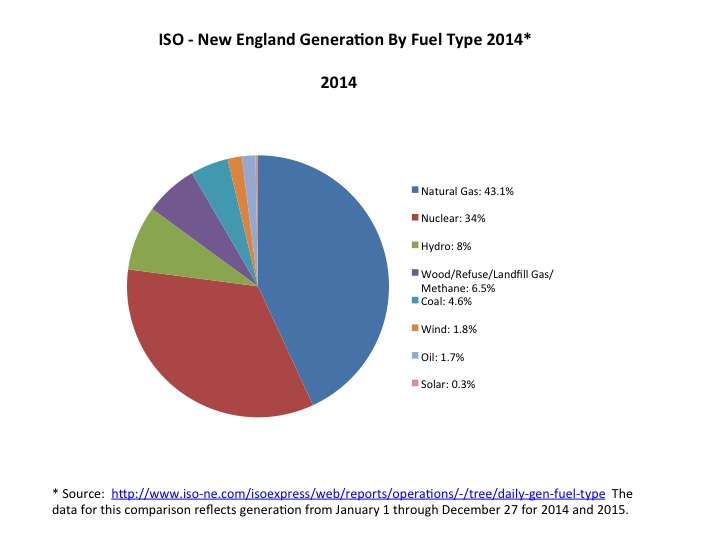
Now that 2015 has come to a close, we have an opportunity to evaluate the facts. ISO-New England (the non-profit, independent entity that ensures the reliability of the electric grid in New England) publishes data that shows daily generation by fuel type. That data shows that in 2014 (the last year of Vermont Yankee's operation) natural gas-fired generators supplied 43.1% of the energy in New England, while nuclear provided 34%. In 2015 (the first year since 1972 without Vermont Yankee) natural gas-fired generators supplied 48.6% of the energy in New England, while nuclear provided 29.5%.
 |
| Comparing these two charts shows the growth of natural gas on the grid 2014 and 2015 Blue is natural gas Red is nuclear |
As you can see in the chart below, the contribution of other sources of energy in New England remained essentially unchanged in 2015 compared to 2014 (the largest change was that coal-fired generators contributed one percent less in 2015 compared to 2014 (3.6% v. 4.6%). The contribution of wind and solar remained vanishingly small in both years (wind was 2.4% in 2015 and 1.7% in 2014, while solar was 0.4% in 2015 and 0.3% in 2014).
 |
| Double-click to enlarge chart |
Generators in New England produced approximately the same amount of total MWhs in 2015 and 2014 (106.7 million MWhs in 2015 v. 107.2 million MWhs in 2014). Taking into account the unusually mild weather in late fall of 2015, these figures deflate another prediction by anti-nuclear advocates that Vermont Yankee's baseload contribution could be replaced, in part, with energy efficiency.
The bottom line is that, without Vermont Yankee, nuclear's carbon-free contribution to the New England electric grid fell by 5.3 million MWhs in 2015 compared to 2014. Over that same time period, the contribution of natural gas-fired generators increased by nearly 5.7 million MWhs. According to the U.S. Energy Information Agency, natural gas-fired generators produce 1.21 pounds of CO2 per kWh (https://www.eia.gov/tools/faqs/faq.cfm?id=74&t=11). Using that formula, the additional MWhs of energy from natural gas-fired generators in New England in 2015 compared to 2014 equals approximately 3.1. million metric tons of additional CO2 in 2015 compared to 2014. To put that in perspective, 3.1 million metric tons of CO2 is equivalent to adding more than 650,000 passenger vehicles to the roads in New England during 2015.
This post first appeared in Linked-In on January 2, 2016 and is reprinted here with permission from Mike Twomey. This post is a good companion piece to the recent post at this blog: Vermont Yankee was replaced by natural gas: Doing the numbers.
The conclusions of the two posts are the same---because facts are facts.
The earlier Doing the Numbers was based on EIA data. This current post by Mike Twomey is based on ISO-NE (New England grid operator) data. Mike Twomey's post includes data through the end of 2015, while the other post only includes data to the third quarter of 2015.
About the author:
Mike Twomey is Vice President for External Affairs at Entergy. He is involved in many areas of negotiation and outreach concerning the nuclear plants. For example, Twomey was quoted in an October post at Vermont Digger: Entergy may move fuel into dry casks sooner than anticipated. In that article, he explains the financing of dry cask storage at Vermont Yankee.


